
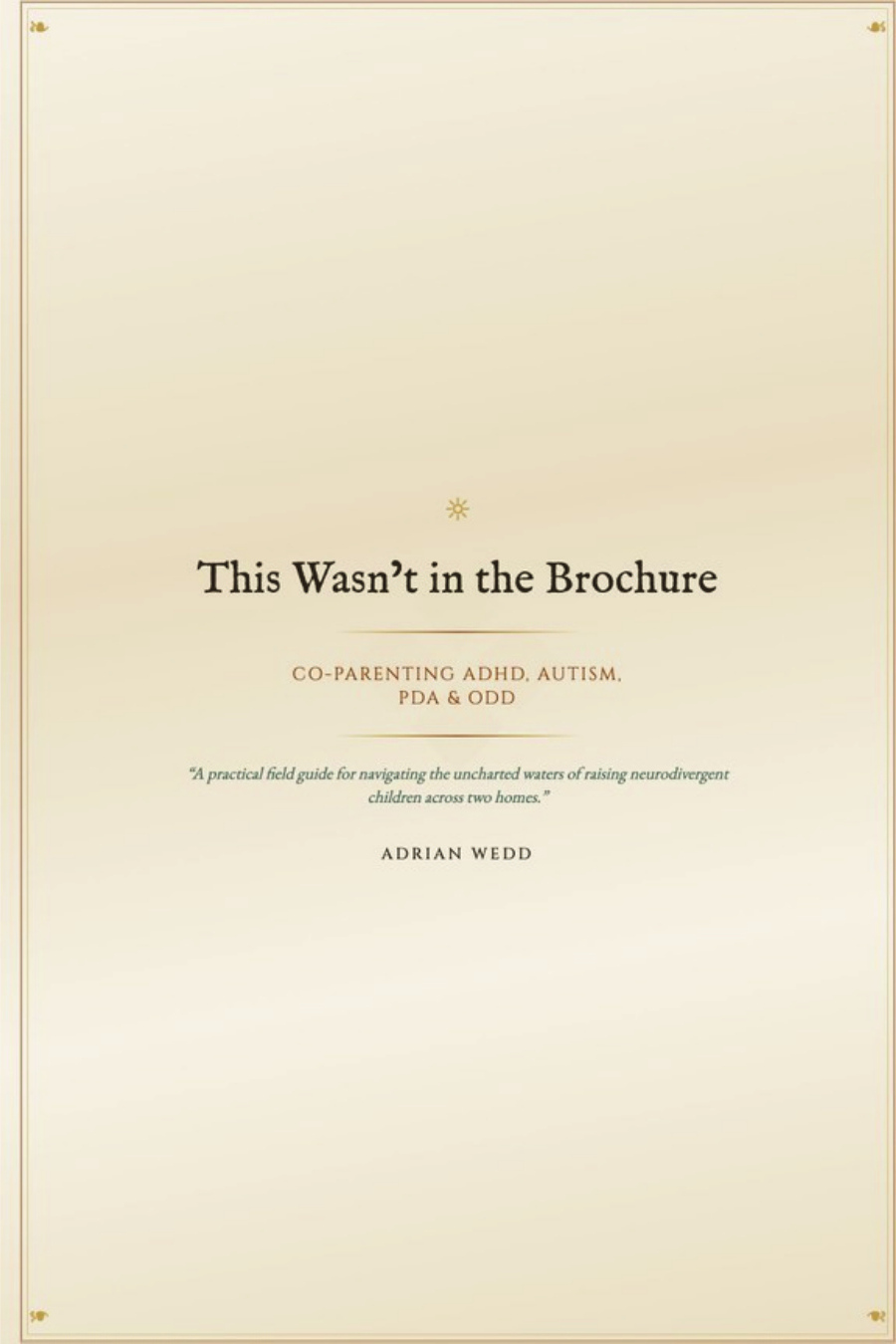
This Wasn’t in the Brochure (NZ Edition)
by Adrian Wedd
Your child has ADHD. Or autism. Or PDA. Or ODD. Or all of the above. And you're co-parenting across two homes.
Nobody warned you about this part.
The morning routine is a battlefield. Transitions between houses trigger meltdowns that last hours. One parent thinks the diagnosis is real; the other thinks the child "just needs discipline." The school keeps calling, the paediatrician has a twelve-month wait, and you're Googling "ADHD meltdown what to do" at 2 a.m. while your ex sends a text about the care arrangement.
This Wasn't in the Brochure is the field guide you needed yesterday.
Written specifically for co-parents of neurodivergent children -- whether you're amicably separated, parallel parenting through high conflict, or still together but drowning -- this book bridges the gap between clinical knowledge and the chaotic reality of raising a child whose brain works differently, across two homes.
What makes this book different:
Every chapter is built around a practical framework that works even when co-parents disagree. Each one includes a Quick Map (the one-page summary if you're too exhausted to read further), a Field Guide explaining the neuroscience in plain language, tactical strategies you can use tonight, a Parent Toolkit with exercises, and a Survival Card with word-for-word scripts for talking to your child, your co-parent, and the bystander judging you in the supermarket.
Every strategy includes an "IF CO-PARENTS DISAGREE" variation -- because this book was written for the real world, where one parent may not believe in the diagnosis, may refuse to follow the same routine, or may not be safe to co-parent with at all.
Inside you'll find:
- The neuroscience of ADHD, autism, PDA, and ODD explained through a single framework -- what's happening in your child's brain, what it looks like at home, what helps, and what backfires
- Morning routines, meltdown protocols, and transition strategies designed for the unique challenge of moving between two households
- School advocacy guidance specific to Aotearoa New Zealand families -- IEPs, ORS funding, RTLB support, the Education and Training Act 2020, and how to present a united front at school meetings even when you can't stand each other
- A full chapter on self-care that goes beyond "have a bath" -- including how to distinguish autistic burnout from depression, and why the answer matters
- Honest discussion of what happens when a parent discovers their own neurodivergence through their child's diagnosis
- Transition checklists from early childhood through adulthood, including the Care of Children Act 2004, Supported Decision-Making, and Enabling Good Lives
- 10 printable toolkit cards: Morning Launch Sequence, Meltdown Protocol, Handoff Script, Symptom Tracker, and more
New Zealand edition -- localised with ORS and NCEA pathways, Whaikaha Ministry of Disabled People guidance, Medsafe prescribing, Care of Children Act 2004, and crisis resources (111, Lifeline Aotearoa 0800 543 354, Need to Talk? 1737, Youthline 0800 376 633). Grounded in Te Ao Maori principles of whanau-centred support. Also available in Australian, US, and UK editions.
The evidence base: Over 50% of citations are from peer-reviewed sources -- exceeding the standard for parenting books. Every claim is sourced, every strategy is grounded in research, and every recommendation is honest about what the evidence does and doesn't support.
Who this book is for:
- Separated or divorced parents of children with ADHD, autism, PDA, or ODD
- Intact couples who feel like they're co-parenting even though they live in the same house
- Grandparents, step-parents, whanau, and anyone in the "wider village" trying to understand
- Parents who suspect they might be neurodivergent themselves
This is not a book about fixing your child. It's a book about navigating the voyage together -- even when "together" means from opposite sides of the harbour.
More books by Adrian Wedd
This Wasn’t in the Brochure (AU Edition)
Co-Parenting ADHD, Autism, PDA & ODD
Your child has ADHD. Or autism. Or PDA. Or ODD. Or all of the above. And you're co-parenting across two homes.
Nobody warned you about this part.
The morning routine is a battlefield. Transitions between houses trigger meltdowns that last hours. One parent thinks the diagnosis is real; the other thinks the child "just needs discipline." The school keeps calling, the therapist has a six-month wait, and you're Googling "ADHD meltdown what to do" at 2 a.m. while your ex sends a text about the custody schedule.
This Wasn't in the Brochure is the field guide you needed yesterday.
Written specifically for co-parents of neurodivergent children - whether you're amicably separated, parallel parenting through high conflict, or still together but drowning - this book bridges the gap between clinical knowledge and the chaotic reality of raising a child whose brain works differently, across two homes.
What makes this book different:
Every chapter is built around a practical framework that works even when co-parents disagree. Each one includes a Quick Map (the one-page summary if you're too exhausted to read further), a Field Guide explaining the neuroscience in plain language, tactical strategies you can use tonight, a Parent Toolkit with exercises, and a Survival Card with word-for-word scripts for talking to your child, your co-parent, and the bystander judging you in the supermarket.
Every strategy includes an "IF CO-PARENTS DISAGREE" variation - because this book was written for the real world, where one parent may not believe in the diagnosis, may refuse to follow the same routine, or may not be safe to co-parent with at all.
Inside you'll find:
- The neuroscience of ADHD, autism, PDA, and ODD explained through a single framework - what's happening in your child's brain, what it looks like at home, what helps, and what backfires
- Morning routines, meltdown protocols, and transition strategies designed for the unique challenge of moving between two households
- School advocacy guidance specific to Australian families - NDIS, education support plans, DDA and DSE protections, and how to present a united front at school meetings even when you can't stand each other
- A full chapter on self-care that goes beyond "take a bath" - including how to distinguish autistic burnout from depression, and why the answer matters
- Honest discussion of what happens when a parent discovers their own neurodivergence through their child's diagnosis
- Transition checklists from early childhood through adulthood, including guardianship, Supported Decision-Making, DSP, and the Special Disability Trust
- 10 printable toolkit cards: Morning Launch Sequence, Meltdown Protocol, Handoff Script, Symptom Tracker, and more
Australian edition - localised with NDIS pathways, Medicare Mental Health Care Plans, PBS medication access, Family Law Act 1975 guidance, and crisis resources (000, Lifeline, Beyond Blue, Kids Helpline, 13YARN). Also available in US, UK, and NZ editions.
The evidence base: Over 50% of citations are from peer-reviewed sources - exceeding the standard for parenting books. Every claim is sourced, every strategy is grounded in research, and every recommendation is honest about what the evidence does and doesn't support.
Who this book is for:
- Separated or divorced parents of children with ADHD, autism, PDA, or ODD
- Intact couples who feel like they're co-parenting even though they live in the same house
- Grandparents, step-parents, and anyone in the "wider village" trying to understand
- Parents who suspect they might be neurodivergent themselves
This is not a book about fixing your child. It's a book about navigating the voyage together - even when "together" means from opposite sides of the harbour.
This Wasn't in the Brochure (US Edition)
Co-Parenting ADHD, Autism, PDA & ODD
Your child has ADHD. Or autism. Or PDA. Or ODD. Or all of the above. And you're co-parenting across two homes.
Nobody warned you about this part.
The morning routine is a battlefield. Transitions between houses trigger meltdowns that last hours. One parent thinks the diagnosis is real; the other thinks the child "just needs discipline." The school keeps calling, the therapist has a six-month wait, and you're Googling "ADHD meltdown what to do" at 2 a.m. while your ex sends a text about the custody schedule.
This Wasn't in the Brochure is the field guide you needed yesterday.
Written specifically for co-parents of neurodivergent children -- whether you're amicably separated, parallel parenting through high conflict, or still together but drowning -- this book bridges the gap between clinical knowledge and the chaotic reality of raising a child whose brain works differently, across two homes.
What makes this book different:
Every chapter is built around a practical framework that works even when co-parents disagree. Each one includes a Quick Map (the one-page summary if you're too exhausted to read further), a Field Guide explaining the neuroscience in plain language, tactical strategies you can use tonight, a Parent Toolkit with exercises, and a Survival Card with word-for-word scripts for talking to your child, your co-parent, and the bystander judging you in the supermarket.
Every strategy includes an "IF CO-PARENTS DISAGREE" variation -- because this book was written for the real world, where one parent may not believe in the diagnosis, may refuse to follow the same routine, or may not be safe to co-parent with at all.
Inside you'll find:
- The neuroscience of ADHD, autism, PDA, and ODD explained through a single framework -- what's happening in your child's brain, what it looks like at home, what helps, and what backfires
- Morning routines, meltdown protocols, and transition strategies designed for the unique challenge of moving between two households
- School advocacy guidance specific to American families -- IEPs, 504 Plans, IDEA protections, FAPE requirements, and how to present a united front at school meetings even when you can't stand each other
- A full chapter on self-care that goes beyond "take a bath" -- including how to distinguish autistic burnout from depression, and why the answer matters
- Honest discussion of what happens when a parent discovers their own neurodivergence through their child's diagnosis
- Transition checklists from early childhood through adulthood, including guardianship, supported decision-making frameworks, and disability benefits
- 10 printable toolkit cards: Morning Launch Sequence, Meltdown Protocol, Handoff Script, Symptom Tracker, and more
US edition -- localized with IEP and 504 Plan guidance, ADA Title II protections, FERPA rights, FDA-approved medication pathways, and crisis resources (911, 988 Suicide & Crisis Lifeline, Crisis Text Line). Also available in Australian, UK, and NZ editions.
The evidence base: Over 50% of citations are from peer-reviewed sources -- exceeding the standard for parenting books. Every claim is sourced, every strategy is grounded in research, and every recommendation is honest about what the evidence does and doesn't support.
Who this book is for:
- Separated or divorced parents of children with ADHD, autism, PDA, or ODD
- Intact couples who feel like they're co-parenting even though they live in the same house
- Grandparents, step-parents, and anyone in the "wider village" trying to understand
- Parents who suspect they might be neurodivergent themselves
This is not a book about fixing your child. It's a book about navigating the voyage together -- even when "together" means from opposite sides of the harbor.
This Wasn't in the Brochure (UK Edition)
Co-Parenting ADHD, Autism, PDA & ODD
Your child has ADHD. Or autism. Or PDA. Or ODD. Or all of the above. And you're co-parenting across two homes.
Nobody warned you about this part.
The morning routine is a battlefield. Transitions between houses trigger meltdowns that last hours. One parent thinks the diagnosis is real; the other thinks the child "just needs discipline." The school keeps calling, the CAMHS waiting list stretches to eighteen months, and you're Googling "ADHD meltdown what to do" at 2 a.m. while your ex sends a text about the contact schedule.
This Wasn't in the Brochure is the field guide you needed yesterday.
Written specifically for co-parents of neurodivergent children -- whether you're amicably separated, parallel parenting through high conflict, or still together but drowning -- this book bridges the gap between clinical knowledge and the chaotic reality of raising a child whose brain works differently, across two homes.
What makes this book different:
Every chapter is built around a practical framework that works even when co-parents disagree. Each one includes a Quick Map (the one-page summary if you're too exhausted to read further), a Field Guide explaining the neuroscience in plain language, tactical strategies you can use tonight, a Parent Toolkit with exercises, and a Survival Card with word-for-word scripts for talking to your child, your co-parent, and the bystander judging you in the supermarket.
Every strategy includes an "IF CO-PARENTS DISAGREE" variation -- because this book was written for the real world, where one parent may not believe in the diagnosis, may refuse to follow the same routine, or may not be safe to co-parent with at all.
Inside you'll find:
- The neuroscience of ADHD, autism, PDA, and ODD explained through a single framework -- what's happening in your child's brain, what it looks like at home, what helps, and what backfires
- Morning routines, meltdown protocols, and transition strategies designed for the unique challenge of moving between two households
- School advocacy guidance specific to UK families -- EHCPs, the SEN Code of Practice, the 20-week statutory timeline, and how to present a united front at school meetings even when you can't stand each other
- A full chapter on self-care that goes beyond "have a bath" -- including how to distinguish autistic burnout from depression, and why the answer matters
- Honest discussion of what happens when a parent discovers their own neurodivergence through their child's diagnosis
- Transition checklists from early childhood through adulthood, including lasting power of attorney, supported living, and the Mental Capacity Act
- 10 printable toolkit cards: Morning Launch Sequence, Meltdown Protocol, Handoff Script, Symptom Tracker, and more
UK edition -- localised with EHCP guidance, NICE clinical pathways, NHS Shared Care prescribing, Children Act parental responsibility, and crisis resources (999, Samaritans 116 123, Shout text line, Childline 0800 1111). Also available in Australian, US, and NZ editions.
The evidence base: Over 50% of citations are from peer-reviewed sources -- exceeding the standard for parenting books. Every claim is sourced, every strategy is grounded in research, and every recommendation is honest about what the evidence does and doesn't support.
Who this book is for:
- Separated or divorced parents of children with ADHD, autism, PDA, or ODD
- Intact couples who feel like they're co-parenting even though they live in the same house
- Grandparents, step-parents, and anyone in the "wider village" trying to understand
- Parents who suspect they might be neurodivergent themselves
This is not a book about fixing your child. It's a book about navigating the voyage together -- even when "together" means from opposite sides of the harbour.