
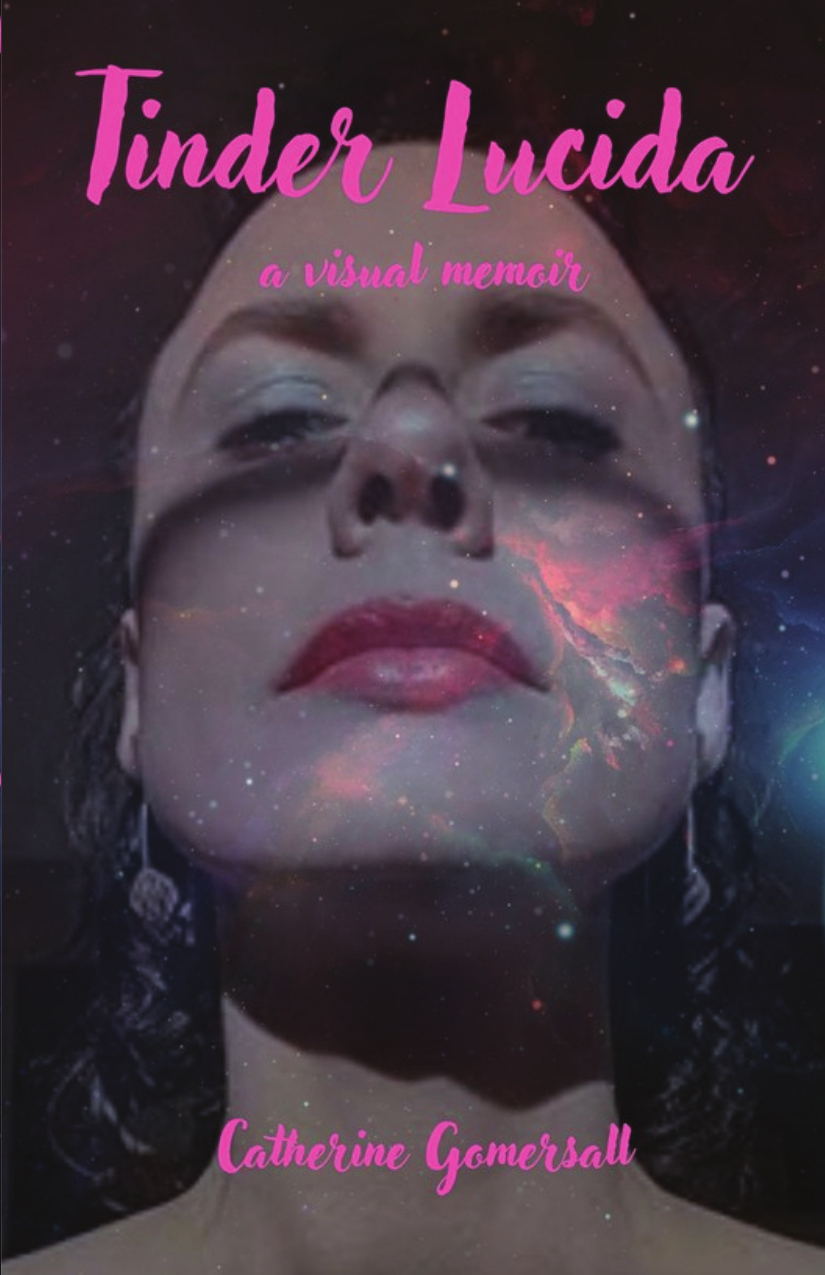
Tinder Lucida
by Catherine Gomersall
In 2016, Catherine Gomersall began making fictionalised Tinder profiles as a joke for her friends on Facebook. What started as deadpan comedy about online dating and performed identity took a darker turn when a protracted sexual assault changed the nature of the project entirely.
Tinder Lucida is the conclusion of The Tinder Project — a multi-year social media performance that used the Tinder interface to interrogate how identity is constructed, policed, and weaponised in digital spaces. This book documents the exhibition held at TAP Gallery, Sydney in 2019, and includes a candid conversation between Gomersall and curator Kit Ball about the project's evolution: from humour to trauma, from Facebook to gallery wall, from self-portraiture to punk defacement.
Gomersall's work asks what it means to present yourself authentically in spaces designed to reduce you to a profile. It asks why irony becomes illegible when a woman refuses to be legible. And it asks what happens when persistence gets reframed as provocation.
Part artist's book, part cultural document, Tinder Lucida is an unflinching record of making difficult work in difficult circumstances — and refusing to stop.
What readers are saying
“Catherine Gomersall has been at the forefront of Australian Performance Art for than a decade.Her multi-disciplined approach is unique. Her ability to use the media to share her ideas without compensation is very generous. Her book recording and documenting her art is timely and should be part of all concerned artists library.”
— Seamus Murphy
More books by Catherine Gomersall

Magic Muse
Taking the Path of Most Resilience
They told you the problem was your attitude. Your persistence was aggression. Your vision, unrealistic. Your refusal to compromise, arrogance. Magic Muse is written for everyone who has heard that and kept going anyway.
Drawing on a decade of art-making without institutional permission, Dr Catherine Gomersall traces her creative practice through nine major projects — from Tinder Machina, a satire of automated intimacy, to Survivor Personae, a collaboration exploring the fractured self of trauma recovery, to Selfie Studio, an AI-guided self-portraiture project that turns the lens toward collective possibility. Together, these works map a journey through digital experimentation, pandemic survival, identity erasure, and the current AI revolution — each project building on the last, none of them waiting for anyone's approval.
But this is not a book about celebrating endurance. Magic Muse makes a harder argument: resilience is not justice, and the two should never be confused. When we conflate them, we ask the excluded to be grateful for the strength their exclusion gave them. We turn survival into virtue and let broken systems off the hook.
Gomersall refuses that bargain. With dry intelligence and hard-won clarity, she examines how the "resilience" demanded of marginalised artists so often functions as another word for accepting what should never have to be accepted — and how creative practice can become, instead, a site of reclamation, sovereignty, and refusal.
Magic Muse is for the artist who has been pushed out of spaces that claimed to support art. For the creative whose layered identity doesn't fit the official record. For anyone who has ever asked not "What's wrong with me?" but "What's wrong with these systems?" — and kept making work anyway.