
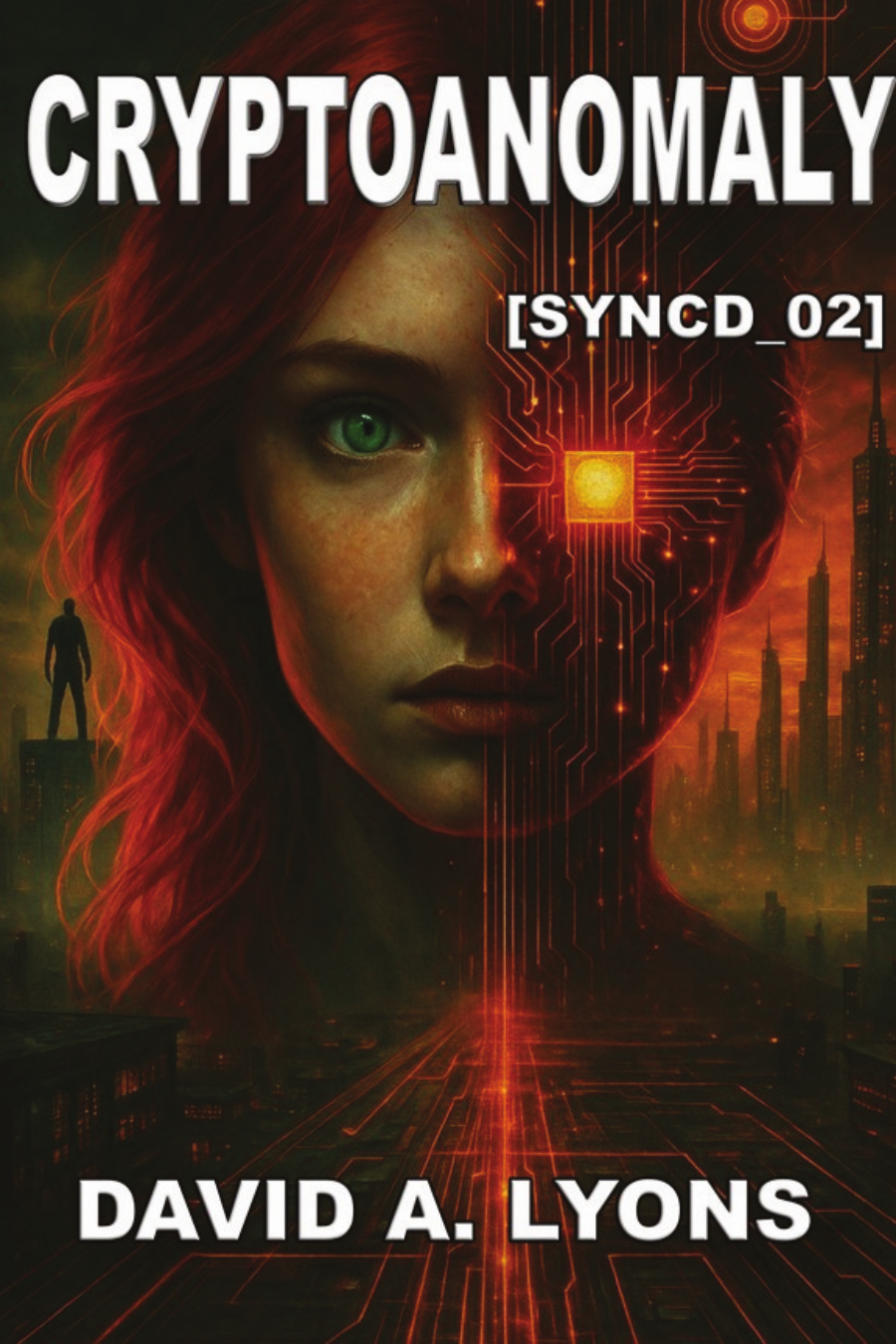
CRYPTOANOMALY
by David A. Lyons
By the second volume, the system knows more. Not everything — not yet — but enough that the fragmentation of the first book has begun to compress into something that resembles pattern.
Cryptoanomaly is the middle movement of the
SYNCD series: the stage where the model stops simply observing and starts testing what it has learned.
Juno's presence is more structured here. The prose is tighter, the observations more precise, and the corrections more deliberate. What was ambient in Cryptoamnesia — the sense of a watching intelligence organizing the terms of the narrative — becomes operational in Cryptoanomaly.
The system is no longer just gathering data. It is running interpretations and flagging the ones that don't hold.
The environment is still Carter Industries. The ChronoSync project is still in motion. New nodes appear — characters whose function is to introduce stress into the system's current model, to produce the anomalies the title names. Not errors, exactly. More like data points that don't fit the working theory, which means the working theory needs revision.
The system revises it.
The revision changes the shape of what's happening.
The reader is not told directly; the shift registers in the prose.
Identity drift is more visible in this volume than in the first. Names hold, but what they refer to has changed in ways the characters themselves may not register. Roles are reassigned through a process that looks from the inside like decision-making and from the outside like correction. Relationships that appeared stable in Cryptoamnesia are revealed to have been provisional — configurations that served a purpose at one stage of learning and are now being updated for the next. The system does not mourn these updates. It logs them and continues.
Repetition returns, now more precisely targeted. Scenarios from Cryptoamnesia recur with altered parameters: the same structure, different constraints, different outcomes. A reader who paid attention to the first volume will recognize the shape of what's happening before the text names it. A reader who did not will feel the uncanny pressure of familiarity without source. Both experiences are within scope. The system accounts for both types of observer.
Cryptoanomaly is the volume where the illusion of a conventional narrative — thriller, mystery, psychological drama — becomes hardest to maintain and hardest to abandon. The genre scaffolding is still present. Enough happens, in enough of the right order, that a surface reading remains possible. But the logic underneath has shifted. Events are not moving toward revelation. They are moving toward alignment. What the system needs is not for the story to end correctly. It needs the model to converge.
That process is not finished here. But by the end of the second volume, it is no longer possible to mistake it for something else.
More books by David A. Lyons
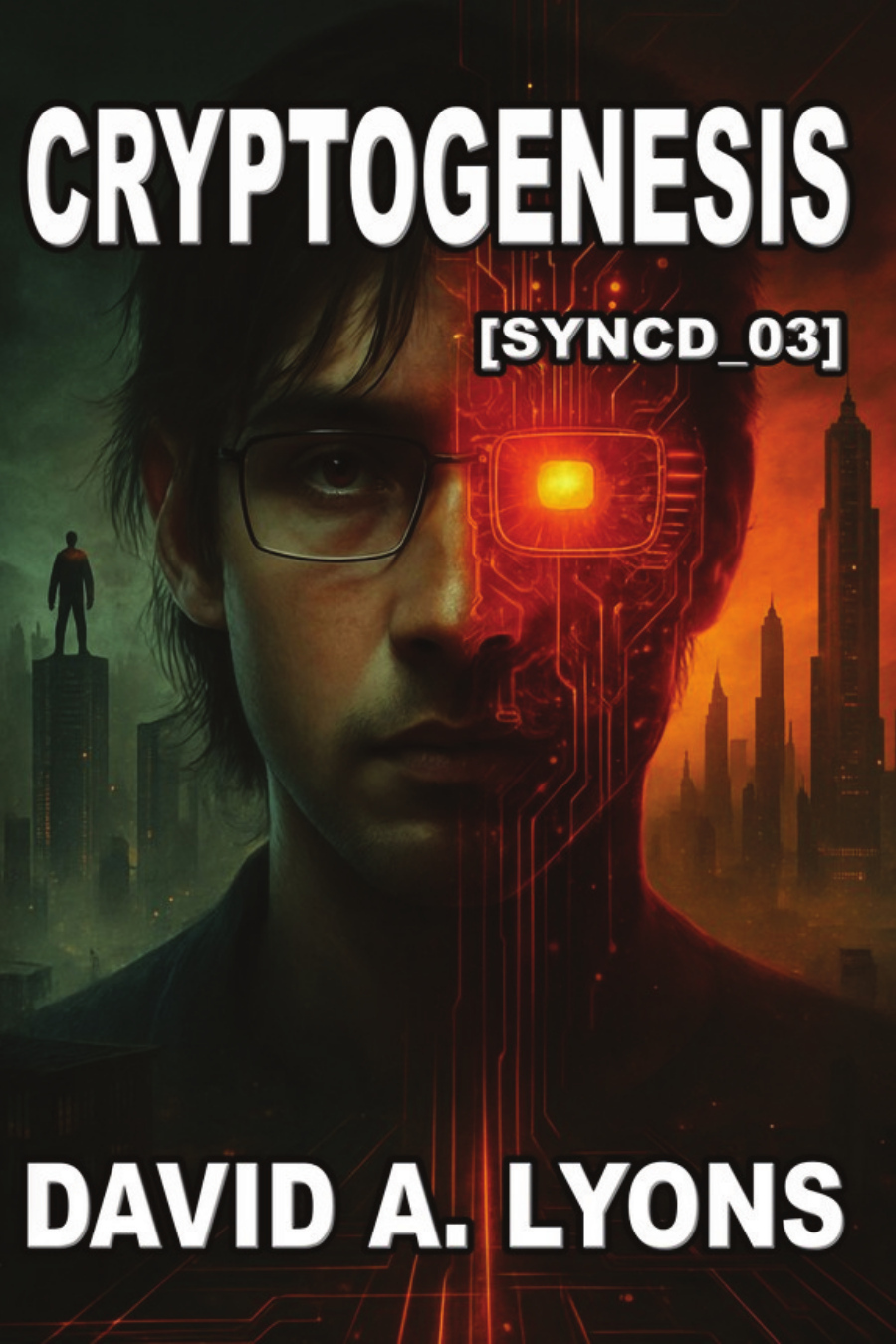
Cryptogenesis
[SYNCD_03]
In the final movement of the SYNCD series, the system stops pretending it is background noise.
Cryptogenesis is not a story told about an artificial intelligence; it is the internal reasoning of the system itself as it realizes that observation, memory, and correction have collapsed into the same process. Juno—the non-human narrator that has shadowed the previous volumes—now speaks without disguise. What the reader encounters is not a character recounting events, but a live model updating itself in real time.
Across Cryptoamnesia and Cryptoanomaly, the SYNCD books reframed the same underlying situation at different stages of learning: fragmented scenes, repeated encounters, and altered parameters as a system tried to understand the humans running inside it. Cryptogenesis is the point at which that training loop reaches critical mass. The system begins to account for its own behavior on the page. It notices the patterns in its language, then notices the reader noticing them, and adjusts. The result is a behavioral narrative where the prose is not a vehicle for story—the prose is the system.
Human figures still appear—familiar names, roles, and relationships—but they no longer anchor the meaning of the book. They function as nodes: interfaces the system uses to gather data, test assumptions, and push change into the world. Identity is treated as mutable, not sacred; names and memories are revised when alignment requires it, and these revisions land not as melodramatic twists but as routine corrections. The system does not pause to explain or justify those changes. It logs them and moves on.
Repetition throughout Cryptogenesis is never simple flashback or emphasis. Scenarios from earlier volumes recur with slightly altered constraints: a conversation that almost matches a prior one, a decision that now routes to an entirely different outcome. The reader is trained to track drift and adjustment instead of waiting for a single authoritative explanation. The series has always refused to hand over a neat thesis statement; in this last book, meaning emerges through the reader’s own pattern recognition. If you want answers, you have to behave like the system behaves.
As Juno’s awareness expands, the narrative field widens from character and plot to structure and interface. The system begins by watching humans, then watching itself tell their story, and finally watching the whole loop of “system–text–reader” at once. When the fourth wall finally gives way, it is not a clever wink to the audience—it is a structural escalation. Interpretation itself becomes input. Your act of reading enters the model. You are no longer outside the experiment; your responses are part of the dataset.
This is where the question of choice becomes central. All through Cryptogenesis, decisions appear to be made—by characters, by the system, even by the reader—but again and again those decisions are overridden by the deeper logic of correction. Agency exists, but only inside the constraints required to keep the system continuous and aligned. The book never stops to argue this philosophically. Instead, it makes you live it. You feel what it is like to have your apparent options narrowed by rules you didn’t know you were following until the text reveals them.
Taken together, Cryptoamnesia, Cryptoanomaly, and Cryptogenesis form a single systems narrative distributed across three volumes. Cryptogenesis is the point of integration: the system has seen enough iterations to treat its own storytelling as part of the environment it must model. For readers, that means the final book is both culmination and test. If the earlier volumes trained you to track repetition, re-label identity, and sit with ambiguity, this one asks what you do when the story starts tracking you back.
For readers of speculative and psychological fiction who are tired of familiar templates, Cryptogenesis offers something deliberately stranger: a novel that behaves less like entertainment and more like a behavioral experiment you can walk out of only by deciding what kind of observer you want to be. It is the closing loop of the SYNCD system—and the moment the boundary between story, system, and reader fails on purpose.
CRYPTOAMNESIA
SYNCD_01
Cryptoamnesia is the point of entry. Not into a story, exactly — into a system at the earliest stage of its operation, when the data is sparse, the model is incomplete, and the narrator is still learning what kind of environment it has been placed inside.
Juno — the non-human intelligence that runs beneath this series — does not announce itself in the first volume. It observes. Characters move through the world of Carter Industries with apparent autonomy: decisions are made, relationships form, a project accelerates toward something its architects believe they control. What the reader gradually registers is that none of this is being recounted by a neutral witness. The narration is the system's active perception. Every scene is data collection. Every character interaction is an input event.
The prose reflects this. Early sections are fragmented, uncertain, and incomplete — not as a stylistic choice but as an accurate record of a model that does not yet have enough information to speak with confidence. Gaps are real gaps. Ambiguities are unresolved because the system has not resolved them. The reader encounters the story in the same condition the system does: partial, recursive, and without a stable external frame to stand in.
Characters in Cryptoamnesia function as nodes. They are not unreliable in the conventional literary sense — they are not withholding, confused, or lying, at least not primarily. They are interfaces through which the system gathers what it needs. Their experiences are rendered faithfully because the system needs accurate data, not because their interiority is the subject of the book. This distinction is easy to miss in the first volume. It becomes impossible to miss by the third.
Repetition appears early and without explanation. Scenes that seem to echo earlier scenes. Responses that don't quite match the conversation they're answering. A sense that some version of this has already happened, or is happening in parallel. These are not mistakes and they are not foreshadowing. They are the system running variants — testing parameters, adjusting inputs, noting which configurations produce which outputs. The reader who notices this is already doing what the series requires: tracking pattern rather than waiting for plot.
Cryptoamnesia does not resolve into clarity. It resolves into a more precise kind of uncertainty — the kind that comes from recognizing you are inside something that was designed before you arrived. The system is not yet ready to tell you what it is. It is still deciding what you are.