Northumberland County Pennsylvania Marriage Records
by Deeben Publications
Pennsylvania began issuing marriage licenses at the county level in October 1885. In Northumberland County, the license applications were issued by the Clerk of the Orphans’ Court and recorded in docket ledgers filed in the Register & Recorder’s Office at the county courthouse in Sunbury. The application documented basic information about the prospective couple, including their names, age (often dates and place of birth were recorded even though the application did not specifically request such information), residence, occupation, and the names of parents. In order to verify the legality of the pending marriage, the application asked specific questions regarding any existing relationships between the bride and groom, either by blood or marriage, and also death or divorce information about any former spouses (occasionally, licenses were refused when it was determined that one of the contracting parties was still legally married to another person). In the event that either bride or groom was still of minor age (under 21 years old), the application also required the written consent of the corresponding parents or guardian.
The marriage license applications transcribed in this volume are arranged by the license number assigned to each application. The summaries include the responses to most of the application questions (when given), except for questions 16 (color of parties) and 19–20 (consent of the parents or guardian of the man and woman). With few exceptions, (noted in the transcriptions), all of the individuals who applied for licenses identified themselves as “White,” and the author generally assumed that parental consent to marriage was given—the applications usually contained the response “Given in due form”—unless the license was refused for some reason. Explanatory remarks written by the clerk of the Orphans’ Court in cases of rejected applications are included in the summaries. All place names and residences are located in Northumberland County, unless otherwise noted (in which case, the author added appropriate county/state—and sometimes country—designations that were not included in the original ledgers). The numerically-arranged license applications are followed by alphabetical groom/bride surname indexes, which also provide the date of marriage and the corresponding license number to allow researchers to easily locate the appropriate summary.
More books by Deeben Publications
Northumberland County Pennsylvania Marriage Records
Volume 2: Marriage License Docket No. 3, 1887–1888
Pennsylvania began issuing marriage licenses at the county level in October 1885. In Northumberland County, the license applications were issued by the Clerk of the Orphans’ Court and recorded in docket ledgers filed in the Register & Recorder’s Office at the county courthouse in Sunbury. The application documented basic information about the prospective couple, including their names, age (often dates and place of birth were recorded even though the application did not specifically request such information), residence, occupation, and the names of parents. In order to verify the legality of the pending marriage, the application asked specific questions regarding any existing relationships between the bride and groom, either by blood or marriage, and also death or divorce information about any former spouses (occasionally, licenses were refused when it was determined that one of the contracting parties was still legally married to another person). In the event that either bride or groom was still of minor age (under 21 years old), the application also required the written consent of the corresponding parents or guardian.
The marriage license applications transcribed in this volume are arranged by the license number assigned to each application. With Docket Book No. 3, the format of the docket changed slightly. The numbered questions were eliminated in favor of a statement asking the same questions, with blanks to fill in the required information by the Clerk of the Orphans Court (see facsimile on next page). The summaries include the responses to most of the application questions (when given), except for the questions about race (color of parties) and consent (of the parents or guardian of the man and woman). With few exceptions (noted in the transcriptions), all of the individuals who applied for licenses identified themselves as “White,” and the author generally assumed that parental consent to marriage was given—the applications usually contained the response “Given in due form”—unless the license was refused for some reason. Explanatory remarks written by the clerk of the Orphans’ Court in cases of rejected applications are included in the summaries. Questions in which the applicants responded “None” are not included in these transcriptions. All place names and residences are located in Northumberland County, unless otherwise noted (in which case, the author added appropriate county/state—and sometimes country—designations that were not included in the original ledgers). The numerically-arranged license applications are followed by alphabetical groom/bride surname indexes, which also provide the date of marriage and the corresponding license number to allow researchers to easily locate the appropriate summary.
Northumberland County Pennsylvania Marriage Records
Volume 3: Marriage License Docket No. 4, 1888–1890
Pennsylvania began issuing marriage licenses at the county level in October 1885. In Northumberland County, the license applications were issued by the Clerk of the Orphans’ Court and recorded in docket ledgers filed in the Register & Recorder’s Office at the county courthouse in Sunbury. The application documented basic information about the prospective couple, including their names, age (often dates and place of birth were recorded even though the application did not specifically request such information), residence, occupation, and the names of parents. In order to verify the legality of the pending marriage, the application asked specific questions regarding any existing relationships between the bride and groom, either by blood or marriage, and also death or divorce information about any former spouses (occasionally, licenses were refused when it was determined that one of the contracting parties was still legally married to another person). In the event that either bride or groom was still of minor age (under 21 years old), the application also required the written consent of the corresponding parents or guardian.
The marriage license applications transcribed in this volume are arranged by the license number assigned to each application. With Docket Book No. 3, the format of the docket changed slightly. The numbered questions were eliminated in favor of a statement asking the same questions, with blanks to fill in the required information by the Clerk of the Orphans Court (see facsimile on next page). The summaries include the responses to most of the application questions (when given), except for the questions about race (color of parties) and consent (of the parents or guardian of the man and woman). With few exceptions (noted in the transcriptions), all of the individuals who applied for licenses identified themselves as “White,” and the author generally assumed that parental consent to marriage was given—the applications usually contained the response “Given in due form”—unless the license was refused for some reason. Explanatory remarks written by the clerk of the Orphans’ Court in cases of rejected applications are included in the summaries. Questions in which the applicants responded “None” are not included in these transcriptions. All place names and residences are located in Northumberland County, unless otherwise noted (in which case, the author added appropriate county/state—and sometimes country—designations that were not included in the original ledgers). The numerically-arranged license applications are followed by alphabetical groom/bride surname indexes, which also provide the date of marriage and the corresponding license number to allow researchers to easily locate the appropriate summary.
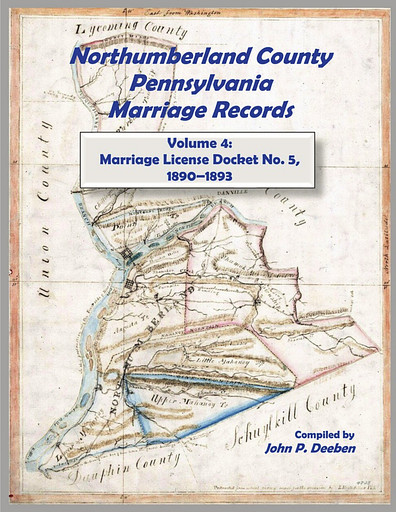
Northumberland County Pennsylvania Marriage Records
Volume 4: Marriage License Docket No. 5, 1890–1893
Pennsylvania began issuing marriage licenses at the county level in October 1885. In Northumberland County, the license applications were issued by the Clerk of the Orphans’ Court and recorded in docket ledgers filed in the Register & Recorder’s Office at the county courthouse in Sunbury. The application documented basic information about the prospective couple, including their names, age (often dates and place of birth were recorded even though the application did not specifically request such information), residence, occupation, and the names of parents. In order to verify the legality of the pending marriage, the application asked specific questions regarding any existing relationships between the bride and groom, either by blood or marriage, and also death or divorce information about any former spouses (occasionally, licenses were refused when it was determined that one of the contracting parties was still legally married to another person). In the event that either bride or groom was still of minor age (under 21 years old), the application also required the written consent of the corresponding parents or guardian.
The marriage license applications transcribed in this volume are arranged by the license number assigned to each application. With Docket Book No. 3, the format of the docket changed slightly. The numbered questions were eliminated in favor of a statement asking the same questions, with blanks to fill in the required information by the Clerk of the Orphans Court (see facsimile on next page). The summaries include the responses to most of the application questions (when given), except for the questions about race (color of parties) and consent (of the parents or guardian of the man and woman). With few exceptions (noted in the transcriptions), all of the individuals who applied for licenses identified themselves as “White,” and the author generally assumed that parental consent to marriage was given—the applications usually contained the response “Given in due form”—unless the license was refused for some reason. Explanatory remarks written by the clerk of the Orphans’ Court in cases of rejected applications are included in the summaries. Questions in which the applicants responded “None” are not included in these transcriptions. All place names and residences are located in Northumberland County, unless otherwise noted (in which case, the author added appropriate county/state—and sometimes country—designations that were not included in the original ledgers). The numerically-arranged license applications are followed by alphabetical groom/bride surname indexes, which also provide the date of marriage and the corresponding license number to allow researchers to easily locate the appropriate summary.
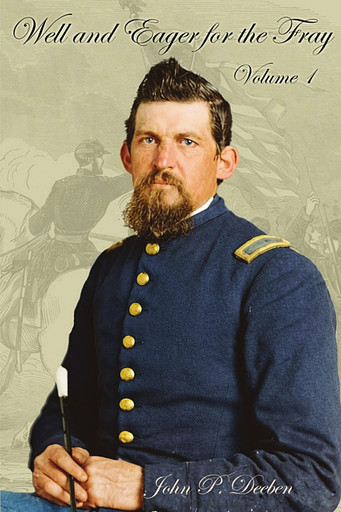
Well and Eager for the Fray
Letters from Northumberland County Soldiers to the Local Press during the Civil War, 1861-1865. Volume 1.
In 1861, young men from Northumberland County, Pennsylvania, enthusiastically answered the call to war. From towns and farmlands along the Susquehanna River to the anthracite coal fields, they flocked to the national colors, ultimately serving in more than twenty different Pennsylvania regiments. Their service collectively spanned the entire length of the Civil War.
These soldiers had a story to tell. While most of them typically corresponded with family and friends, apprising loved ones of their well-being and recounting military adventures, many also wrote for a more public audience. Acting as impromptu field correspondents, they penned reports to hometown newspapers on a regular basis, keeping communities informed of their activities, conveying news about the fate of neighbors, and perhaps most importantly, providing relentless support for hometown morale. Above all else, they voiced unwavering belief in the just and righteous nature of the Union cause.
Little has been done to highlight the role of Civil War soldiers as war correspondents, yet a huge, untapped body of work remains hidden among the columns of period local newspapers, waiting to be discovered. Some of these soldiers even came from a journalism background, bringing a more professional perspective to their descriptions of the war.
With this book, author John P. Deeben assembles for the first time an anthology of soldier letters written specifically for publication in two local Northumberland County newspapers, the Sunbury Gazette and Sunbury American. The letters collectively bring to life the story that Northumberland County played in the Civil War.
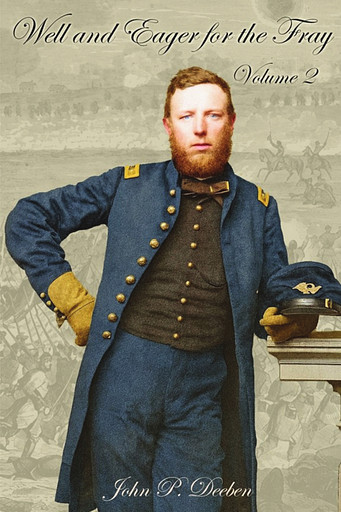
Well and Eager for the Fray
Letters from Northumberland County Soldiers to the Local Press during the Civil War, 1861-1865. Volume 2.
In 1861, young men from Northumberland County, Pennsylvania, enthusiastically answered the call to war. From towns and farmlands along the Susquehanna River to the anthracite coal fields, they flocked to the national colors, ultimately serving in more than twenty different Pennsylvania regiments. Their service collectively spanned the entire length of the Civil War.
These soldiers had a story to tell. While most of them typically corresponded with family and friends, apprising loved ones of their well-being and recounting military adventures, many also wrote for a more public audience. Acting as impromptu field correspondents, they penned reports to hometown newspapers on a regular basis, keeping communities informed of their activities, conveying news about the fate of neighbors, and perhaps most importantly, providing relentless support for hometown morale. Above all else, they voiced unwavering belief in the just and righteous nature of the Union cause.
Little has been done to highlight the role of Civil War soldiers as war correspondents, yet a huge, untapped body of work remains hidden among the columns of period local newspapers, waiting to be discovered. Some of these soldiers even came from a journalism background, bringing a more professional perspective to their descriptions of the war.
With this book, author John P. Deeben assembles for the first time an anthology of soldier letters written specifically for publication in two local Northumberland County newspapers, the Sunbury Gazette and Sunbury American. The letters collectively bring to life the story that Northumberland County played in the Civil War.
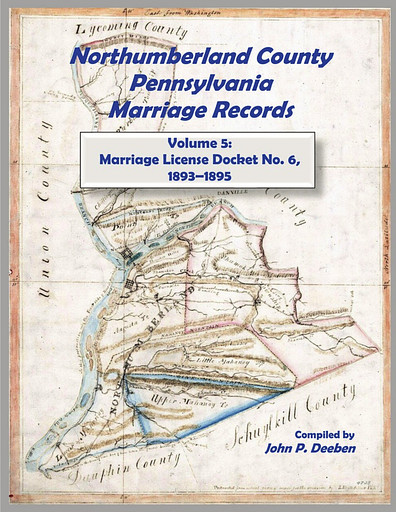
Northumberland County Pennsylvania Marriage Records
Volume 5: Marriage License Docket No. 6, 1893-1895
Pennsylvania began issuing marriage licenses at the county level in October 1885. In Northumberland County, the license applications were issued by the Clerk of the Orphans’ Court and recorded in docket ledgers filed in the Register & Recorder’s Office at the county courthouse in Sunbury. The application documented basic information about the prospective couple, including their names, age (often dates and place of birth were recorded even though the application did not specifically request such information), residence, occupation, and the names of parents. In order to verify the legality of the pending marriage, the application asked specific questions regarding any existing relationships between the bride and groom, either by blood or marriage, and also death or divorce information about any former spouses (occasionally, licenses were refused when it was determined that one of the contracting parties was still legally married to another person). In the event that either bride or groom was still of minor age (under 21 years old), the application also required the written consent of the corresponding parents or guardian.
The marriage license applications transcribed in this volume are arranged by the license number assigned to each application. With Docket Book No. 3, the format of the docket changed slightly. The numbered questions were eliminated in favor of a statement asking the same questions, with blanks to fill in the required information by the Clerk of the Orphans Court (see facsimile on next page). The summaries include the responses to most of the application questions (when given), except for the questions about race (color of parties) and consent (of the parents or guardian of the man and woman). With few exceptions (noted in the transcriptions), all of the individuals who applied for licenses identified themselves as “White,” and the author generally assumed that parental consent to marriage was given—the applications usually contained the response “Given in due form”—unless the license was refused for some reason. Explanatory remarks written by the clerk of the Orphans’ Court in cases of rejected applications are included in the summaries. Questions in which the applicants responded “None” are not included in these transcriptions. All place names and residences are located in Northumberland County, unless otherwise noted (in which case, the author added appropriate county/state—and sometimes country—designations that were not included in the original ledgers). The numerically-arranged license applications are followed by alphabetical groom/bride surname indexes, which also provide the date of marriage and the corresponding license number to allow researchers to easily locate the appropriate summary.
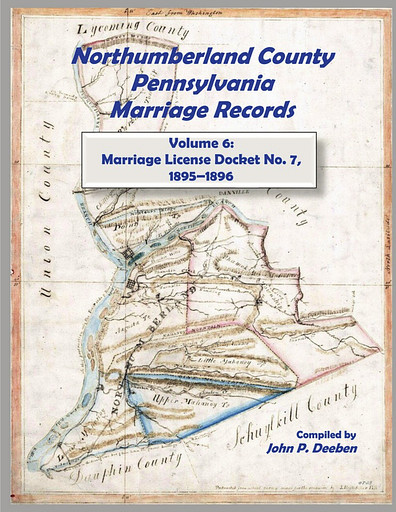
Northumberland County Pennsylvania Marriage Records
Volume 6: Marriage License Docket No. 7, 1895-1896
Pennsylvania began issuing marriage licenses at the county level in October 1885. In Northumberland County, the license applications were issued by the Clerk of the Orphans’ Court and recorded in docket ledgers filed in the Register & Recorder’s Office at the county courthouse in Sunbury. The application documented basic information about the prospective couple, including their names, age (often dates and place of birth were recorded even though the application did not specifically request such information), residence, occupation, and the names of parents. In order to verify the legality of the pending marriage, the application asked specific questions regarding any existing relationships between the bride and groom, either by blood or marriage, and also death or divorce information about any former spouses (occasionally, licenses were refused when it was determined that one of the contracting parties was still legally married to another person). In the event that either bride or groom was still of minor age (under 21 years old), the application also required the written consent of the corresponding parents or guardian.
The marriage license applications transcribed in this volume are arranged by the license number assigned to each application. With Docket Book No. 3, the format of the docket changed slightly. The numbered questions were eliminated in favor of a statement asking the same questions, with blanks to fill in the required information by the Clerk of the Orphans Court (see facsimile on next page). The summaries include the responses to most of the application questions (when given), except for the questions about race (color of parties) and consent (of the parents or guardian of the man and woman). With few exceptions (noted in the transcriptions), all of the individuals who applied for licenses identified themselves as “White,” and the author generally assumed that parental consent to marriage was given—the applications usually contained the response “Given in due form”—unless the license was refused for some reason. Explanatory remarks written by the clerk of the Orphans’ Court in cases of rejected applications are included in the summaries. Questions in which the applicants responded “None” are not included in these transcriptions. All place names and residences are located in Northumberland County, unless otherwise noted (in which case, the author added appropriate county/state—and sometimes country—designations that were not included in the original ledgers). The numerically-arranged license applications are followed by alphabetical groom/bride surname indexes, which also provide the date of marriage and the corresponding license number to allow researchers to easily locate the appropriate summary.
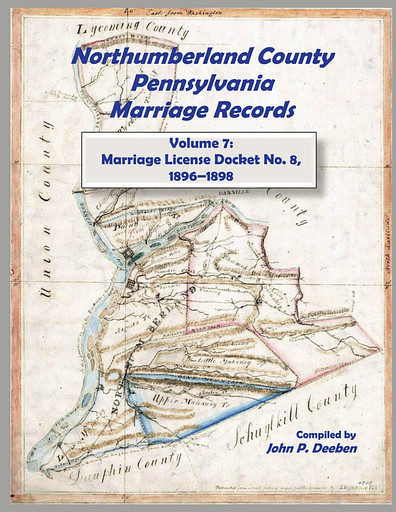
Northumberland County Pennsylvania Marriage Records
Volume 7: Marriage License Docket No. 8, 1896-1898
Pennsylvania began issuing marriage licenses at the county level in October 1885. In Northumberland County, the license applications were issued by the Clerk of the Orphans’ Court and recorded in docket ledgers filed in the Register & Recorder’s Office at the county courthouse in Sunbury. The application documented basic information about the prospective couple, including their names, age (often dates and place of birth were recorded even though the application did not specifically request such information), residence, occupation, and the names of parents. In order to verify the legality of the pending marriage, the application asked specific questions regarding any existing relationships between the bride and groom, either by blood or marriage, and also death or divorce information about any former spouses (occasionally, licenses were refused when it was determined that one of the contracting parties was still legally married to another person). In the event that either bride or groom was still of minor age (under 21 years old), the application also required the written consent of the corresponding parents or guardian.
The marriage license applications transcribed in this volume are arranged by the license number assigned to each application. With Docket Book No. 3, the format of the docket changed slightly. The numbered questions were eliminated in favor of a statement asking the same questions, with blanks to fill in the required information by the Clerk of the Orphans Court (see facsimile on next page). The summaries include the responses to most of the application questions (when given), except for the questions about race (color of parties) and consent (of the parents or guardian of the man and woman). With few exceptions (noted in the transcriptions), all of the individuals who applied for licenses identified themselves as “White,” and the author generally assumed that parental consent to marriage was given—the applications usually contained the response “Given in due form”—unless the license was refused for some reason. Explanatory remarks written by the clerk of the Orphans’ Court in cases of rejected applications are included in the summaries. Questions in which the applicants responded “None” are not included in these transcriptions. All place names and residences are located in Northumberland County, unless otherwise noted (in which case, the author added appropriate county/state—and sometimes country—designations that were not included in the original ledgers). The numerically-arranged license applications are followed by alphabetical groom/bride surname indexes, which also provide the date of marriage and the corresponding license number to allow researchers to easily locate the appropriate summary.
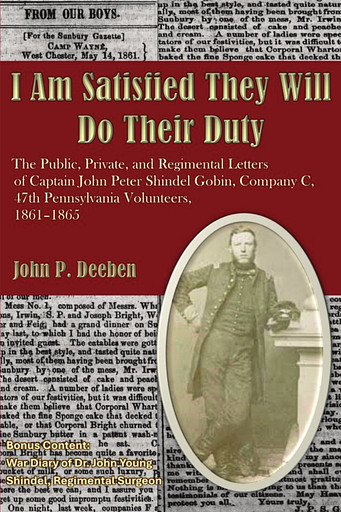
I Am Satisfied They Will Do Their Duty
The Public, Private, and Regimental Letters of Captain John Peter Shindel Gobin, Company C, 47th Pennsylvania Volunteers, 1861-1865
Northumberland County native John Peter Shindel Gobin served faithfully during the Civil War as an officer in the 11th and 47th Pennsylvania Volunteer Regiments. More importantly, he chronicled his experiences in personal letters to his family and friends, as well as public reports for his hometown community in the form of letters written to the local Sunbury newspapers. Collectively, these writings offered articulate, nuanced observations of army life that only a trained lawyer and newspaperman with an eye for detail and a gift for words could provide. His regimental letters as well, written while serving as colonel of the 47th Pennsylvania, opened a fuller window onto Gobin’s talent for administration and leadership.
John Peter Shindel Gobin’s public, private, and regimental correspondence together provide a more complete picture of a young idealistic officer who would one day rise to become Pennsylvania’s lieutenant governor.
Bonus content includes a transcription of the war diary of Dr. John Young Shindel, regimental surgeon of the 47th Pennsylvania and Gobin’s beloved cousin.