
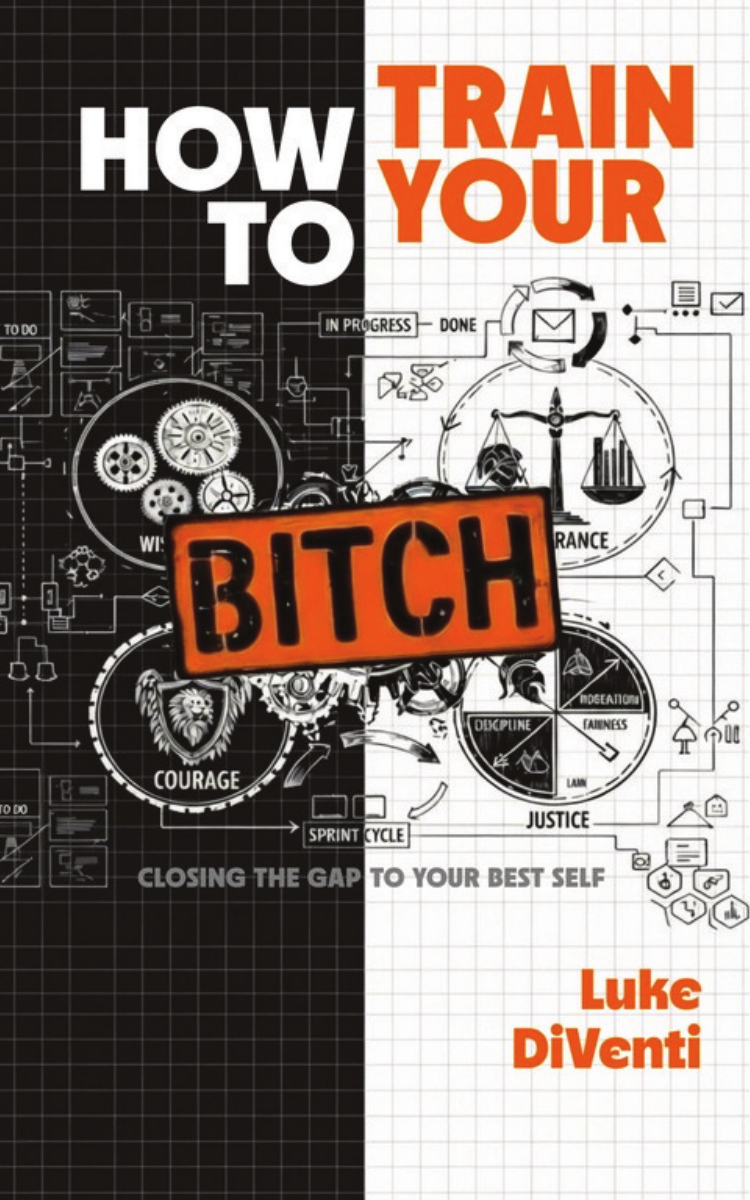
How to train your BITCH
by DiVenti Books
In a crowded self-improvement landscape driven by inspiration and quick fixes, Luke DiVenti takes a radically structured approach in “How to Train Your BITCH: Closing the Gap to Your Best Self: A Stoic Agile Approach.” Blending the endurance of ancient Stoic philosophy with the execution discipline of modern Agile Scrum, DiVenti introduces what he calls Stoixism, a new category of personal development built on systems, iteration, and measurable progress.
Described as where “Atomic Habits” meets “The Daily Stoic,” but constructed on an engineering chassis, the book reframes self-improvement as an operational challenge rather than an emotional one. Instead of chasing fleeting motivation, readers are guided through a 100-day framework that treats life like a software product in need of debugging, iteration, and disciplined upgrading.
At the center of DiVenti’s approach is a provocative concept. The internal voice of doubt, distraction, and self-sabotage must be trained rather than ignored. Drawing from Stoic principles such as discipline, voluntary discomfort, and control over perception, he pairs timeless philosophy with Agile tools including sprints, retrospectives, and incremental improvement cycles. The result is a structured methodology designed to close the gap between intention and execution.
The book provides readers with a practical blueprint for identifying limiting behaviors, running personal experiments, tracking performance, and adjusting strategy in real time. By applying Scrum-inspired planning to daily life, DiVenti argues that transformation becomes less about willpower and more about systems. Each chapter builds toward operational clarity, encouraging readers to think like engineers of their own character.
Luke DiVenti brings analytical rigor and philosophical depth to the self-improvement genre. His Stoixism framework positions discipline as a design principle and resilience as a repeatable process. By merging ancient wisdom with contemporary execution models, he offers readers a way to build not just better habits, but a better operating system for life.