
Beyond EBITDA
by ThinkIP
Beyond EBITDA examines why conventional valuation methods — net asset valuation, capitalisation of earnings, EBITDA multiples, and comparable transactions — systematically understate or misstate the value of privately held businesses in an increasingly intangible-asset economy. Drawing on the author's doctoral research and three decades of business, franchise, and intellectual property valuation practice, the book argues that value-determining factors such as revenue quality, intellectual property strength, ownership certainty, legal protection, transferability, and founder dependency are rarely captured by profit-multiple approaches, yet materially affect what a business is actually worth to a buyer.
The book is organised in five parts. Part One traces the historical origins of traditional valuation methods and the structural mismatch between an industrial-era analytical framework and a modern, intangible-asset economy. Part Two reviews the five conventional valuation methods on their own terms, identifying their genuine strengths and specific limitations. Part Three introduces the dimensions of business quality — revenue quality, intellectual property, ownership, protection, commercialisation, and transferability — that determine durable value but do not appear on a balance sheet. Part Four presents IPAPS™, the Intellectual Property Asset Pricing System, a disciplined discounted cash flow methodology in which diagnostic findings are translated into documented economic consequences and allocated once to the valuation input that most faithfully represents them, avoiding double counting or mechanical score-to-value adjustment; a fully worked valuation illustrates the methodology in practice. Part Five considers the implications of artificial intelligence, data, and the broader intangible economy for the future of business valuation.
The book is intended for business owners, valuers, accountants, and advisors seeking a more rigorous, evidence-based and defensible basis for determining enterprise value.
More books by ThinkIP
OWN IT
Scale Smarter. Work Less. Build What Lasts.
This is not just a book. It is a wake-up call to every business owner overlooking the goldmine beneath their nose.
In boardrooms and cafés, warehouses and home offices, I have met founders hustling hard, refining products, building brands, solving problems. And yet, many miss the very thing that could change their trajectory… the silent, invisible power of Intellectual Property Assets.
This book is for those who have built something meaningful but struggle to pinpoint what truly sets them apart. For those looking to scale smartly, and one day EXIT not QUIT with pockets full and a legacy intact.
Inside, you will find more than theory. You will meet real businesses. Some that thrived by leveraging IP, others that lost everything by ignoring it. You will learn how to turn your tools, habits, and systems into protected, bankable assets. Your brand, your processes, your customer insights, your secret sauce can all fuel growth, wealth, and resilience.
Some key ideas will be intentionally revisited throughout the book. That’s not repetition. It’s reinforcement. Because the right message, seen twice, lands deeper and lasts longer.
Whether you are a tech startup or a family-run take-away shop, you will be encouraged to stop thinking like a worker in your business and start acting like the architect of it. Today, enduring businesses do not just make great products. They protect great ideas.
So, take a breath. Open your mind and discover what you’ve really been building all along. Because your business is not just what you do. It’s what you own. Once you get that, everything changes.
Dr. M- Think IP. Because it Pays.™
THINK IP
Identify, Create, Build, Protect, Value, Commercialise and Manage- INTELLECTUAL PROPERTY
What if your most valuable business asset isn’t on your balance sheet… yet?
THINK IP reveals how Intellectual Property quietly drives the world’s most profitable businesses and how it can transform yours.
From Tesla to Qantas, Lorna Jane to Cochlear, global success isn’t built on size… it’s built on strategy. IP isn’t just legal protection. It’s a commercial engine, valuation driver, and the currency of competitive advantage.
This book shows you how to:
Turn knowledge and know-how into assets
Stop trading hours and start building enterprise value
Use IP to scale, license, franchise, or exit stronger
Create a “sale-ready” business that investors actually want
Apply the THINK IP Lifecycle: Identify → Protect → Value → Commercialise
Based on real cases and decades of advisory experience, THINK IP gives business owners, advisors, founders, and investors a clear roadmap to grow faster, sell smarter, and protect what truly matters.
Every successful business has valuable IP… whether they know it or not. The question is: Are you using yours… or losing it?
It’s time to THINK IP… because it pays.

TOO LATE FOR SORRY
A story of greed, love and betrayal
The sea stretched endlessly, its waves gilded by the dying light of the sun, a silent witness to the countless souls it had carried across its vast embrace… explorers, conquerors, traders, and romanticizing dream chasers. Now, this tide carried another family toward an uncertain future. A family of intense ambition, the quiet rebels of their new world, those who dare to waltz with the impossible, where fortunes await, and legacies are shaped in the passions of sweat and the relentless pursuit of influence.
From the mist-laden docks of England, the Digby Family embarked on a journey that would forever alter their existence. Their destination…Mauritius, a gleaming jewel in the Indian Ocean, where the scent of sugarcane sweetened the air and opportunity whispered dangerously through the fields. But prosperity is never handed over willingly; it is wrested from fate's grip, traded for with sacrifice, and cloaked in the shadows of greed, love, lusts and the many temptations of wealth and betrayal.
At the heart of this tale stands a rainmaker, a matriarch and two brothers bound by blood, divided by destiny. Together, they must navigate the treacherous waters of ambition and survival, rescuing their family from the brink of ruin. But in a world where power breeds envy and loyalty is tested at every turn, even the strongest of bonds may not withstand the weight of empire.
This is their story as told by nephew Nathan.. The rise. The fall. The price of love and legacy.
The God Code
When creation tries to become creator
The God Code… When creation tries to become creator
What happens when humanity begins to imitate the divine, not in worship, but in ambition?
The God Code explores the spiritual and moral tensions of the AI age, where machines learn to think, but humans risk forgetting how to pray. It’s a book about technology, yes … but more deeply, about theology… how creation’s pursuit of intelligence can drift from its Creator’s wisdom.
From Genesis to the digital age, this prophetic reflection reveals how Artificial Intelligence magnifies what already rules the human heart… pride or purpose, greed or Grace. It challenges leaders, educators, and believers to use innovation as stewardship, not self-exaltation.
Through Scripture, story, and real-world examples, The God Code offers practical ways to navigate the age of automation with humility, discernment, and faith. Its message is simple yet urgent.
Use AI, but stay anchored in awe. Learn from it, but never bow to it. Because technology may build systems, but only God can shape souls.
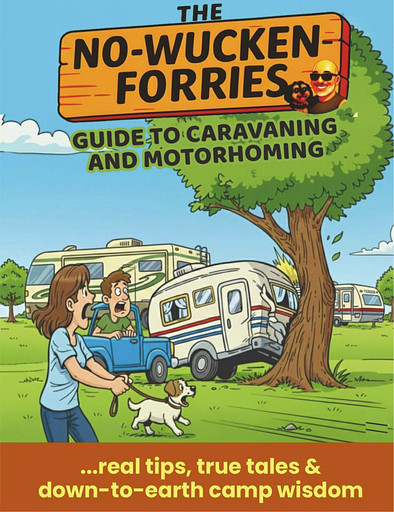
The No-Wucken-Forries Guide to Caravaning and Motorhoming
Real Tips, True Tales & Down-to-Earth Camp Wisdom
So… you bought a caravan! Or a motorhome! Or you’re thinking about it!
Congratulations you’ve just signed up for freedom, fresh air, breathtaking sunsets and a masterclass in problem-solving you didn’t know you needed.
The No-Wucken-Forries Guide to Caravaning & Motorhoming isn’t written by a glossy influencer with a drone and a sponsorship deal. It’s written by someone who’s lived it! The good, the bad, and the “why is everyone staring at me in this caravan park?” moments.
Inside you’ll find:
Real-world tips that actually work (not the YouTube fantasy version).
True tales from the road… funny, painful, and painfully funny.
Practical camp wisdom learned the hard way, so you don’t have to.
Power, water, hitching, reversing, dogs on the road, campground politics, and unexpected wildlife encounters.
And one very opinionated Shidoodle named Bella, who features whether she was invited or not.
This book won’t make you a perfect camper. But it will make you a calmer one.
You’ll learn how to laugh when things go wrong, fix what matters, ignore what doesn’t, and realise that most “disasters” become great stories by the next campfire.
If you want a no-nonsense, down-to-earth guide that feels like advice from a mate … not a manual… this is the book you want riding shotgun.
Real tips. True tales. No Wucken-Forries!
The Quiet Logic of Fasting
How the body manages insulin, hunger and energy when eating pauses
What this book ultimately offers is not a method, but a way of seeing. When the body is understood as responsive rather than defective, urgency softens. Decisions become less reactive. Eating becomes something you participate in rather than manage, and fasting becomes something the body does rather than something you impose.
There will be times when regular meals are supportive. There may be times when longer pauses feel natural. There will also be periods when fasting is not appropriate at all. None of these outcomes represent success or failure. They represent a body responding intelligently to its circumstances.
If there is one idea worth carrying forward, it is this… your body has not been failing you. It has been adapting to the conditions it has been given. When those conditions change, its responses change too.
Understanding that is not about control. It is about orientation. From that place, choices around eating, fasting, and health can be made with clarity rather than fear and that, more than any protocol, is what makes them sustainable.
UNLOCK YOUR HIDDEN IP
From Activity to Structured Asset Turn What You Do Into What You Own by Decoupling What You Are Selling
Most businesses are built on effort. The smart ones are built on assets. THINK IP shows you how to make that shift.
This book is a practical, commercial guide to building a business that creates real value through intellectual property. It is written for operators, founders, and advisors who want more than activity and income. It is for those who want a business that can scale, generate consistent returns, and stand on its own.
THINK IP introduces a clear framework to Identify, Create, Build, Protect, Value, Commercialise and Manage Intellectual Property. Each stage is broken down into plain language and applied through real business thinking. You will learn how to uncover hidden IP in your current operations, restructure your offer into multiple revenue streams, and design systems that reduce reliance on you as the owner.
The book goes beyond theory. It shows how to decouple services into products, how to price and position those products, and how to turn everyday business activity into repeatable, transferable assets. It explains how IP drives valuation, why planning matters, and how to operate as though you are building to sell from day one.
Along the way, you will be challenged to think differently about growth, profit, and control. You will see how strong businesses are built through structure, discipline, and leverage, not just effort and intention.
Whether you are starting with a small budget or refining an established operation, THINK IP gives you a roadmap to build a business that pays, scales, and lasts. It is direct, practical, and grounded in real commercial experience.
If you are serious about building a smarter, more valuable business, this is where you start.
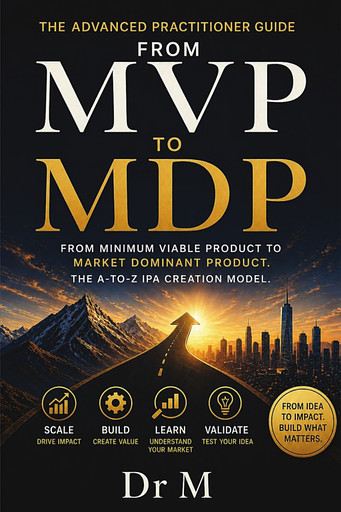
THE ADVANCED PRACTITIONER'S GUIDE
From Minimum Viable Product to Market Dominant Product The A-to-Z IPA Creation Model
Most businesses reach a point where what they do works. Revenue comes in, customers return, and the operation holds together. But beneath that stability sits a hard ceiling. The business depends on the founder, margins are under pressure, and growth requires more effort rather than better structure. The result is predictable. The business performs, but it never becomes something that can scale, be defended, or command real value.
THINK IP — From Minimum Viable Product to Market Dominant Product is about breaking that ceiling.
This book introduces a practical, commercially grounded system for turning a working business into a structured, scalable, and valuable asset base. At its core is the A-to-Z IPA Creation Model, built around 10 levers and 26 drivers that guide you from raw capability to fully formed Intellectual Property Assets. Each step is designed to convert what you already know, do, and deliver into something that can be documented, owned, protected, and commercialised.
Rather than focusing on theory or startup hype, the book takes the perspective of an operator. It shows how to deconstruct a service into its core components, standardise delivery, build repeatable systems, and package those systems into products that can be priced with confidence and deployed beyond the founder. As structure increases, so does control over pricing, margins, and growth.
A running case study demonstrates how a simple, single-site business can be transformed into a licensing model with multiple revenue streams, stronger margins, and a materially higher valuation. The numbers make the shift clear. The product may not change, but the structure does, and that is where the value is created.
The book also introduces a Practitioner Workbook that captures the outputs of each driver. This is not a set of exercises. It is a working record of the assets being built, designed to be used in real commercial settings with partners, investors, or buyers.
This is written for founders, business owners, and advisors who want more than incremental growth. It is for those who want to move from selling effort to owning systems, from reacting to the market to shaping it, and from building income to building value.
If your business works but feels constrained, this book shows you what to do next.
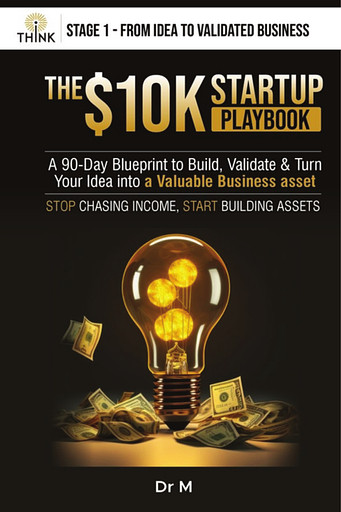
THE $10K STARTUP PLAYBOOK
A 90-Day Blueprint to Build, Validate, and Turn Your Idea Into a Valuable Business Asset. Stop Chasing Income. Start Building Assets.
The $10K Startup Playbook: A 90-Day Blueprint to Build, Validate, and Turn Your Idea Into a Valuable Business Asset
Most people who start a business begin in the wrong place. They buy the logo. They set up the Instagram account. They tell everyone they know. And then, months later, they find themselves working harder than they ever did as an employee, wondering why the business feels more like a trap than a triumph. The problem is rarely effort. The problem is structure.
The $10K Startup Playbook by Dr Maurice Roussety, known to his clients, students, and readers as Dr M, is a book about fixing that problem before it starts. Written for founders at the beginning of something real, it is a practical, principle-driven blueprint for building a business that generates not just income but lasting, transferable value, within ninety days and a budget of $10,000.
Dr M brings more than three decades of experience to these pages. He has consulted to some of Australia's most recognised organisations, among them Westpac, Commonwealth Bank of Australia, Australia Post, IAG, and Optus, as well as to dozens of startups navigating their first serious growth decisions. His doctoral research at Griffith University redefined how practitioners understand and price intangible assets, and it is that rare combination of academic rigour and real-world practice that gives this book its edge. He does not write the way academics write. He writes the way a trusted advisor speaks, directly, clearly, and with a clear-eyed understanding of what founders actually face.
At the heart of the book is a distinction that changes everything. Income is what you earn when you show up. Value is what you build when you build correctly. Most startup advice focuses on the former. This book is about the latter. Through the THINK IP framework, a seven-discipline model covering Identify, Create, Build, Protect, Value, Commercialise, and Manage, Dr M shows readers how to look at their business differently from the very first day. The knowledge you develop, the systems you create, the processes you refine, and the brand you build are not overhead. They are intellectual property. And intellectual property, when built deliberately, is the difference between a business that sells and a business that simply closes.
That distinction is brought to life through case studies drawn from the Australian business landscape and beyond, including a now-famous example of two near-identical businesses on the same street, selling the same product to the same customers, with a $160,000 difference in their sale price. The gap had nothing to do with the quality of the product and everything to do with the structure beneath it.
Each chapter is anchored to one of fifteen IP Building Blocks, a framework developed to help founders identify, protect, and commercialise the value hiding inside what they are already doing. The THINKaways and Calls to Action at the end of each chapter are designed not just to prompt reflection but to drive real decisions.
This is Stage 1 of the THINK IP Entrepreneur Series. It is the foundation on which every stage that follows is built. Whether you are still holding an idea or already in motion, this book will change not just how you start, but what you are building toward.
Your business is not just what you do. It is what you own. And once you understand that, everything changes.
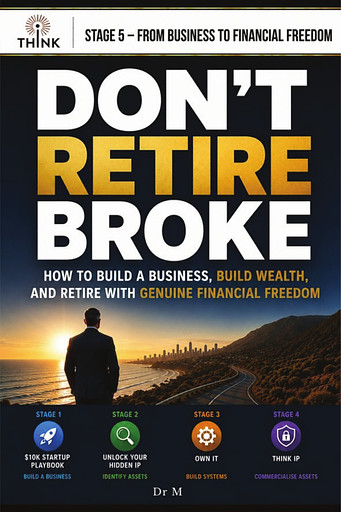
DON'T RETIRE BROKE
How to Build a Business, Build Wealth, and Retire With Genuine Financial Freedom
How to Build a Business, Build Wealth, and Retire With Genuine Financial Freedom
Most business owners assume that if they build a successful business, personal wealth will naturally follow.
Unfortunately, that assumption is wrong.
Every year, founders who have spent decades building profitable businesses discover that business success and personal financial freedom are not the same thing. Many have strong revenues, valuable assets, loyal customers, and impressive reputations, yet still find themselves financially exposed when it comes time to exit, retire, or step away from the business.
DON'T RETIRE BROKE was written to solve that problem.
As the final stage of the THINK IP Entrepreneur Series, this book takes founders beyond start-up, growth, systems, and intellectual property strategy to address the question that ultimately matters most:
How do you convert business success into lasting personal wealth?
Drawing on decades of experience working with business owners, investors, franchise systems, intellectual property assets, business valuations, and exit strategies, Dr M presents a practical roadmap for navigating the complete financial lifecycle of business ownership.
Inside this book, you will learn:
• Why every founder manages two balance sheets and why most focus on the wrong one
• The 21 Founder Wealth Principles that separate financially free entrepreneurs from those who remain trapped in their businesses
• How to buy, build, protect, harvest, and transfer wealth throughout the business lifecycle
• Why cash flow, valuation, risk management, succession planning, and exit readiness are critical to long-term financial success
• How intellectual property assets, systems, brands, customer relationships, and business models contribute to business value and personal wealth
• The common mistakes that cause successful founders to retire with less wealth than they expected
• How to prepare your business for sale, transition, retirement, or legacy planning years before the need arises
• Practical frameworks, case studies, diagnostics, scorecards, and tools that help transform theory into action
Unlike many business books that focus solely on revenue growth, DON'T RETIRE BROKE focuses on what happens after the revenue is earned. It explores the decisions that determine whether decades of hard work ultimately create freedom, choice, security, and lasting wealth.
This is not a book about getting rich quickly.
It is a book about building wealth deliberately.
Whether you are launching your first business, growing an established enterprise, preparing for an eventual exit, or approaching retirement, the principles contained in these pages will help you align your business goals with your personal financial objectives.
Because the ultimate purpose of business ownership is not simply to create income.
It is to create options.
It is to create freedom.
It is to create a life where work becomes a choice rather than a necessity.
If you have spent years building your business, this book will help ensure that the wealth you create is not trapped inside the enterprise but transferred to the person who took the risk to build it.
You built the business.
Now build the wealth.
DON'T RETIRE BROKE provides the roadmap.
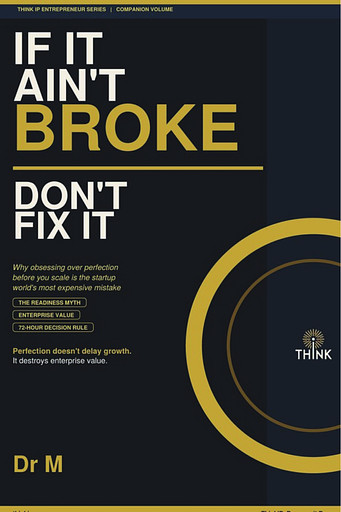
IF IT AIN'T BROKE DON'T FIX IT
Why obsessing over perfection before you scale is the startup world’s most expensive mistake
You have built something real. Revenue is coming in. Customers are returning. The product does what it says it does. By every measure that matters, you have a business that works.
So why are you still fixing it?
After three decades advising founders across Australia and beyond, Dr Maurice Roussety, known to his clients, students, and readers as Dr M, has sat across from that founder hundreds of times. The city changes. The industry changes. The product changes. But the answer to that question is always the same. We are not ready yet.
Not ready. The two most expensive words in the startup vocabulary.
What follows the answer is always a list. The interface needs a redesign before enterprise clients will take it seriously. The reporting module has limitations that will show up in churn data eventually. The advisory board wants the pricing model reviewed before the next raise. The brand consultant recommends a full refresh before investing in marketing. The accountant wants the governance documentation completed before the team is scaled. There is always something on the list. And as long as there is something on the list, the founder who built a genuinely valuable business will not scale it.
This book was written to end that loop.
IF IT AIN'T BROKE DON'T FIX It is the book the startup ecosystem has never had a financial incentive to produce. It is the honest account of the Readiness Myth, the pervasive, expensive, and largely unexamined belief that one more improvement is always required before growth can responsibly begin. The Readiness Myth is not malicious. It does not announce itself. It arrives dressed as prudence, as due diligence, as responsible governance, as the kind of thoughtful preparation that separates serious founders from reckless ones. And in most cases, it is destroying enterprise value while pretending to protect it.
Dr M names the forces behind that destruction and shows precisely how they operate.
The first force is structural. The advisory and vendor ecosystem that surrounds every growing business is built around identifying problems, not confirming readiness. Advisors paid by the month have no financial incentive to deliver an outcome that ends the engagement. Consultants retained to fix the brand, the pricing, the process, or the governance are commercially rewarded for finding the next problem the moment the current one is resolved. Boards that meet monthly and feel the obligation to contribute will always find something to contribute. This is not a character flaw in any individual. It is arithmetic. And it plays out in advisory relationships every day, in language framed entirely in the founder's interest, while the founder's runway shrinks and their momentum stalls.
The second force is psychological. Most founders who build something genuinely good are high-achievers who see gaps. They see the feature that is not quite right, the process that could be tighter, the pitch deck that could be more compelling. They do not see a working product. They see the distance between what they built and the best possible version of what they could build. That distance becomes the thing that must be closed before scaling is responsible. It never closes. Perfection is not a commercial condition. It is a moving standard that the advisory ecosystem is very well paid to keep moving.
The third force is invisible. Nobody talks about the cost of pause. The startup world has built an entire culture around the cost of moving too fast, shipping too soon, scaling too early. It has almost nothing to say about the cost of moving too slowly. And yet that cost is real, it is compounding, and it is permanent. The competitor who moves while you prepare does not give back the advantage they build. The customers who choose an inferior product because it was in the market first do not wait. The market window that closes while you are still optimising does not reopen.
Through the story of Jayden Clarke, founder of ClearOps, a workflow automation platform for the construction and trades industry, Dr M shows that dynamic in full. Jayden has forty-two paying customers, a strong net promoter score, healthy retention, and a product that his clients describe as the best thing they use. He also has an advisory board, two early-stage investors, and his own internal critic, all of whom have a list of things that need to be fixed before scaling becomes responsible. He has been working through that list for eighteen months. The list has not shortened.
Jayden's story is the applied thread of this book. But the framework Dr M builds around it is the practical core.
The Enterprise Value Test gives every founder a single filter for every item on their pre-scaling list. Will this materially increase revenue, improve margins, improve scalability, improve transferability, or reduce material risk? If the honest answer is no, the item is improvement theatre, activity that looks like progress, consumes runway, generates invoices, and produces no commercial value at all. The framework of Chapter 5 gives that theatre a more precise taxonomy, showing exactly how to distinguish a fatal break from a functional one and both of those from the cosmetic and imagined items that populate most advisory recommendations. The Scale Readiness Index in Chapter 6 converts the scaling decision from a subjective judgment call into a scored commercial assessment. The 72-Hour Decision Rule in Chapter 13 gives the founder a time-bounded, evidence-based response to every future recommendation that something must be fixed before growth can begin.
And the 90-Day Scaling Sprint gives the founder a concrete execution framework for the moment they decide to move.
This book is not an argument for shipping broken things. It is an argument for an honest assessment of what broken actually means, one that the people who benefit from the founder's continued hesitation are not well placed to provide. The businesses that have scaled fastest did not do so by waiting. They did so by moving first, gathering real market intelligence, improving in response to actual customer behaviour, and building the competitive advantages of velocity that no amount of theoretical preparation can replicate.
The first customer who paid for your product gave you the permission to scale. Every customer who paid after that confirmed it.
IF IT AIN'T BROKE DON'T FIX IT is the book that shows you how to act on it.
THE YEAR I STOPPED BEING NEEDED
A Landscaping Owner Learns What He Actually Built
UNDERSTAND
You wanted the earlier abstract expanded to five hundred words rather than one hundred and fifty, giving enough room to cover the book's premise, structure, and argument in real depth rather than in outline form.
ANALYZE
A five hundred word abstract can do more than state the premise and conclusion. It has room to walk through the actual mechanism of the story, the specific relationships that carry the emotional weight, and the underlying idea about value that the whole series is built on, without becoming a plot summary.
REASON
The right way to use that extra length is to slow down on the parts the short version had to compress, why Michael has never questioned his business, what the valuation process actually forces him to confront, and how the people around him, not just the numbers, are what finally change his answer.
SYNTHESIZE
Below is the expanded abstract, written to inform a reader deciding whether to read the book, not to sell it to them.
CONCLUDE
The Year I Stopped Being Needed follows Michael Carter, the founder of a landscaping business called GreenScape, through the year he is finally forced to answer a question he has spent thirty years avoiding, what his business is actually worth, and how much of that worth depends on him personally. The occasion is ordinary. His son raises the subject of selling, and Michael realizes he has no real answer, only an assumption that the business is valuable because it is large, busy, and profitable, three things he has never examined closely enough to separate from his own daily presence inside them.
The novel uses this question to examine a pattern common among founders, the confusion of being personally necessary to a business with that business being genuinely valuable to anyone else. Michael has built a company that requires him to make every important decision, hold every important relationship, and carry every piece of institutional knowledge that was never written down. He mistakes this for strength. Dr M, a valuation advisor with no interest in flattering him, spends a year walking Michael through an inventory of everything the business depends on, and the process repeatedly exposes the same finding in different forms, that what feels like indispensability is often just undocumented risk.
The book does not treat this as a purely financial discovery. Michael's inability to separate his own identity from his business has shaped every relationship around him. His son left the company years earlier not because he disliked the work but because he could not build an identity of his own inside a business that only had room for one. His wife has understood the real problem for years and has been waiting, without much hope, for Michael to arrive at it himself. An old friend who represents the life Michael might have had outside the business offers him a kind of company that asks nothing of him in return. Each of these relationships functions as a different angle on the same central question, what does Michael actually value, and has he ever built anything that does not require him to keep proving his own worth.
The book concludes that a business properly built eventually stops needing its founder, and that this is not a loss but the actual definition of success, though very few founders experience it that way when it happens to them. Michael's year ends not with a sale, and not with a number, but with the quieter recognition that the business no longer needing him is the closest thing to freedom he has been offered in thirty years.
The Year I Stopped Being Needed is the first of four novel companions in the ThinkIP series, each one built around the same set of fourteen value drivers and carried by a different founder discovering a different piece of the same underlying argument, that value and necessity are not the same thing, and that most founders only discover the difference once it is almost too late to use it.
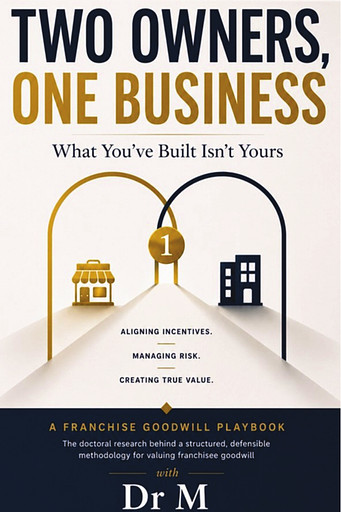
TWO OWNERS, ONE BUSINESS
Who really owns the goodwill in a franchise business?
For decades, that question has challenged franchisors, franchisees, accountants, lawyers, business valuers and the courts. While franchise businesses create billions of dollars in enterprise value worldwide, traditional valuation methods often overlook one critical reality: value is created by two independent business owners operating within a shared commercial relationship.
In Two Owners, One Business, Dr Maurice ("Dr M") Roussety presents a compelling new perspective on franchise goodwill, drawn from original doctoral research and more than forty years of commercial experience. Blending governance, agency theory, corporate finance and business valuation, he introduces a practical framework for understanding how franchise goodwill is created, how risk should be measured and how value can be more accurately assessed.
This book introduces several original models, including the Governance Structure Evaluator™, Franchise Risk Ecology™, Franchise Risk Imputation Model™ and the True Value Model™, providing a structured methodology for analysing governance quality, pricing franchise-specific risk and valuing franchise goodwill with greater transparency and economic rigour.
Written in clear, accessible language, this book is essential reading for franchisees, franchisors, business valuers, accountants, lawyers, lenders, investors, regulators and postgraduate students seeking a deeper understanding of value creation within franchise systems.
Whether you are valuing a business, resolving a dispute, designing a franchise system or simply seeking to understand what drives long-term enterprise value, Two Owners, One Business challenges conventional thinking and offers a practical framework for the future of franchise valuation.
WHAT WE OWE EACH OTHER
Two Siblings, One Family Business, One Inheritance
Bill Tanner spent forty-four years building Tanner Industrial from a rented shed and a secondhand lathe into a business worth eleven million dollars. Three years ago, a valuation confirmed what he'd worked toward his whole career: the business no longer needed him. He could disappear for a month and nothing would blink.
At seventy-four, that success has left him with a harder problem than the one he solved. His business runs fine without him. His family does not.
Sarah has been at the factory by five forty most mornings for fifteen years, holding the entire production schedule together in a whiteboard shorthand only she can read. She built the systems no one else had to think about, solved the crises that never made it into a board report, and never once heard her father say her name at an industry dinner. Daniel left at twenty-six with eleven thousand dollars and a conviction he could build something entirely his own, no family name attached. He did, and sold it four years ago, and still isn't sure the look on his father's face that day ever really left him.
When Bill decides it's time to hand the business to the next generation, he makes one decision that undoes months of careful planning: he calls Daniel first. Sarah finds out second-hand, from a colleague, days later.
What follows is not a shouting match. It's something slower and harder to walk back, a family finally forced to answer a question they've spent decades avoiding: not what the business is worth, but what each of them is actually owed for building it, staying with it, or leaving it behind. Dr M, the valuer who once found nothing fragile in Tanner Industrial, returns to discover that the risk his first assessment eliminated in Bill never disappeared. It simply moved to Sarah, and nobody, including her, ever noticed it happening.
As the family works through what fairness actually means, past contribution against future potential, recognition against risk, inheritance against ownership, the story widens to include a mother whose own forty years of unpaid work have never once been asked about, and a son whose private crisis turns out to be more relevant to the family's future than anyone realized. A structure that looks fair on paper is tested and found wanting before something sturdier, and more honest, takes its place.
What We Owe Each Other is a novel about succession, fairness, and the particular damage that accumulates in families who never learn to say the hard thing out loud. It is the third book in the ThinkIP™ series, following Beyond EBITDA and The Year I Stopped Being Needed, and it stands entirely on its own.
For anyone who has ever built something alongside people they love and wondered what it would take for someone to finally say it counted.
WHEN YOUR AI WORKS FOR SOMEONE ELSE
Who Owns and Controls the Intellectual Property Powering Your Business—and Can a Buyer Acquire It?
You replaced yourself with AI.
The business runs leaner.
Margins have improved.
Fewer employees are required.
Decisions happen faster.
And, finally, the business can operate without you.
For decades, founders have been told that this is exactly how to create a more valuable and sellable business:
Reduce founder dependency. Systemise. Document. Delegate.
Artificial intelligence appears to offer the fastest route yet to achieving it.
But what if you haven't eliminated dependency at all?
What if you've simply moved it somewhere else?
That is the uncomfortable question at the centre of When Your AI Works for Someone Else.
Dr M argues that a business can become dramatically easier to operate while simultaneously becoming more dependent on AI models, vendors, platforms and commercial terms it neither owns nor controls.
And that distinction may remain invisible—until a buyer starts asking questions.
Imagine a founder who has successfully automated customer service, advertising, content generation, scheduling, inventory management or other critical functions.
The resulting earnings are real.
But can those earnings survive a sale?
Who owns the configuration and workflows producing them?
Who controls the underlying model?
Where does the business's data sit?
Can the AI capability be transferred to a buyer?
What happens if the vendor changes its pricing, model, functionality or terms?
Could the business reproduce tomorrow's results if that relationship disappeared?
Those questions expose a distinction conventional financial statements may struggle to reveal:
AI-enabled earnings are not automatically AI-owned value.
The book develops this argument through a modern extension of a much older economic problem—agency theory.
Businesses have always delegated authority.
To managers.
Employees.
Franchisees.
Contractors.
Platforms.
Now they are delegating judgement and increasingly execution to agents that are not human.
AI does not need ambition, greed or self-interest to create an agency problem. Misalignment can arise because the objective an AI system optimises is not necessarily identical to the business owner's intention—and because another party may ultimately control the infrastructure through which that objective is executed.
From there, the book moves from theory to ownership.
It asks whether the business owns merely the output of its AI systems or controls the capability that repeatedly produces that output.
That distinction leads to one of the book's most important ideas:
Founder dependency can become vendor dependency.
And vendor dependency matters because a future buyer is not merely purchasing yesterday's profits.
The buyer is purchasing the ability to reproduce tomorrow's cash flows.
The book therefore introduces the Agentic Dependency and Value Framework, assessing AI-enabled business capability across three headline dimensions:
Capability — how much value AI is creating inside the business.
Independence — how much of that value the business could retain without any single vendor.
Transferability — whether the underlying capability could survive a sale or change of ownership substantially intact.
The analysis then goes further.
Dr M examines how AI-dependent earnings can be classified, how reliability, duration and transition exposure affect their economic character, how AI dependency should be investigated during due diligence, and how identified risks can be reconciled with valuation without simply applying arbitrary discounts.
Importantly, the answer is not to stop using AI.
The manuscript says this explicitly.
AI-enabled functions can create significant operating improvements. The problem is not adoption.
The problem is adopting capability without understanding who owns and controls what makes that capability valuable.
That leads to the constructive final part of the book: Building Value the Business Can Keep.
Rather than arguing that mid-sized businesses should build their own foundation models, Dr M identifies a more practical ownership target: business-controlled configuration, workflows, data, documentation and integrations, even where the underlying AI infrastructure remains licensed from an external provider.
The objective is not technological independence at any cost.
It is commercial control where control matters.
Because the ultimate test of an AI-enabled business is not simply:
Does the AI make us more efficient today?
It is:
If this relationship ended tomorrow, could the business keep producing the result—and does the differentiated capability belong to the business or to someone else?
For founders building with AI, advisers assessing AI-enabled businesses, valuers trying to distinguish earnings from transferable value and buyers conducting due diligence, When Your AI Works for Someone Else presents a new way to think about one of the defining enterprise-value questions of the AI economy:
Your AI may work for your business.
But does your business own what makes it valuable?
________________________________________
BETTING ON ME
When The Founder Is The Brand Who Owns The Value
They weren't betting on the agency. They were betting on her.
For eleven years, Nadia Hollis has built Bright Field into a successful creative agency by doing what every personal-brand expert told her to do.
Become visible.
Become known.
Become the reason clients choose the business.
And it worked.
Clients don't simply want Bright Field. They want Nadia.
When a major new client tells her, “It's you we're betting on,” Nadia hears what should be the ultimate validation of everything she has built.
Instead, the words begin to trouble her.
Because Nadia has created something extraordinarily successful around one central proposition:
She is irreplaceable.
Then a chance conversation leads her to Dr M and an IPAPS™ assessment of the business she believes she understands better than anyone.
What he finds challenges almost everything Nadia believes about what makes Bright Field valuable.
Forty per cent of its revenue sits with one major client on a contract that can be terminated with thirty days' notice.
Important client relationships run through Nadia.
Critical management decisions remain concentrated with her.
And the methodology Nadia has spent years presenting publicly as part of her thinking was substantially developed and documented by Tom Okafor, a senior strategist who has quietly begun taking calls from a competitor's recruiter.
Suddenly, Nadia faces a question she has never seriously considered:
If she is the business's most valuable asset, does that value actually belong to the business?
And another question follows.
Who owns the intellectual property created by the people whose work helped build her reputation?
As Nadia begins examining Bright Field honestly, the problem becomes much bigger than founder dependency.
Tom wants recognition for the framework he helped create.
Priya Chen has been running one of Bright Field's most important client relationships for years—yet is rarely recognised publicly as the person doing it.
Nadia's long-time coach, Renata, has built her own successful methodology around the proposition that founder visibility is the answer.
And Nadia herself must confront something more personal:
Has she built a business—or has she built an extraordinarily successful commercial structure around herself?
The distinction matters because founder visibility is not inherently a weakness.
It can be a genuine competitive advantage.
The problem emerges when personal goodwill and enterprise goodwill become indistinguishable.
A buyer does not simply ask whether the founder is brilliant.
A buyer asks whether the customers will stay, whether the team can perform, whether the intellectual property is actually owned, whether the systems can be reproduced and whether the earnings can continue when the founder is no longer standing in the room.
Through Nadia's increasingly uncomfortable journey, Betting On Me explores the human reality behind four critical IPAPS™ value drivers:
Revenue quality. Founder dependency. Intellectual property ownership. Management capability.
But this is not a story about making the founder disappear.
Nadia does not need to become less talented, less visible or less valuable.
She needs to build something more difficult:
a business in which she remains an asset without remaining the only asset that matters.
That requires giving others genuine authority.
Recognising where intellectual property actually came from.
Separating ownership from authorship and attribution.
Turning undocumented know-how into business capability.
Allowing clients to build relationships with people other than the founder.
And ultimately proving—not merely promising—that the business can function without her.
The transformation is tested in the only way that ultimately matters.
A major client must accept someone other than Nadia.
A senior employee must decide whether recognition and ownership are sufficient reasons to stay.
A pitch must succeed without Nadia leading it.
And Nadia must finally leave the business long enough to discover whether it actually needs her.
Betting On Me is a story about success, ownership and the uncomfortable moment when a founder discovers that the very thing that built the business may also be preventing it from becoming truly transferable.
Because there is a difference between building a business that depends on you...
and building a business that is valuable because of what you created, even when you are no longer there.