 GPI
GPI
Powered by Books.by
GPI
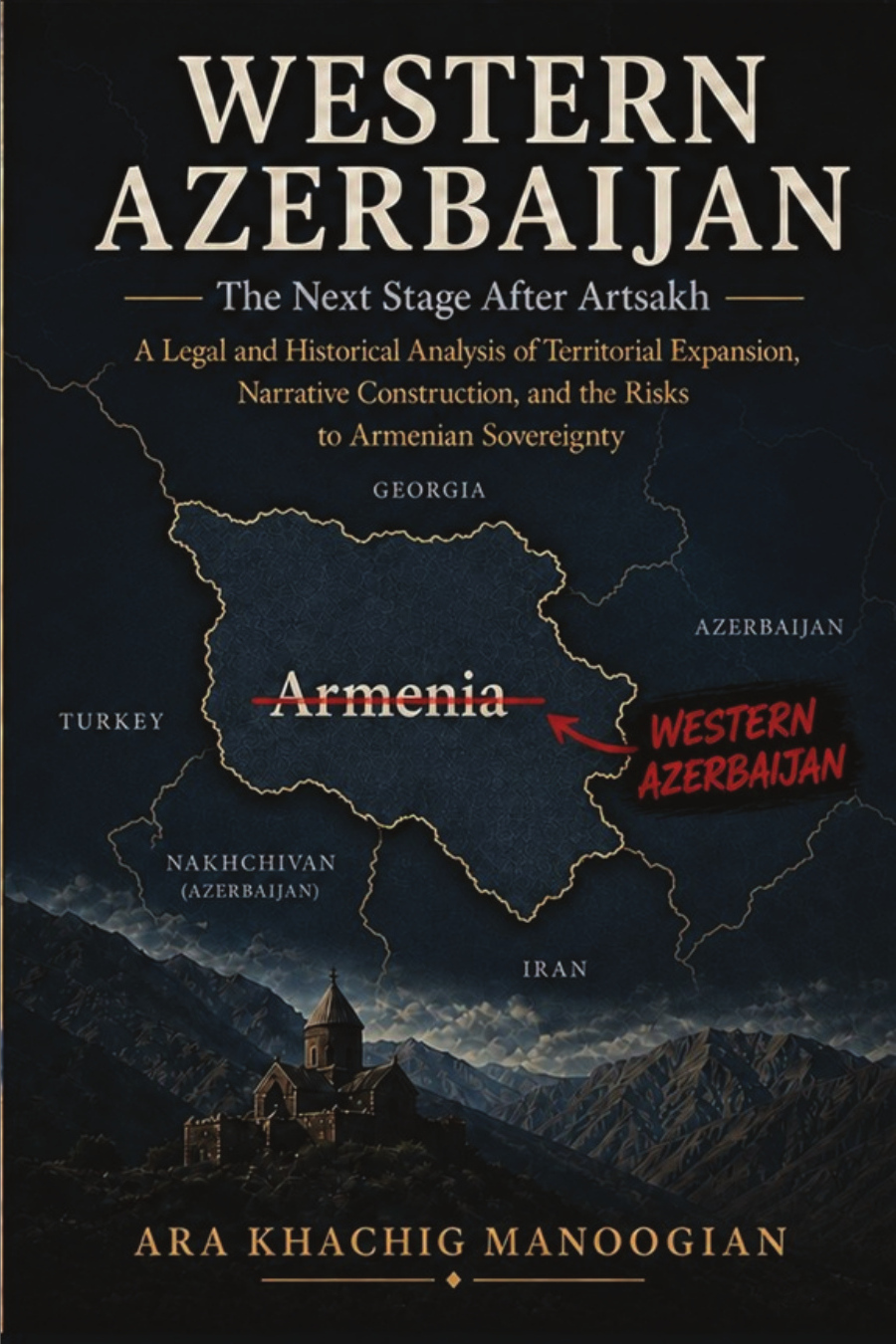
A Legal and Historical Analysis of Territorial Expansion, Narrative Construction, and the Risks to Armenian Sovereignty
by Ara Khachig Manoogian
After the 2023 depopulation of Artsakh, Azerbaijan’s doctrine of “Western Azerbaijan” has turned Armenia itself into a declared target. In this rigorously documented study, Ara Khachig Manoogian traces how rhetoric becomes state policy: from Soviet border engineering and post-Soviet oil and arms networks to cultural erasure, weaponized “return,” and the manipulation of international law. Western Azerbaijan: The Next Stage After Artsakh is both a warning and a record of how narrative can prepare the ground for territorial expansion—and what that now means for Armenian sovereignty.
In 2023, the Armenians of Artsakh were forced from their homes under blockade, bombardment, and a carefully constructed language of “restoring territorial integrity.” That operation is now being treated not as an isolated conflict, but as a precedent. Under the banner of “Western Azerbaijan,” Baku has elevated a previously marginal slogan into a formal doctrine that recasts the Republic of Armenia itself as Azerbaijani land—temporarily occupied, awaiting “return,” and open to future pressure.
Western Azerbaijan: The Next Stage After Artsakh is a legal and historical analysis of how that doctrine works. Ara Khachig Manoogian approaches “Western Azerbaijan” not as a rhetorical irritant, but as an integrated project of territorial expansion, narrative construction, and legal inversion. Drawing on declassified material, Soviet and post-Soviet archival sources, international legal instruments, and decades of first-hand experience in Artsakh, he traces the path by which a slogan becomes policy, policy becomes pressure, and pressure becomes altered reality on the ground.
The book begins by situating “Western Azerbaijan” in the longer history of Armenian presence in the region and the imperial structures that once governed it. It examines how Tsarist and Soviet border engineering, census practices, and administrative language laid the groundwork for later claims, and how the post-Soviet struggle over Nagorno-Karabakh created a laboratory in which new doctrines could be tested. From there, Manoogian follows the story through the 1990s and 2000s—through MEGA Oil and the early post-Soviet arms and logistics networks, through the gradual militarization of Azerbaijan’s position, and through the ways energy politics and external strategic interests helped insulate Baku from meaningful accountability.
At the core of the book is a detailed reading of how narrative is weaponized. Manoogian dissects schoolbooks, museum displays, public speeches, and official reports that systematically recast Armenian presence as temporary, fabricated, or criminal. He analyzes the 2016 Azerbaijani Ministry of Foreign Affairs report on “illegal economic and other activities” in the “occupied territories” as a key example of how legal language, maps, and economic data were combined to portray Armenian life in Artsakh as a web of offenses to be undone. He shows how the language of “settlers,” “plunder,” and “demographic engineering” was used to prepare a wider public to accept blockade, war, and forced displacement as acts of “correction.”
From there, Western Azerbaijan turns to the 2020 war, the blockade of the Lachin Corridor, and the 2023 depopulation of Artsakh as a single sequence rather than three separate events. The book demonstrates how dehumanizing rhetoric, selective use of international resolutions, and the cultivated ambiguity of “peace initiatives” enabled the step-by-step destruction of an Armenian polity under the eyes of institutions that had long claimed to protect vulnerable populations. It documents how international courts issued binding measures that went unenforced, how human rights bodies issued warnings that were effectively ignored, and how the absence of consequence became its own kind of signal.
Crucially, the study argues that the doctrine of “Western Azerbaijan” now extends this method beyond Artsakh. Manoogian shows how the same narrative architecture—historic inversion, weaponized “right of return,” erasure and relabeling of cultural heritage, and the rebranding of pressure as “connectivity” or “normalization”—is being applied to Armenia itself. He examines corridor projects, transit frameworks, and “peace routes” that slice through Armenian territory while advancing strategic goals long articulated by Azerbaijan and Turkey. He situates recent diplomatic developments in a broader pattern: what is first imposed through blockade and war can later be consolidated through agreements presented as pragmatic steps toward peace.
Alongside this structural analysis, the book is also a personal record. Manoogian writes as someone who lived and worked in Artsakh for years, who documented corruption and abuse when it was inconvenient for both Armenian and Azerbaijani authorities, and whose investigations became part of the informational battlefield around the conflict. His vantage point allows him to connect high-level legal and geopolitical developments with lived experience in towns, villages, and institutions that no longer exist in their previous form.
The result is neither a simple chronicle nor a detached legal brief. Western Azerbaijan is a warning, a case study, and an evidentiary record. It offers:
– A rigorous account of how “Western Azerbaijan” emerged from Soviet-era engineering and post-Soviet narrative construction.
– A detailed examination of the MEGA Oil story, arms pipelines, and external complicity in shifting the regional balance of power.
– An analysis of how international law was selectively invoked, inverted, or ignored to legitimize pressure on Armenians in Artsakh and beyond.
– A mapping of the mechanisms of cultural erasure and relabeling now underway in occupied territories.
– A framework for understanding how the precedent of Artsakh shapes the risks facing Armenian sovereignty today.
For policymakers, lawyers, scholars, journalists, and members of the Armenian and broader diasporas, this book provides a meticulously documented structure for thinking about the next phase of the conflict. It insists that what has been done cannot be dismissed as a closed chapter—and that the doctrine of “Western Azerbaijan,” if unchallenged, points directly toward a new stage of danger for Armenia itself.
Joined books.by 9 months ago.
Oil, Law, and the Duty to Resolve the Armenian Genocide -- A Legislator’s Guide To Justice For Armenia
Betrayal Unfinished is a powerful examination of the Armenian Genocide not only as a historical crime, but as an unresolved legal and political reality. Author Ara Khachig Manoogian explores how genocide, territorial dispossession, oil politics, and great-power interests shaped the modern Middle East and Caucasus, and why recognition without remedy remains incomplete justice. Blending history, law, and geopolitics, this book challenges governments, lawmakers, and citizens to confront what obligations follow once genocide has been officially acknowledged.

Tala'at's Execution
A gripping work of historical investigation, this book recounts the dramatic pursuit of Tala'at Pasha after his escape from postwar justice. As the architects of the Armenian Genocide found protection abroad and powerful interests maneuvered behind the scenes, one man refused to let the verdicts of history be ignored. Shahan Natalie, survivor of earlier massacres and mastermind of Operation Nemesis, organized the covert mission that would bring Tala'at to account. Blending political intrigue, hidden alliances, and the desperate struggle for Armenian survival, this book offers a bold and controversial account of justice pursued when nations failed to act.
Genocide And The West's Secret War For OIL!
Betrayal: The Promise Never Kept — Genocide And The West’s Secret War For OIL! exposes the forces behind the Armenian Genocide and the geopolitical struggle for oil that shaped World War I. Drawing from the archives of Shahan Natalie, this volume presents a documented narrative linking global powers, financial interests, and wartime policy to the destruction of 2.5 million Armenians between 1894 and 1923.
This volume includes the censored memoirs of Soghomon Tehlirian and traces the events, decisions, and actors behind one of history’s greatest crimes.
Genocide And The West's Secret War For OIL!
Betrayal: The Promise Never Kept — APPENDIX is the companion volume to the main work, containing the primary source material behind the case.
This volume compiles rare, out-of-print texts, official treaties, government records, and historical documents, including U.S. Congressional material and a full presentation of Armenia’s natural resource holdings. Together, these documents provide the evidentiary foundation supporting the conclusions presented in Volume I.

Exposing the Fear That Rules Us and the Road Every One of Us Must Walk to Be Free
For nearly eighty years, humanity has lived beneath the fear of nuclear annihilation. The Great Lie challenges the narratives that shaped the nuclear age, examining how fear, propaganda, war, and political power transformed modern civilization while offering a roadmap for breaking free from fear itself and reclaiming a future built on truth, reason, peace, and human freedom.
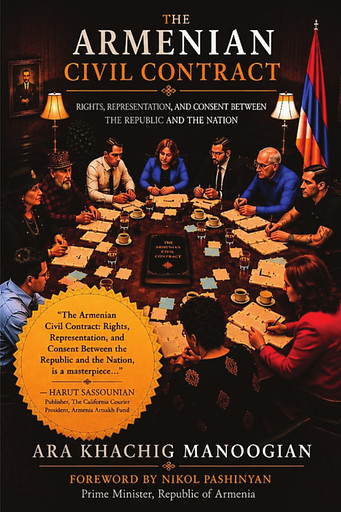
Rights, Representation, and Consent Between the Republic and the Nation
The Armenian Civil Contract explores the relationship between the Republic of Armenia and the global Armenian nation. Drawing on history, international law, constitutional principles, and the Armenian experience, Ara Khachig Manoogian examines questions of sovereignty, representation, diaspora participation, national rights, and consent. At its core, the book asks a fundamental question: who has the authority to negotiate, alter, or surrender rights that belong not merely to a government, but to an entire people? Through historical analysis and contemporary case studies, the book presents a framework for understanding how nations should approach decisions that affect future generations, displaced populations, and the enduring rights of a people.
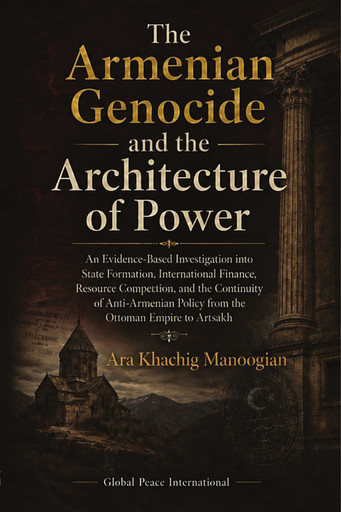
An Evidence-Based Investigation into State Formation, International Finance, Resource Competition, and the Continuity of Anti-Armenian Policy from the Ottoman Empire to Artsakh
An evidence-based investigation into the political, financial, military, and institutional forces surrounding the Armenian Genocide. Drawing on archival records and historical scholarship, Ara Khachig Manoogian traces the destruction and dispossession of the Armenian people from the Ottoman Empire to Artsakh and examines how its consequences were preserved through diplomacy, state formation, and international power.
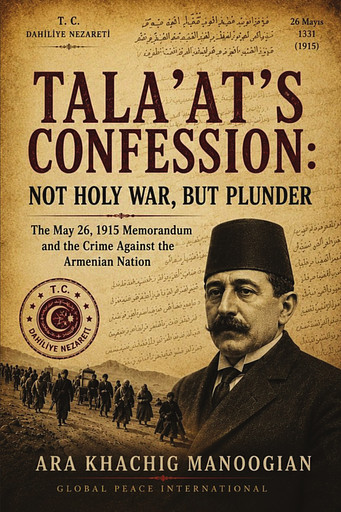
The May 26, 1915 Memorandum and the Crime Against the Armenian Nation
Tala’at’s Confession: Not Holy War, but Plunder presents one of the most important surviving documents of the Armenian Genocide: the Ottoman memorandum of May 26, 1915, authored by Interior Minister Tala’at Pasha. Through documentary analysis and historical evidence, Ara Khachig Manoogian argues that the memorandum constitutes a written confession of a state policy aimed not only at the destruction of the Armenian people, but also at the systematic confiscation and redistribution of their property. The result is a compelling examination of genocide, motive, and organized plunder in the perpetrators' own words.