
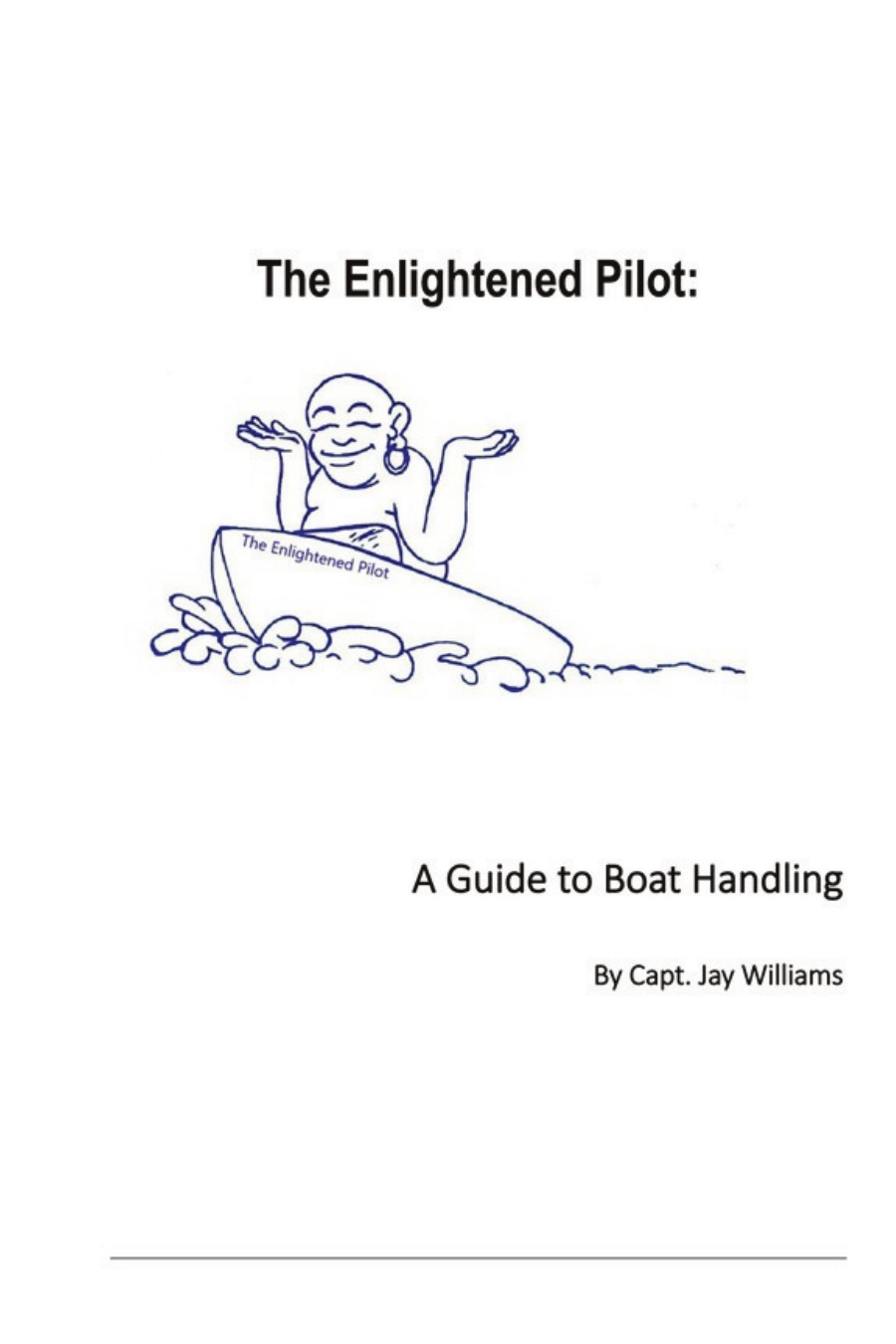
The Enlightened Pilot
by Jay Thomas Williams
The Enlightened Pilot teaches boaters how to take the helm with calm confident control. Through a clear 9-step path, Capt. Jay Williams shows how to read the conditions, handle your vessel safely, and enjoy every moment fully, without fear of costly mistakes. You’ll learn to plan maneuvers and execute procedures that allow boating to be a safe, satisfying experience for you, your crew, and passengers.
Captain Jay Williams, heir to three generations of pilots’ teaching, carries forward his family's loving legacy of nurturing mariners, teaching not only the art and science of boat handling, but the peace and confidence that grows with the communion of pilot, vessel, and environment.
More books by Jay Thomas Williams
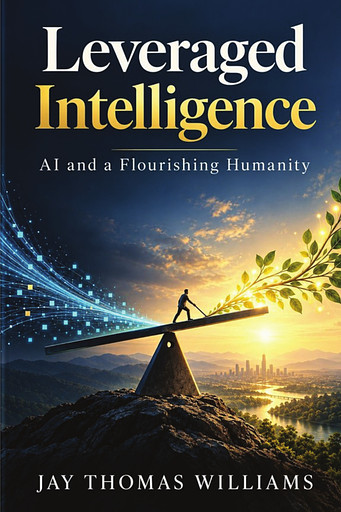
Leveraged Intelligence
AI and a Flourishing Humanity
What might become possible if more people had help asking better questions, seeing new possibilities, and bringing their best ideas to life? As artificial intelligence enters our everyday lives, we have an extraordinary opportunity to expand our capacity to learn, create, and care for one another.
In *Leveraged Intelligence: AI and a Flourishing Humanity*, Jay Thomas Williams invites us to reconsider both the name and the purpose of this powerful technology. Calling it “leveraged intelligence” shifts our attention toward the human possibilities it can help us realize. The change matters because how we name a tool shapes our relationship with it—and the future we imagine. This name keeps human purpose, judgment, and responsibility at the center.
With warmth and clear-eyed hope, Williams explores how we can use AI to broaden our understanding while strengthening our capacity to think for ourselves. Greater capability can amplify our mistakes as readily as our wisdom, making compassion, honest inquiry, and a willingness to correct our course essential companions to technological progress.
A flourishing humanity begins with what we choose to cultivate together. This book invites us to put our growing intelligence in service of lives with greater dignity, deeper connection, and wider possibility. Come and see.
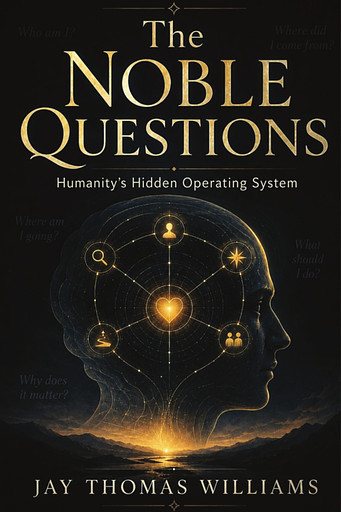
The Noble Questions
Humanity's Hidden Operating System
Why do we keep doing what we do not want to do—and fail to do what we know matters?
Because much of what controls human behavior remains hidden from view.
Beneath every habit, decision, relationship, conflict, institution, and culture lie working answers to five unavoidable questions:
Who am I?
Where did I come from?
Where am I going?
What should I do?
Why does it matter?
We do not have to ask these questions consciously before answering them. Their demands are already operating beneath our awareness. Their answers determine what we notice and overlook, desire and fear, pursue and avoid, protect and permit. They shape what feels possible, necessary, right, dangerous, or beyond question.
Many of these answers were inherited from families, religions, cultures, authorities, wounds, fears, and expectations long before we were able to examine them. Some remain fragmented, contradictory, or no longer suited to the lives we are living.
Nevertheless, they continue to govern us.
The Noble Questions reveals the hidden operating system beneath human behavior. It shows how unseen answers become personal instincts, social expectations, institutional priorities, and cultural realities. What begins beneath awareness eventually controls what we choose—and helps create the worlds we inhabit.
Jay Thomas Williams argues that these five questions are distinct, but the life they organize is one—and that Love, understood not merely as affection but as truthful and responsible participation in relationship, offers a coherent answer to them all.
You are already answering the Noble Questions.
The question is whether you will bring those answers into awareness—or continue allowing them to decide for you.
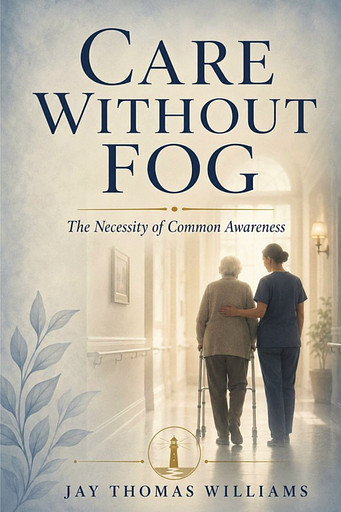
Care Without Fog
The Necessity of Common Awareness
Care Without Fog begins with the painful truth that in senior care, people can be safe enough and still disappear.
A resident may be fed, housed, medicated, bathed, and supervised while her personhood slowly fades from view. Families worry but do not know where to take their concern. Staff notice things the system cannot hear. Leaders manage pressure without seeing the larger pattern. Communities assume someone else is handling it.
Jay Thomas Williams names this condition fog: the partial visibility that keeps sincere care from becoming shared responsibility.
This book is not written to blame families, staff, facilities, churches, boards, or communities. It is written to show why care fails when awareness is scattered, delayed, softened, or blocked. Compassion must have a pathway. Dignity must be visible enough to be protected. Awareness must reach the people who can act.
Care Without Fog is a practical and moral call to build systems that can see clearly enough for public love to respond, correct, and repair.
Love at the Helm
How Compassion Goes Public
The world does not need one more culture-war sermon. It needs a real way to end the war without abandoning compassion, truth, or freedom. Love at the Helm: How Compassion Goes Public makes a practical case for Rapid Collective Awakening: communities learning to grow up and wake up together—without breaking people—before our technology outruns our wisdom.
This is a field manual, not a manifesto—philosophically serious, spiritually grounded, and relentlessly usable. It offers guardrails that keep awakening from backfiring: free inquiry, voluntary honesty, due process, evidence over performance, pluralism, and repair with reintegration.
Williams frames these guardrails as RUDDER—how Love steers in public: Responsibility, Understanding, Due process, Dissent, Evidence, Repair.
Inside you’ll find policies, procedures, and practices—structures—you can adopt in families, churches, workplaces, and towns—plus “receipts” for what works.
Religion Your Way
A Fitting Path
Are you searching for a spiritual path that speaks to you—one that fits your life, your experiences, and your heart?
In Religion Your Way, author Jay Thomas Williams offers a deeply personal and profoundly hopeful guide for anyone longing for clarity, healing, and connection. Drawing from his own journey through hardship, despair, and transformation, Jay shares the tools and insights that helped him rebuild his life, find meaning, and embrace love as the foundation of existence.
This book is for seekers of all kinds-those who feel broken, unsure where to turn, or simply yearning for something more. It's for anyone ready to move past rigid dogmas and embrace a dynamic, living spirituality that integrates ancient wisdom with modern insights.
Through practical exercises, personal stories, and illuminating reflections, Religion Your Way helps you: rediscover hope, even in your darkest hours; build a spiritual framework that's uniquely yours; integrate ancient traditions with modern practices like mindfulness, shadow work, and personal growth tools; explore the power of forgiveness, love, and service to transform your life.
At its heart, Religion Your Way reminds us that healing is always possible, love is always present, and your spiritual path is waiting to unfold--your way.
Whether you're just beginning your spiritual journey or looking for deeper meaning along the way, this book will inspire you to step forward with courage, authenticity, and an open heart.
The End of Childhood
Adult Training For the Rule of Love
You say you want love. But under stress—disagreement, shame, power, consequences—most of us revert to childhood strategies: blame, performance, denial, contempt, avoidance, and scapegoats. Then we repeat the same fights with new names and call it “just how people are.”
The End of Childhood is not a book of inspirational quotes about love. It’s adult training.
Jay Thomas Williams argues that most relational breakdowns aren’t caused by “bad people,” but by undertrained awareness and conditions that reward staying asleep. This book gives you a practical operating system you can run on a bad day:
See → Own → Choose → Repair.
You’ll learn the “Ups” that turn immaturity into adult action—Grow Up, Wake Up, Own Up, Show Up, Clean Up, Build Up, Scale Up—and you’ll get short REP practices you can use in real time: micro-pauses, truth sentences, repair scripts, and forgiveness reps that don’t excuse harm or demand self-hatred.
Religious, secular, religion-wounded, or skeptical—translate the language if you want. The work is the same: tell the truth, take responsibility, choose on purpose, and repair what you damage. No savior fantasies. No ladders. No scapegoats.
If you’re tired of repeating yourself, this is your way out.
The Immature Church
Protective Dishonesty, Nondual Reading, and the Gospel We’ve Been Afraid to Tell
What if the church’s deepest problem is not disbelief, decline, or cultural hostility—but
immaturity?
Many people love the church and still feel exhausted by it. They sense a gap between the gospel’s
promise and the church’s lived reality: between love proclaimed and love practiced, between truth confessed and truth avoided. This book is written for those readers—not to shame the church, but to carefully tell the truth about it.
The Immature Church argues that much of the church’s current crisis comes from a pattern learned long ago: self-protection at the cost of honesty. What once felt pastoral now feels hollow. Half-truths meant to keep people safe have begun to erode trust, spiritual formation, and credibility. The result is a church that struggles to realize its own good news.
Drawing on philosophy, theology, and lived experience, this book offers a clear diagnosis—and a grounded hope. It reframes salvation as participation instead of transaction, forgiveness as practiced repair instead of forced closure, and love as a capacity that must be trained and supported by structure. It invites clergy and laity alike to read Jesus without fear, to face backlash without collapse, and to imagine communities where truth, responsibility, and compassion can become normal.
This is not a manifesto or a program. It is an invitation to stop managing appearances and start honoring reality. An invitation to trust that people are capable of more than dependence. An invitation for the church to grow up—and live up—to the love it proclaims.
If you have ever wondered whether the church could be more honest without losing its soul, this book is written for you.

The Dignity Floor
A Decent Minimum
Society is not judged by its ideals. It is judged by whether ordinary people can afford honesty, responsibility, and repair.
In The Dignity Floor: A Decent Minimum, Jay Williams argues that much of what we call “moral failure” is actually design failure. When people live in chronic threat—one diagnosis away from bankruptcy, one missed paycheck away from eviction, one mistake away from exile—honesty becomes dangerous. Responsibility becomes a trap. Repair becomes rare. People don’t become dependable because they are shamed, preached at, or inspired. They become dependable when reality is livable.
This book offers a practical standard for public life: love is not a feeling we hope for, it is a structure we build. Williams names a three-part design for a decent society:
Dignity Floor + Shared Reality + Repair Lanes
You’ll learn what a dignity floor actually is (and what it isn’t), why shared reality is a public good that must be built on purpose, and how repair lanes make failure survivable without becoming permissive. Along the way, Williams exposes how disposability becomes profitable through extraction, why hoarding is a system outcome, and how communities can install “receipts,” measure what matters, and correct course without scapegoats.
The Dignity Floor is not a partisan manifesto. It is a blueprint for maturity—clear enough to use in a town, a church, a school district, a workplace, or a state.
Because a society that wants truth must make honesty survivable—and the least we owe each other is is something that can truly be built.