 Joe Kidd
Powered by Books.by
Joe Kidd
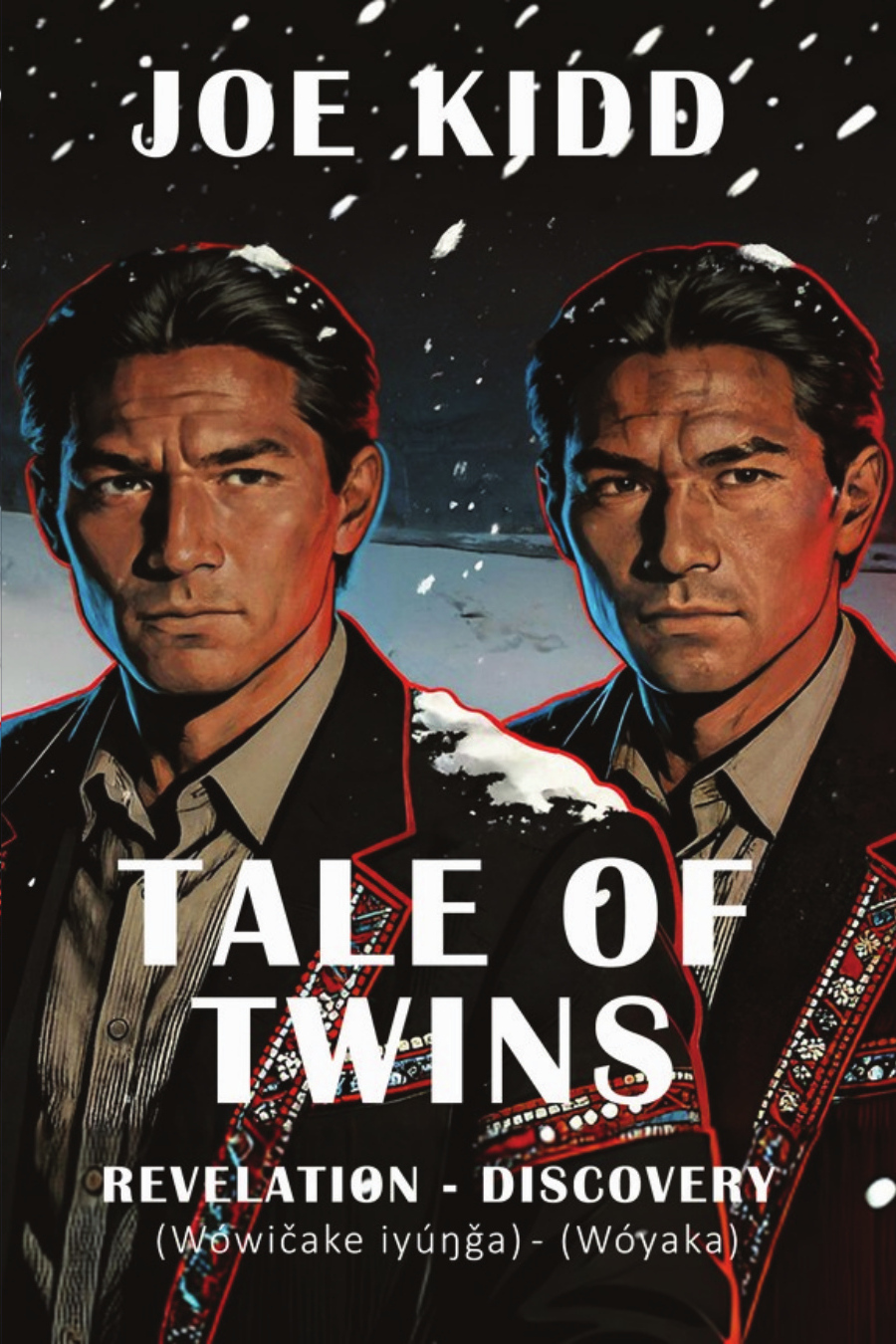
Volume 1 : Revelation - Discovery
by Joe Kidd
Tale of Twins is an epic American novel in three volumes—and counting—rooted in Lakota tradition, Indigenous sovereignty, and one of the most extraordinary premises in contemporary fiction: the discovery, by a Native family who belongs to the land above it, of the largest natural resource find in the recorded history of human civilization. Written under the pseudonym Joe Kidd, the series moves from the intimate emotional territory of siblings making life-defining choices to the vast geological and spiritual territory of an underground world that has been waiting, in its specific patient way, for the right people to find it.
It is a story about what it means to belong to land rather than own it. About what happens when the people who have always been displaced from the center of their own story finally stand at the center of it. About the relationship between what the earth holds and what the people above it are capable of receiving. And about the oldest question of all—one that the second book raises at its close and that will take the full length of the series to answer.
TALE OF TWINS
Publisher's Summary – Volume One: Books One and Two
Joe Kidd, Author
THE STORY IN BRIEF
Tale of Twins is an epic American novel in three volumes—and counting—rooted in Lakota tradition, Indigenous sovereignty, and one of the most extraordinary premises in contemporary fiction: the discovery, by a Native family who belongs to the land above it, of the largest natural resource find in the recorded history of human civilization. Written under the pseudonym Joe Kidd, the series moves from the intimate emotional territory of siblings making life-defining choices to the vast geological and spiritual territory of an underground world that has been waiting, in its specific patient way, for the right people to find it.
It is a story about what it means to belong to land rather than own it. About what happens when the people who have always been displaced from the center of their own story finally stand at the center of it. About the relationship between what the earth holds and what the people above it are capable of receiving. And about the oldest question of all—one that the second book raises at its close and that will take the full length of the series to answer.
THE WORLD
The series is set primarily in rural Kansas, on and beneath a million acres of land that was taken in an 1874 railroad land grant by a German immigrant named Heinrich Braun who believed he was taking farmland. He was not taking farmland. He was taking the rim of an impact crater eight hundred miles in diameter, created when an iron-nickel-lead asteroid sixty-nine miles wide arrived from space at hypervelocity and restructured the geology of a continent. He had no idea. Neither did anyone else—for another hundred and fifty years.
The land passed through three generations of the Braun family, each generation a little more aware of the obligation it carried, until it reached William White Bear—a man of German-Lakota ancestry who spent sixty years trying to answer the question his mother asked him at a kitchen table when he was twelve years old: this is what you have. What are you going to do about it?
William's answer, building slowly across six decades, was to prepare a structure capable of holding whatever the land eventually gave—legal, financial, institutional, relational—and to wait for the people who belonged to the land to be in a position to receive what it offered.
The people he was waiting for were the Lakota family at the center of the series. And the land they belonged to was holding something that no one, including William, had fully imagined.
BOOK ONE – Revelation
Book One establishes the family and the world.
The Prologue establishes the purpose of the novel. The Tale of Twins is a Lakota prophecy about the mending of the “sacred hoop”. The tale involves six sets of twins, all in the same blood line, with the fifth set being the “chosen” to set the table for the mending of the “sacred hoop” by the sixth twin. Our protagonists are the fifth set, they will be parent to the sixth set. The “sacred hoop” is the balance of all peoples in the land. The “sacred hoop” was broken by the invaders and colonizers hundreds of years ago.
Tommy Lakota and TJ Lakota are twins, born in Paradise Kansas under circumstances that the community's elders understand as significant but that take two full books (volume one) to fully reveal. Hana the mother of twins, is three years older—the family's moral center, its healer, the person who holds the others accountable to what they said they believed when the believing was easy.
Tommy is the earth-listener. From childhood he receives information from the land in ways he cannot fully explain and that his grandfather—a man of extraordinary patience and quiet authority—teaches him to trust. His grandfather's central instruction is the spine of the entire series: the earth has been keeping records longer than we have. If you learn to read them, you'll know things no library can tell you. Tommy spends his adult life learning to read them, training in geology at the University of Kansas because he understands that the two languages—the ancestral knowing and the technical science—are not in opposition but are, when held together, more powerful than either alone.
TJ is the reader of rooms. He understands how systems work and, early in his adult life, how to work systems in ways that serve the wrong people. His arc through Book One and into Book Two is the most morally demanding of the three siblings—the long, specific, unsentimentalized process of turning genuine gifts from wrong targets to right ones. He is the most complicated and in some ways the most important of the series' characters because his journey is not from weakness to strength but from misdirected strength to purposeful strength, which is harder and rarer and more honest about how human change actually works.
Hana is the healer. She works in the Sliprock clinic of the Navajoe Indian Health Service with the frustration of a person who sees exactly what her patients need and operates inside a system designed to make providing it as difficult as possible. Her frustration is not despair—Hana is constitutionally resistant to despair—but it is the accumulating pressure of someone who has been apologizing for the failures of a broken system for long enough to understand that the apologies are the problem. The system is the problem. And the system can be replaced.
Book One also introduces William White Bear, whose sixty years of obligation and preparation give the series its structural foundation; Mia, the young Lakota woman whose death from a preventable medical failure is the wound at the center of William's obligation and the ghost that haunts every institution the series builds; and Joseph White Bear, Mia's father, whose forty years of fighting for land rights is the precedent and the inspiration for everything his daughter's moral descendants will eventually accomplish.
The White Buffalo Woman visits Tommy three times in Book One—in dream, in the space between sleep and waking, and once in full waking presence. She shows him a road. She points him in a direction. She does not tell him where it goes, because the destination cannot be understood before the walking has been done.
Book One ends with choices needing to be made.
Book Two begins with the choices made: Hana accepting the Amity Health position and leaving Sliprock with the specific grief of a person who loves the place they are leaving and understands that leaving is the only way to serve it properly; TJ tearing up the Bogota envelope in a parking lot and beginning the long, grinding, unglamorous work of becoming a different kind of man; Tommy spreading a topographic map on a kitchen table at two in the morning and drawing a line twenty-four miles long.
BOOK TWO – Discovery
Book Two opens with the walk.
Twenty-four miles northeast of Walker Air Base, to the intersection of 290th Street and US 281, on foot, with a compass and four liters of water and the accumulated understanding of a man who has spent his whole life learning to read the land. Tommy arrives at the intersection and presses his hands to the ground and knows—in the specific, unmistakable, body-knowledge way that he has been trained since childhood to trust—that this is the place.
What follows is the most significant geological discovery in recorded human history, found by the right people, held within a structure that was built for it before anyone knew what it would need to hold, and managed with the discipline of people who understand that the way you find something determines what you can do with it.
Below the Kansas plain, at approximately 500 meters depth, inside a cavern system that is itself the impact structure left by the asteroid's arrival, the family finds five things:
A freshwater sea—682 miles long, 327 miles wide, with depths approaching five miles at its center, containing 871,000 cubic miles of fresh water. One hundred and fifty-eight times the combined volume of all five Great Lakes. Biologically active. In slow circulation driven by a geothermal upwelling. Home to microbial life that has been evolving in sealed isolation for tens of millions of years. Directly below a region where the Ogallala Aquifer—the sole water source for millions of surface residents—has been dropping at a foot per year and is projected to fail within a generation.
An oil lake—257 miles long, 197 miles wide, 25.2 miles deep—sitting southwest of the sea, connected to it through a dynamic two-mile transition zone, with a ceiling that descends from a thousand feet at its northeastern end to sixty feet at its far southwestern extreme. The ceiling above it is embedded with gemstones—ruby, sapphire, emerald—following the vein network of the formation below in densities that exceed any record in the surface gemstone literature.
The formation itself—the asteroid, the iron-nickel-lead body sixty-nine miles wide and fifty-eight miles long, sitting in the center of the eight-hundred-mile impact basin it created. Its surface at the waterline carries gems and gold. At depth, it carries something else.
Wakantankium—named by Tommy for the great spirit in whose land it was found. A new mineral species. An eighth crystal system, where seven were previously known to exist. A density of 34.7 grams per cubic centimeter, fifty percent greater than osmium, the densest naturally occurring element previously identified. Optical properties that interact with light at the quantum level in ways that existing physics does not fully account for. The discovery within the discovery: not a resource but a door—into physics that has not yet been described, into applications that have not yet been imagined, into a relationship between matter and light that the universe has been expressing in the sealed dark below Kansas for longer than the human species has been asking questions about the physical world.
And the obsidian road—the impact glass floor of the cavern, running thirty miles from the primary access shaft to the base of the formation's cliff face, marked at the twenty-mile section on both floor and ceiling simultaneously by parallel grooves of absolute consistency in spacing and orientation that no natural geological process can produce. The marks were made deliberately. By something precise. In whatever time and by whatever agency remained below the resolution of the available analytical tools.
Dr. Sarah Runningwater, a Diné archaeomaterials specialist, delivers two findings when she descends the road and examines the marks. The first is scientific: they are mechanically produced, intentional, controlled. The second is something else: her grandmother carried a story about a road below the earth and the ones who walked it before memory—the ones before the before—and in the keeper-of-stories tradition, marks on paired surfaces are the signature of paired intention. Left to be found by listeners who would recognize the doubling. The road was marked for earth-listeners. Whatever made the marks expected them.
The question the marks raise—what made them, and when, and why, and what it means that a grandmother's story and a geological formation are telling the same story in different languages—is the question that closes Volume One Book Two. Not answered. Held. By the right people, with the right combination of scientific discipline and ancestral knowing and the specific, earned courage of a family that has been walking toward something without knowing exactly what.
Around the discovery, the institutions rise.
Amity Health opens its doors in a converted antique mall north of Salina, under Hana's leadership, building the health system that Mia designed in her mind and never had the time to build—community-accountable, relationship-based, treating housing and food and safety as medical facts rather than social work footnotes.
First Peoples Bank of Amity opens in the rebranded First National Bank of Minneapolis, Kansas, under TJ's leadership, with an alternative underwriting framework that values community character alongside credit scores and that makes loans to people the conventional system was designed to exclude.
Lakota Spaceport rises from the rehabilitated Walker Air Base, under Kam's leadership, with a runway configuration capable of operating on four compass bearings simultaneously and a near-space operational capacity that draws fourteen letters of intent before the first phase of construction is complete.
Makhá Etáŋhaŋ manages the land—the million acres, the underground world, the agricultural cooperative of 847 leaseback farming families growing 900,000 acres of corn above the underground sea, and the growing city rising eighteen miles north of Lincoln, Kansas.
Amity City, Kansas. Incorporated. Real. A city built above the underground sea, designed from its foundations on the principle that the community governs itself and the land is stewardship rather than ownership, that the underground belongs to the earth and the people are its caretakers.
Book Two closes as it must—in the pattern that has run through everything from the beginning. Hana is expecting twins. Kam is expecting twins. Four more children coming, in pairs, as this family comes. Two things remember each other. The river does not forget its source. The circle deepens.
The oldest question is held.
WHY THIS STORY NOW
Tale of Twins arrives at a moment when the central questions it engages—about land and sovereignty, about water and its future, about the relationship between Indigenous knowledge and scientific understanding, about who gets to determine what happens to what lies beneath the earth—are no longer peripheral concerns but defining ones.
The series offers no simple answers to those questions. It offers something rarer: a fully imagined vision of what it looks like when those questions are engaged honestly, by people with the right combination of gifts and obligations, in relationship to a land that has been keeping records longer than any of them.
It offers the possibility that the earth has been waiting for the listeners.
And that the listeners have arrived.
Tale of Twins will be published in three volumes.
Volume one consists of:
• Book One: Revelation (Wówicakĥe Ečhúŋyapi)
• Book Two: Discovery (Wóyaka)
Volume two consists of:
• Book Three: New Beginnings (Piya Wiconi).
• Book Four: Long Journey (Háŋska Oómani)
Volume Three consists of:
• Book Five: Amity (Mitákuye Oyáśiŋ)
• Book Six: Sacred Hoop Restored (Càgléška Wakà waštḗ)
Books Three through Six are in development.
"The land is patient because it knows the difference between the people who are passing through and the people who belong. It is waiting for the ones who belong."
— Mia, in a letter written three months before her death, opened twenty years later above the underground sea she never knew existed.
— Joe Kidd
Joined books.by 5 months ago.
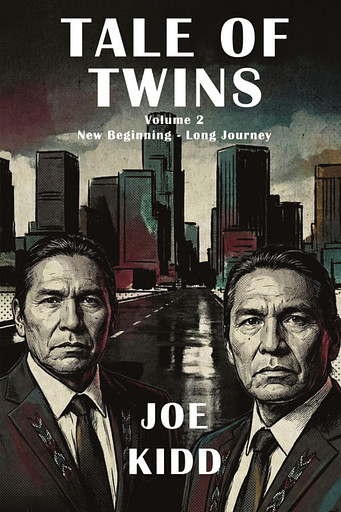
New Beginning – Long Journey
Tale of Twins: Volume Two – New Beginning – Long Journey is the breathtaking continuation of Joe Kidd's epic American saga—a novel of geological wonder, spiritual reckoning, family obligation, and the most extraordinary discovery in the history of human civilization, found by the people who always belonged to the land above it.