
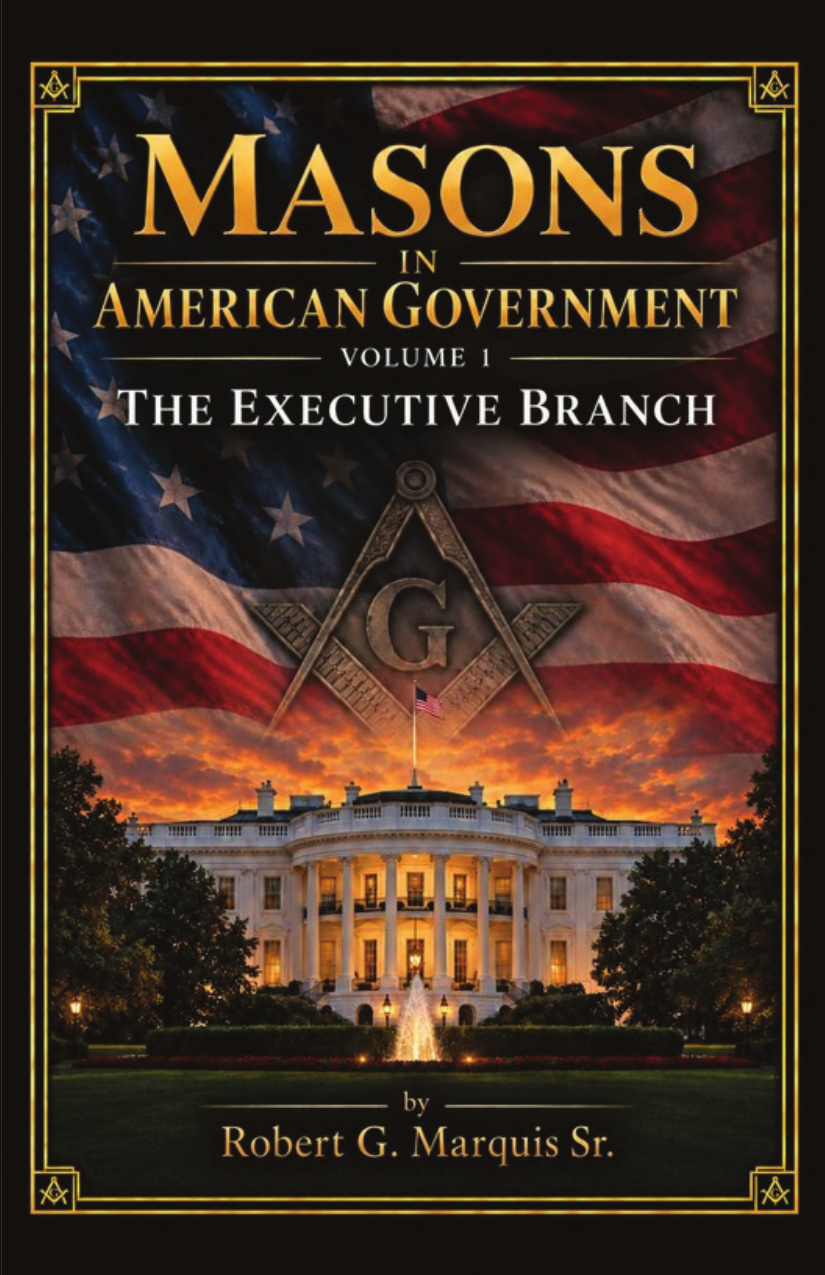
Masons in American Government
by Robert G. Marquis Sr.
Freemasonry and the American government have crossed paths since the earliest days of the Republic. But who among America’s Presidents and Vice Presidents were actually Masons—and what does the historical record really show?
Masons in American Government: The Executive Branch examines the documented Masonic connections of the men who have occupied the nation’s two highest elected offices.
Rather than simply repeating familiar lists of “famous Masons,” Robert G. Marquis Sr. looks at each individual separately, distinguishing confirmed Masonic membership from incomplete degrees, honorary associations, disputed claims, and stories that have grown through repetition.
Along the way, the book explores Presidents such as George Washington, Andrew Jackson, Theodore Roosevelt, Franklin D. Roosevelt, Harry S. Truman, and Gerald Ford, as well as the Vice Presidents whose Masonic histories form another important part of the story.
This is not a book claiming that Freemasonry secretly controlled American government. It is a historical examination of the men, the records, and the Masonic connections that can actually be documented.
For readers of American history, presidential history, and Masonic history, Masons in American Government separates the record from the legend.
More books by Robert G. Marquis Sr.
The Christian and the Storm
Holding to Faith When Life Falls Apart
The Christian and the Storm is a pastoral, scripturally grounded look at one of the hardest questions Christians face: How do we hold on to faith when life hurts?
Robert G. Marquis Sr. does not offer easy answers or shallow promises. Instead, he turns to Scripture and the experiences of people such as Joseph, Job, Moses, Daniel, Paul, Martha, Mary, and the disciples to explore the many kinds of storms that enter our lives.
Some storms are caused by others. Some come because we did what was right. Some are consequences of our own choices. Others seem to have no good explanation at all. There are storms that last for years, storms that arrive one after another, and prayers whose answers may be yes, no, or not now.
Using the King James Version throughout, Marquis addresses suffering with honesty while continually returning to one central truth: the storm does not change God.
Written for individuals, Sunday school classes, ministry leaders, support groups, and small-group study, The Christian and the Storm offers practical encouragement for living faithfully while the storm is still raging—and hope for the life that comes afterward.
The Christian and the Mason
Conflict or Misunderstanding?
Can a committed Christian also be a Freemason?
In The Christian and the Mason: Conflict or Misunderstanding?, Robert G. Marquis Sr. examines some of the most common Christian objections to Freemasonry and considers them from the perspective of both an ordained Christian minister and a Freemason.
From the beginning, Marquis makes one point clear: Freemasonry is not Christianity. It is not a church, it does not offer salvation, and it cannot replace a man’s faith. The real question is whether membership in the Masonic fraternity is necessarily incompatible with a committed Christian life.
The book examines concerns involving prayer, religious tolerance, Masonic obligations, symbolism, secrecy, Scripture, and other issues that have led Christians to question or condemn Freemasonry. Rather than dismissing those concerns, Marquis takes them seriously and distinguishes between genuine theological differences and misconceptions about what Freemasonry actually teaches and practices.
Written for Christians with questions about Freemasonry, Masons who have faced those questions themselves, and anyone willing to examine the subject before reaching a conclusion, The Christian and the Mason invites the reader to consider whether the conflict is real—or whether much of it comes from misunderstanding.
The Christian and the Magician
Faith, Illusion, and the Line Between Them
Can a Christian practice magic?
The answer depends on what we mean by the word magic.
In The Christian and the Magician: Faith, Illusion, and the Line Between Them,
Robert G. Marquis Sr. examines the difference between theatrical magic performed for entertainment and the occult practices condemned in Scripture.
Writing as both an ordained Christian minister and an experienced magician, Marquis explores biblical passages commonly used in discussions of magic, the ethics of deception in performance, and the line between illusion, entertainment, superstition, and spiritual practice.
He also considers the long and sometimes uneasy relationship between Christians and magicians, asking whether illusion on a stage is inherently dishonest—or whether intent, context, and purpose matter.
Rather than dismissing Christian concerns or defending magic without question, Marquis invites readers to look carefully at what Scripture actually condemns, what magicians actually do, and where the real boundaries should be drawn.
The Christian and the Magician is written for Christians with questions about magic, magicians who have wrestled with questions of faith, and anyone interested in understanding where illusion ends and something very different begins.
Robert G. Marquis Sr. is an ordained Christian minister, magician, two-time IBM Ring 161 “Magician of the Year,” and author.
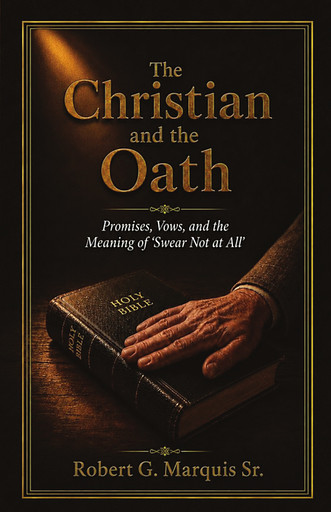
The Christian and the Oath
Promises, Vows, and the Meaning of “Swear Not at All”
Can a Christian take an oath?
Jesus said, “Swear not at all.” James said, “Neither by any other oath.” For many Christians, that seems to settle the question.
But then Scripture gives us Abraham taking an oath, Paul calling God as his witness, God Himself swearing an oath, and Jesus answering when He was solemnly adjured by the living God.
So what does the Bible actually teach?
In The Christian and the Oath, Robert G. Marquis Sr. examines oaths, vows, promises, covenants, affirmations, and obligations from a distinctly Christian perspective. Along the way, he considers marriage vows, courtroom testimony, public service, church covenants, fraternal obligations, promises of secrecy and loyalty, and the difficult question of what happens when someone has promised to do something that is wrong.
The issue is bigger than whether we use the words swear, promise, or affirm. It is about truth, integrity, and whether a Christian’s word can be trusted.
At the heart of the book is one simple principle:
The Christian is not free to promise what the Christian is not free to do.
Because sometimes faithfulness means keeping your word.
And sometimes faithfulness means refusing to give it.