 Shaunacy King
Powered by Books.by
Shaunacy King
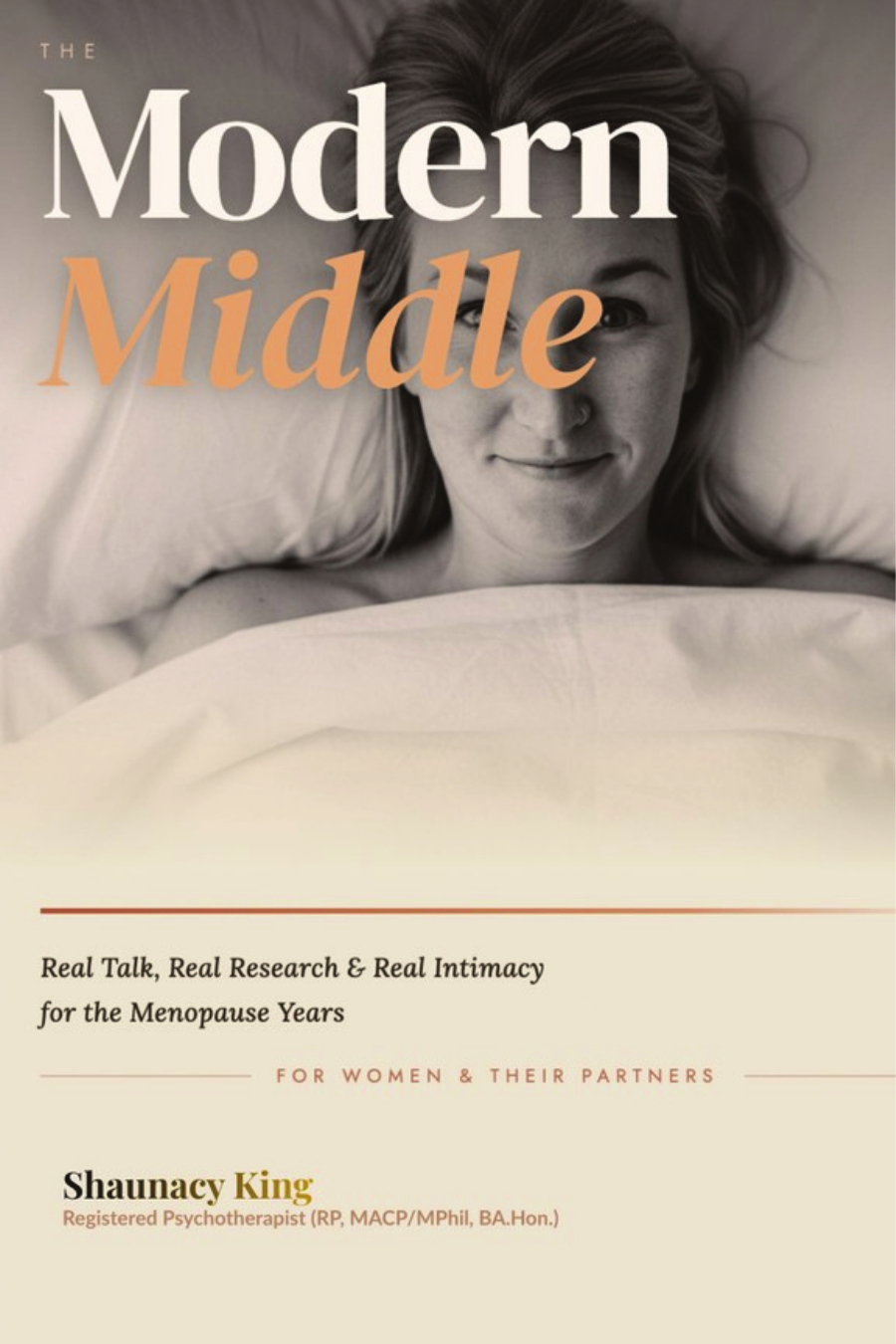
Real Talk, Real Research & Real Intimacy for the Menopause Years
by Shaunacy King
The Modern Middle: Real Talk, Real Research & Real Intimacy for the Menopause Years
Shaunacy King, RP (MACP / MPhil / BA.Hons)
There is a moment — sometimes gradual, sometimes startling — when everything shifts. Sleep that was once easy and deep becomes fitful and elusive. A wave of heat sweeps through the body at 3 a.m. A word evaporates mid-sentence. Emotions arrive with a force that feels disproportionate, even to the person experiencing them. And somewhere in the middle of all of it, a relationship that once felt steady begins to feel unfamiliar — not broken, exactly, but strained in ways that are difficult to name and harder still to talk about.
The Modern Middle is written for the couple standing in that moment. Not just for the woman navigating the menopause transition, and not just for her partner — but for both of them, together, because this is a transition that belongs to the relationship as much as it belongs to the individual.
Written by Shaunacy King — Registered Psychotherapist, Certified Sex Therapist, and Licensed Health Coach — this is not a symptom management manual or a clinical guideline dressed in accessible language. It is a guided workshop: honest, research-grounded, occasionally funny, and built from the ground up on the conviction that couples who navigate the menopause years with shared knowledge, active communication, and genuine curiosity about each other's experience fare dramatically better than those who navigate it alone.
Rooted in Real Research
Every chapter of The Modern Middle is anchored in current, peer-reviewed evidence drawn from the leading edges of neuroscience, sex therapy, relationship science, and women's health. Readers will encounter the groundbreaking neuroimaging work of Dr. Lisa Mosconi at Weill Cornell Medicine, whose PET scan studies produced the first direct visual evidence of how estrogen decline reshapes the female brain — not metaphorically, but measurably. They will engage with Dr. Rosemary Basson's paradigm-shifting model of responsive desire, which permanently changed how sex therapists understand female libido. They will draw on decades of couples research from Dr. John Gottman, whose data on emotional bids and communication patterns predicts relationship longevity with startling accuracy.
The book also draws on the work of influential clinical authors whose writing has transformed how couples understand desire, pleasure, and intimacy: Emily Nagoski's groundbreaking framework for female sexuality in Come As You Are; Nan Wise's neuroscience of pleasure in Why Good Sex Matters; Esther Perel's paradigm-shifting work on erotic intelligence in long-term partnerships in Mating in Captivity; Lauren Fogel Mersy and Jennifer Vencill's inclusive guide to desire differences in Desire; and Lori Brotto's evidence-based case for mindfulness as a genuine clinical tool in Better Sex Through Mindfulness.
Full reference sections at the end of every chapter are not academic window dressing. They are an invitation — to follow the citations, to walk into a doctor's appointment armed with specific studies, to trust that the hope this book offers is not optimism dressed as fact. The science is real. The solutions are evidence-based. And the reassurance is earned.
The Biopsychosocial Lens
At the heart of The Modern Middle is a foundational idea: the menopause transition is a biological event that unfolds in a psychological and social context, and all three dimensions matter equally. Hormone changes are real and consequential — this book does not minimize them. But estrogen decline alone does not determine how a woman experiences this transition. Research consistently shows that relationship quality, communication patterns, cultural beliefs, sleep, stress load, partner support, self-perception, and attitudes toward aging all play significant roles — in some studies, more significant roles than the hormonal changes themselves.
This is the biopsychosocial framework, and it is the lens through which every chapter is written. It is also what makes this book different: the recognition that the person sitting across the table is not a supporting actor in someone else's story, but a full participant in a shared one. The book takes seriously what some clinicians have begun calling "couplepause" — the growing recognition that both partners experience age-related biological, psychological, and relational shifts concurrently and interdependently, and that addressing the needs of one without addressing the other is incomplete at best and counterproductive at worst.
What the Book Covers
Organized in four carefully sequenced parts, The Modern Middle builds from biological foundation to practical toolkit to a broader invitation about identity and the relationship ahead.
Part One — What's Actually Happening lays the groundwork. These four chapters cover the biology and neuroscience of perimenopause and menopause in detail: what is happening hormonally during the transition nobody warned anyone about; the full symptom spectrum, from sleep disruption and hot flashes to cognitive changes and mood shifts that often go unnamed; what partners specifically need to understand about what their person is experiencing and why it matters to them too; and what actually happens to the brain on menopause — mood, memory, mental health, and the neurological mechanisms behind all of it.
Part Two — The Intimacy Shift is the heart of the book. These four chapters address how the menopause transition affects all three dimensions of intimacy — physical, emotional, and communicative — with honesty about the disruptions and with evidence-based tools for navigating them. Here the book takes on desire: what changes, why, and what the research actually says about it — including the distinction between spontaneous and responsive desire that changes everything. It addresses the physical side of sex with frank, practical, solution-oriented guidance. It explores emotional intimacy as the connective tissue of a relationship, and what happens when it begins to fray. And it takes on the conversations that feel impossible but turn out to be the most important ones — what to say, how to say it, and why the research on communication patterns predicts relationship outcomes with uncomfortable precision.
Part Three — Staying Connected translates understanding into action. These four chapters cover what couples can actually do: how to reimagine a sexual relationship that continues to feel alive and satisfying — expansion, not replacement; how to be a genuine ally rather than a well-meaning bystander; which lifestyle strategies actually move the needle on symptoms and intimacy, with the research to back them up; and when and how to bring in professional support — navigating the healthcare system together, finding the right specialists, and knowing the difference between what can be managed at home and what warrants clinical attention.
Part Four — The Bigger Picture lifts the lens from the transition itself to the people it is shaping. These three chapters ask the questions that rarely get asked: Who am I now, in the middle of this? What does identity look like when the things you used to know about yourself no longer fit the same way? What does the relationship you want to build next actually look like — and how do you get there, together? The section closes with a direct letter to both partners: an honest, warm, and unsentimental send-off into whatever comes next.
A Working Toolkit in Every Chapter
The Modern Middle is designed to be used, not merely read. At the end of every chapter, a Workshop Moment offers a guided exercise drawn from evidence-based couples therapy, sex therapy, and communication research. Some take five minutes; some take an evening. Some are completed individually first and then shared; some are done together from the start. All of them are designed to create the kinds of conversations that don't happen naturally — because the topics involved are genuinely difficult to raise without a prompt.
Every one of the book's 14 Workshop Moments is compiled in Appendix D, organized by purpose, for couples who want to work through them as a deliberate standalone series — one per week, or in whatever structure fits their lives.
The back matter extends the toolkit further. Appendix A is a quick-reference guide to the most common symptoms of the menopause transition, organized by treatment tier from first-line self-care through specialist referral — practical enough to bring to a medical appointment. Appendix B is a plain-language glossary of 107 key terms, each cross-referenced to the chapter where it's explored in depth. Appendix C is a curated resource guide covering professional organizations, recommended books, podcasts, apps, online communities, and crisis resources. And Appendix D compiles all the Workshop Moments in one place, indexed by purpose.
Written for Every Couple
The Modern Middle addresses both the woman in the transition and her partner with equal directness, equal respect, and equal commitment to honesty. It is also explicitly written for same-sex couples and LGBTQ+ readers — not as an afterthought, but as a deliberate inclusion. When both partners may be navigating hormonal transitions simultaneously, the dynamics are different, the communication needs are different, and the resources have historically been even more inadequate. Throughout the book, wherever research speaks specifically to LGBTQ+ experiences, it is named directly. The exercises are designed for any couple configuration.
The Promise
This book does not promise that it will make the menopause transition easy. It won't. It does not promise that every couple who reads it will emerge with a perfect relationship and a thriving sex life. Life is not that tidy.
What it does promise is this: you will finish it with a clearer understanding of what is happening and why. You will have language for experiences that may have felt unspeakable. You will have tools you can use, starting tonight if you choose. And you will have real, peer-reviewed evidence that the outcomes of this transition are not predetermined — that the factors that matter most are ones you can influence, and that couples who navigate this transition with knowledge and intentionality fare significantly better than those who don't.
The menopause years are not the beginning of the end. They are a transition. And transitions, navigated with the right information, the right tools, and the right partner beside you, can lead somewhere extraordinary.
The Modern Middle is the companion for that work.
Shaunacy King is a Registered Psychotherapist (RP) in Ontario, Canada, with over twenty years of experience supporting people through some of the most intimate and consequential transitions of their lives.
Her clinical practice, based at Willow Path Therapy in Belleville, Ontario, specializes in sex therapy, sexuality and intimacy concerns, relationship counselling, reproductive and perinatal support, complex trauma, and midlife experiences — with a particular focus on the perimenopause and menopause years. She offers services virtually to clients across Ontario and in-person in the Kingston-Belleville-Peterborough region. Her academic path is as unconventional as the career it produced. Shaunacy holds a Bachelor of Arts (Honours) and a Master of Philosophy from the University of Glasgow, Scotland, where she developed the foundational research skills that would eventually serve a very different purpose. She later pursued doctoral studies in Canadian Studies at Trent University before returning to the clinical path, completing a Master of Arts in Counselling Psychology (MACP) from Yorkville University — where her focus crystallized around trauma, sexuality, reproductive health, and the psychology of midlife. That combination of humanities scholarship, cultural analysis, and clinical training is part of what makes her work distinctive: she brings both rigorous research fluency and genuine warmth to the evidence she translates. Before establishing her psychotherapy practice, Shaunacy built one of Canada's most respected reproductive support organizations. As co-founder and longtime director of Doula Training Canada — a division of The Healing Arts Learning Organization — she trained hundreds of birth and postpartum doulas and childbirth educators across the country and internationally, working with families in Canada, Costa Rica, Ecuador, Tanzania, and First Nations communities. During that decade-plus of reproductive support work, she identified a striking and persistent gap: the perimenopause and menopause transition, affecting millions of women, had almost no equivalent support infrastructure. No trained advocates. No accessible, plain-language education. No equivalent of the doula model that had transformed perinatal care. She set about changing that. The result was the Menopause Doula Program — one of the first formalized support and education programs specific to perimenopause and menopause in the world. The program has since trained practitioners internationally, equipping coaches, therapists, yoga teachers, and wellness professionals with the knowledge and skills to meet women in the menopausal transition with the same quality of informed, evidence-based, humanizing support that had long existed in birth work. This book is, in many ways, the natural continuation of that mission: bringing research-grounded menopause education directly to the women and couples who need it most. In her clinical practice, Shaunacy uses an integrative, client-centred approach drawing on EMDR, Cognitive Behavioural Therapy (CBT), Dialectical Behaviour Therapy (DBT), Narrative Therapy, Emotion-Focused Therapy, and the Gottman Method. She is a member of AASECT (American Association of Sexuality Educators, Counselors and Therapists), ISSWSH (International Society for the Study of Women's Sexual Health), CRPO (College of Registered Psychotherapists of Ontario), CCPA (Canadian Counselling and Psychotherapy Association), and WAS (World Association for Sexual Health). She is also a Certified Health Coach with a specialization in midlife wellness. Her professional experience has been shaped by working alongside clients across the full reproductive lifespan — from first pregnancies to postmenopause — and she carries that longitudinal perspective into everything she writes and teaches. Shaunacy lives in Ontario, Canada with her husband Greg and her two children, Hayden and Norah. She is, by her own account, always in pursuit of a great cup of coffee, an oceanside sunset, and a paddleboard on the open water. She believes in the power of honest conversation to change things — in therapy rooms, in living rooms, and on the page.