 South East Writers
Powered by Books.by
South East Writers
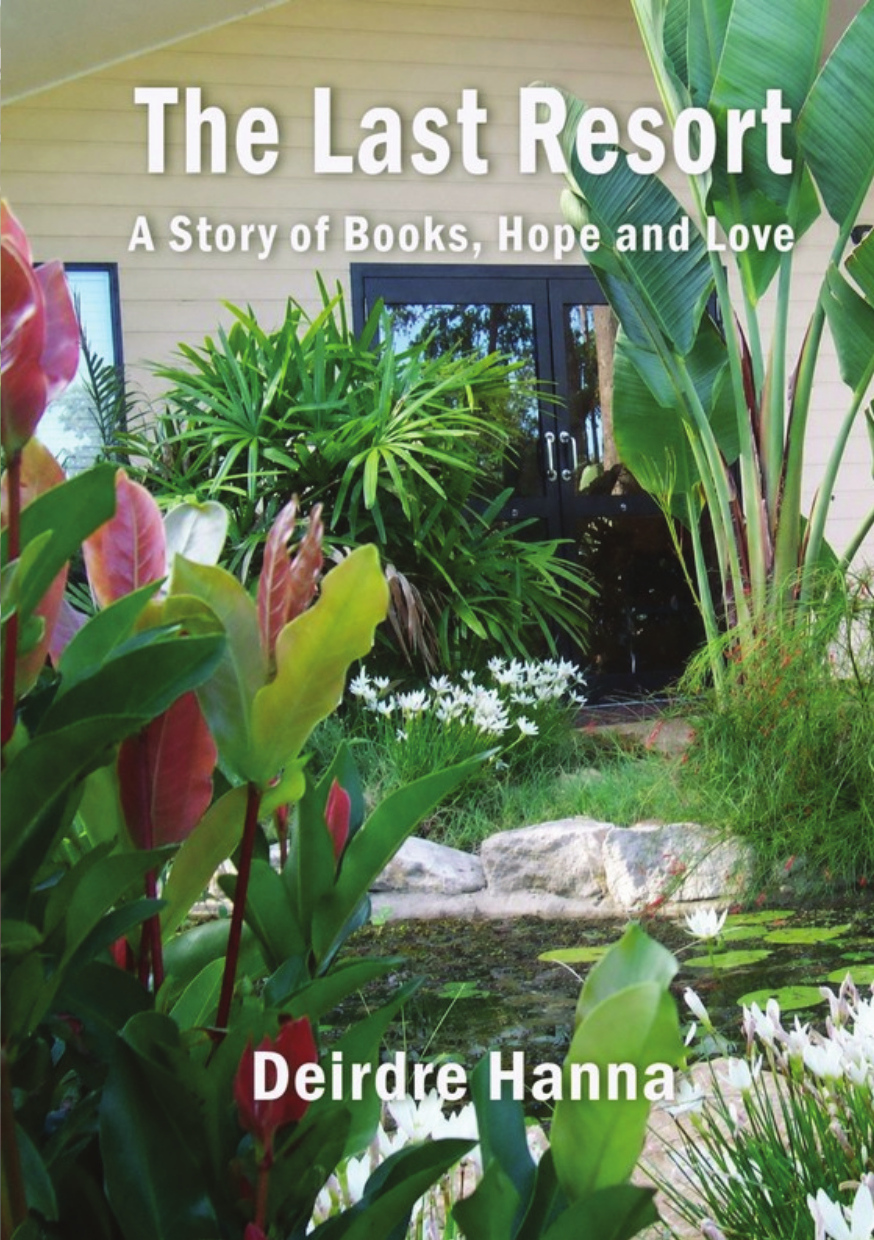
A Story of Books, Hope and Love
by
The Last Resort: A Story of Books, Hope and Love is Deirdre Hanna’s deeply personal account of the ideas, books, dreams, losses and relationships that led to the creation of Hopewell Hospice and Paradise Kids on the Gold Coast. It traces her lifelong fascination with death, spirituality and grief, her own experience with cancer, and the influence of writers and thinkers such as Cicely Saunders and Ken Wilber. At its heart, it is also a love story—about Deirdre, Ian, the people they cared for, and the belief that compassionate care can help people live fully even as they approach death.
The Last Resort: A Story of Books, Hope and Love is a reflective memoir about mortality, spirituality, grief, compassion and the unlikely chain of events that led Deirdre Hanna to help create Hopewell Hospice and Paradise Kids on the Gold Coast. It is not simply the story of founding a hospice. It is the story of how one woman’s lifelong fascination with books, death, faith, dreams and human suffering gradually became a practical vocation.
From the beginning, books are central. Deirdre describes herself as someone who has always lived surrounded by them, often reading several at once and regarding empty surfaces as wasted opportunities for more book storage. That affection for reading is not just a personality trait; it becomes the framework through which she understands her life. Books introduce her to death as a child, console and entertain her during cancer treatment, broaden and challenge her theology, and eventually lead her towards the ideas and people who shape her work in hospice and grief care.
As a child, Deirdre was already unusually preoccupied with mortality. She cried over fictional deaths in The Snow Goose, Anne of Green Gables, Seven Little Australians and Little Women. She was fascinated by dying long before most children—or adults—would willingly discuss it. Even as a teenager, she was capable of reminding school friends over lunch that they were all one meal closer to death, a conversational habit that did little for her popularity. This mixture of humour, curiosity and seriousness continues throughout the book.
That humour is one of the book’s distinctive qualities. Deirdre frequently writes about painful subjects without making the narrative oppressive. Her account of chemotherapy, for example, combines the fear and physical reality of cancer with the comic relief she found in reading Bill Bryson and David Sedaris. She describes developing a lasting aversion to apple juice after drinking it following chemotherapy and refers to the result as “post-traumatic juice syndrome.” The humour does not diminish the seriousness of illness. Instead, it becomes part of the way she survives and makes sense of it.
A major turning point comes through dreams and spirituality. Deirdre recounts a vivid dream in which a voice tells her to “find out about Cicely Saunders.” At that time she had no idea who Saunders was. She soon discovers that Dame Cicely Saunders was one of the pioneers of the modern hospice movement and founder of St Christopher’s Hospice in London. That discovery becomes one of the great organising threads of Deirdre’s life. She begins reading about hospice care, studying chaplaincy and reconsidering what it means to care for someone when medicine can no longer cure them.
The philosophy she develops is simple but profound: when cure is no longer possible, care is still possible. A dying person is not merely a body with a diagnosis. They also have fears, relationships, unfinished business, beliefs, regrets, hopes, families and stories. Deirdre becomes deeply influenced by the idea of whole-person care—physical, emotional, social and spiritual—and by the conviction that dying should not automatically mean being separated from ordinary life.
Her experiences as a hospital chaplain reinforce this belief. She meets patients who do not necessarily need more medical intervention but do need somewhere safe, human and homelike to spend the final stage of their lives. She remembers one young Irish woman dying far from her family who simply wanted somewhere she could live and tell her story. Another important influence is “Auntie Marge,” who desperately wanted to leave hospital and return home but could not manage the stairs. These encounters help Deirdre imagine a different kind of place: not an institution where dying people are removed from life, but a home in which they are allowed to continue living until they die.
That idea becomes Hopewell Hospice.
The practical story of Hopewell is one of the most engaging parts of the book because Deirdre makes no attempt to pretend that she and her husband, Ian, knew exactly what they were doing. They had vision and determination, but very little money and limited experience of the regulations, governance and systems required to run a residential hospice. Ian mortgaged his own home and helped purchase a ten-bedroom property on Hope Island called Glory Farm. Its address was Sickle Avenue—an irony Deirdre is quick to notice.
Hopewell grows through a mixture of faith, persistence, volunteers, community support, fortunate coincidences and what Deirdre sometimes regards as synchronicity. There are periods when finances are perilously tight. One Christmas Eve, with six residents in the hospice and insufficient money to pay nursing wages over the public holidays, a cheque for $80,000 unexpectedly arrives through a bequest from a woman they had never met. For Deirdre, moments like this become part of the mystery surrounding the project: practical needs answered in ways that seem almost impossible.
Yet Hopewell is not presented as an idealised sanctuary. It is lively, unpredictable and sometimes chaotic. Animals become part of hospice life. There is a baby kangaroo sleeping in a cardigan sleeve, a dachshund hiding under the bedclothes of its dying owner, a large black dog sleeping in the kitchen and three Angora goats that repeatedly escape into the neighbouring nursing home and eat the residents’ slippers. Eventually the exasperated matron wheels the goats back to Hopewell in a wheelchair. The goats are eventually replaced by a lawnmower.
These episodes illustrate what Deirdre wanted Hopewell to be: a home rather than a sterile institution. Residents could have pets, family, gardens, music, meals, celebrations and ordinary pleasures. They were not required to become serene or philosophical simply because they were dying. One of the book’s strongest ideas is that hospice care is not about teaching someone how to have a “good death.” It is about allowing them to have their own death.
The book then expands beyond adult hospice care into the creation of Paradise Kids. Again, the seed comes from Deirdre’s lifelong interest in the way children experience death and loss. She recognises that children often understand far more than adults assume, while also experiencing conflicting emotions they may not know how to express. Paradise Kids develops as a program giving children a safe place to talk about grief, death, family breakdown, trauma and loss through storytelling, art, play, body awareness, meditation and other activities.
Deirdre’s own childhood becomes part of this story. She writes candidly and humorously about jealousy when her twin brothers were born, pinching babies, dobbing on friends and her early tendency towards people pleasing. These memories are not included merely for amusement. They help her explain why children need permission to experience complicated emotions without being judged. Grieving children can simultaneously love someone, resent them, miss them, feel relieved, be angry, curious or frightened. Paradise Kids is built around making room for those contradictions.
The memoir also documents Deirdre’s Churchill Fellowship, which enabled her to travel overseas and study spiritual care for people with cancer. She visits hospices and educational centres in several countries, including St Christopher’s Hospice in London, where she finally encounters Cicely Saunders herself. One of the amusingly deflating moments of the book comes when Deirdre, after years of feeling spiritually directed towards Saunders, discovers that Saunders appears entirely unimpressed by her. Deirdre comes to appreciate that the dream does not require validation; what matters is the work Saunders has done.
Other influences include Zen Hospice in San Francisco and Esalen at Big Sur. These experiences broaden Deirdre’s understanding of spiritual care beyond conventional religion. She becomes increasingly convinced that spirituality may be expressed through presence, silence, nature, touch, relationship, music or simply being willing to sit beside someone without trying to fix them. This inclusive approach becomes central to Hopewell’s philosophy.
A major intellectual influence throughout the later sections is philosopher and writer Ken Wilber. Deirdre and Ian become deeply interested in Wilber’s Integral approach, which attempts to understand people and organisations through multiple perspectives rather than reducing them to a single dimension. Deirdre jokingly refers to her long-term enthusiasm for Wilber as “Wilberitis.”
For Hopewell, Integral thinking provides language for something Deirdre and Ian were already trying to do intuitively: see each person as a whole being living within relationships, cultures, bodies, communities and larger systems. Spirituality cannot be separated neatly from medicine, family, psychology, environment or social structures. Ian, in particular, is drawn to Wilber’s maps of human development because he had always been interested in how things fitted together.
The second major part of the book becomes increasingly personal as Deirdre tells Ian’s story. He emerges as a scholar, minister, educator, community builder and practical counterbalance to Deirdre’s dreaming. If Deirdre imagined possibilities, Ian helped turn them into buildings, organisations and programs. She describes him as a man with a large mind, large heart and an unreliable awareness of how much physical space he occupied. He loved books, mountains, maps and ideas but regarded eating largely as an inconvenience—unless pavlova was involved.
Their relationship is not presented as effortless. They encounter criticism from within the church, professional difficulties, conflict and painful transitions. Yet their shared interest in spirituality, psychology, education and human development becomes a foundation for their work together. Hopewell is ultimately presented as something created through their combined qualities: Deirdre’s vision and Ian’s capacity to build.
The emotional centre of the final part of the book is Ian’s illness and death in 2015. Cancer spreads throughout his body, and the man who had helped create a place for dying people eventually becomes a resident there himself. Music from The Blenders, the a cappella group with which he had sung for decades, surrounds him during his final days. Before his death, friends and family organise a This Is Your Life celebration for him so that he can hear what his life has meant to others while he is still alive.
At that gathering Ian looks around at the people present and says:
“Who would have thought that two little kids from the bush could have done what we’ve done?”
The line becomes a kind of summation of their shared life.
Ian spends his final three days at Hopewell and dies on Resurrection Sunday. After his death, Deirdre takes some of his ashes to Assisi, connecting their story once again with St Francis, whom they had chosen as the hospice’s patron saint. Other ashes are scattered in Beaudesert, where Ian grew up, and part of him remains connected to Hopewell.
By the end, The Last Resort has travelled far beyond the story of how a hospice was founded. It has become a meditation on how a life acquires meaning through accumulated experiences—books read at the right moment, people encountered unexpectedly, mistakes, grief, dreams, faith, questioning, illness, laughter and relationships.
The title itself becomes layered with meaning. “The Last Resort” is partly gallows humour, partly a reference to the hospice itself, but ultimately something deeper. Hopewell is not presented as a place where people go because every other option has failed. It is a place where another kind of care becomes possible when cure is no longer the central goal.
The strongest theme in the book is ultimately love.
Deirdre repeatedly returns to the idea that books opened doors for both her and Ian. Books educated them, challenged them, changed their theology, broadened their understanding of spirituality and gave them models for what might be possible. But, as she concludes, books were never the final destination.
Love was.
That is why The Last Resort is simultaneously a memoir, a hospice story, a spiritual journey, an account of grief and a love story. It is about learning that death is not separate from life, that caring for people who are dying can teach us how to live, and that although love cannot prevent death, death does not necessarily have the last word.
South East Writers (SEW) brings together people who share an interest in writing, from enthusiastic amateurs to published authors. Through regular meetings, feedback and encouragement, members work to improve their craft while producing writing across a wide range of genres and styles.
South East Writers Inc. — known as SEW — was established in 2017 with a clear purpose: to educate, support and raise standards in the craft of writing and the broader creative arts. From its beginning, SEW was intended to be more than a social writing group. It was formed as a not-for-profit creative community where writers and other creative people could meet, share ideas, receive constructive feedback and continue developing their skills. The organisation welcomes people from all areas of writing and storytelling, including novelists, memoirists, screenwriters, editors, illustrators, designers and anyone with an interest in creative expression. Its membership reflects a broad mix of experience, from emerging writers to published authors and creative professionals. SEW’s core purpose has remained consistent: to foster a supportive and constructive environment where writers of all levels can grow in confidence, improve their craft and stay motivated. Through regular meetings, workshops, guest author talks, writing programs and general association, members are encouraged to write regularly, exchange ideas, learn new techniques and support one another’s creative development. Since its establishment, SEW has continued to provide a place where creativity, practical knowledge and shared experience can come together. It remains a hub for writers and creatives who value encouragement, honest feedback, skill development and the ongoing practice of storytelling. Check out our website at southeastwriters.org
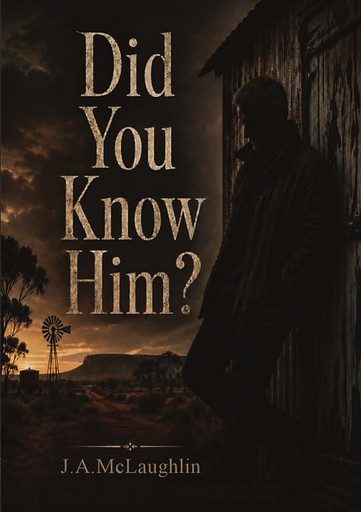
When Tony Quinlan dies while rescuing a woman from floodwaters, those who loved him are forced to confront the man they thought they knew. Through a series of linked stories, Did You Know Him? uncovers the private griefs, buried memories, family wounds and quiet acts of love that shaped one man’s life — and asks whether we ever truly know another person.

A series of short stories by SEW Authors
Voices Unbound brings together a lively collection of short stories from South East Writers, showcasing local voices across memoir, fiction, humour, reflection, drama and imagination.
Each story offers a glimpse into a different mind, memory or world — sometimes funny, sometimes moving, sometimes unexpected, but always personal.
This anthology is a celebration of creativity, community and the simple power of a well-told story.
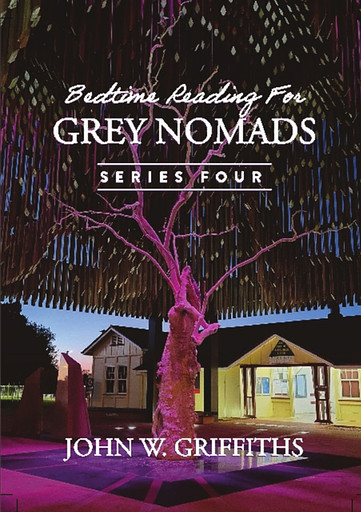
A collection of short stories, some new and some of my favourites
Warm, observant, nostalgic, and unmistakably Australian, this is easy reading for anyone who enjoys a good story, a wry smile, and a reminder that the road still has plenty of surprises left.
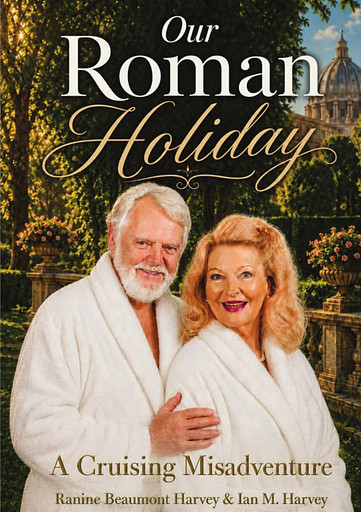
A Cruising Misadventure
When Ranine became seriously ill in Rome, Ian had to navigate the crisis with little Italian, too much luggage, and no real idea what would happen next.
Told with warmth and dry humour, this is a story of love under pressure, kindness in unexpected places, and the strange absurdity of surviving a disaster far from home.
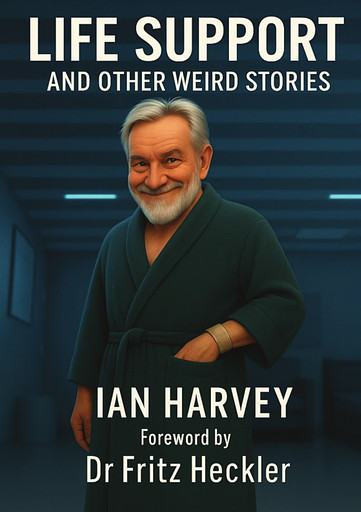
Life, Death, and the Bits In Between That No One Talks About
Life Support is a darkly funny memoir about emergency surgery, ICU, medical indignities, and the strange things that become amusing only after you have survived them.
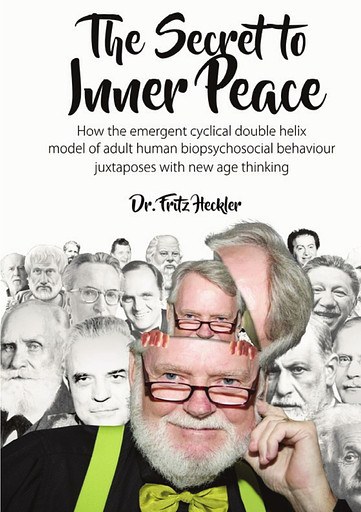
How the emergent cyclical double helix model of adult human bio psycho-social behaviour juxtaposes with new age thinking
The Secret to Inner Peace brings Dr Fritz Heckler’s peculiar wisdom to the serious business of being human, blending humour, psychology and philosophical mischief in a search for calm amid the usual internal chaos.
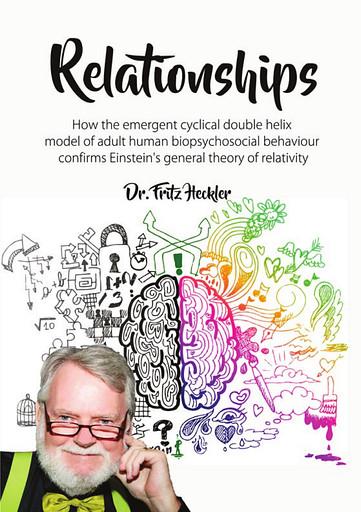
How the emergent cyclical double helix model of adult human bio-psycho-social behaviour confirms the current understanding of Einstein's theory of general relativity
Relationships is Dr Fritz Heckler’s cheerfully questionable exploration of the strange connections that hold the universe — and occasionally people — together. From cosmic entanglement to misplaced car keys, this collection blends quotes, jokes, anecdotes and philosophical mischief into a book that is either deeply meaningful, deeply meaningless, or quite possibly both.