 The Oz Jeff Banks
Powered by Books.by
The Oz Jeff Banks
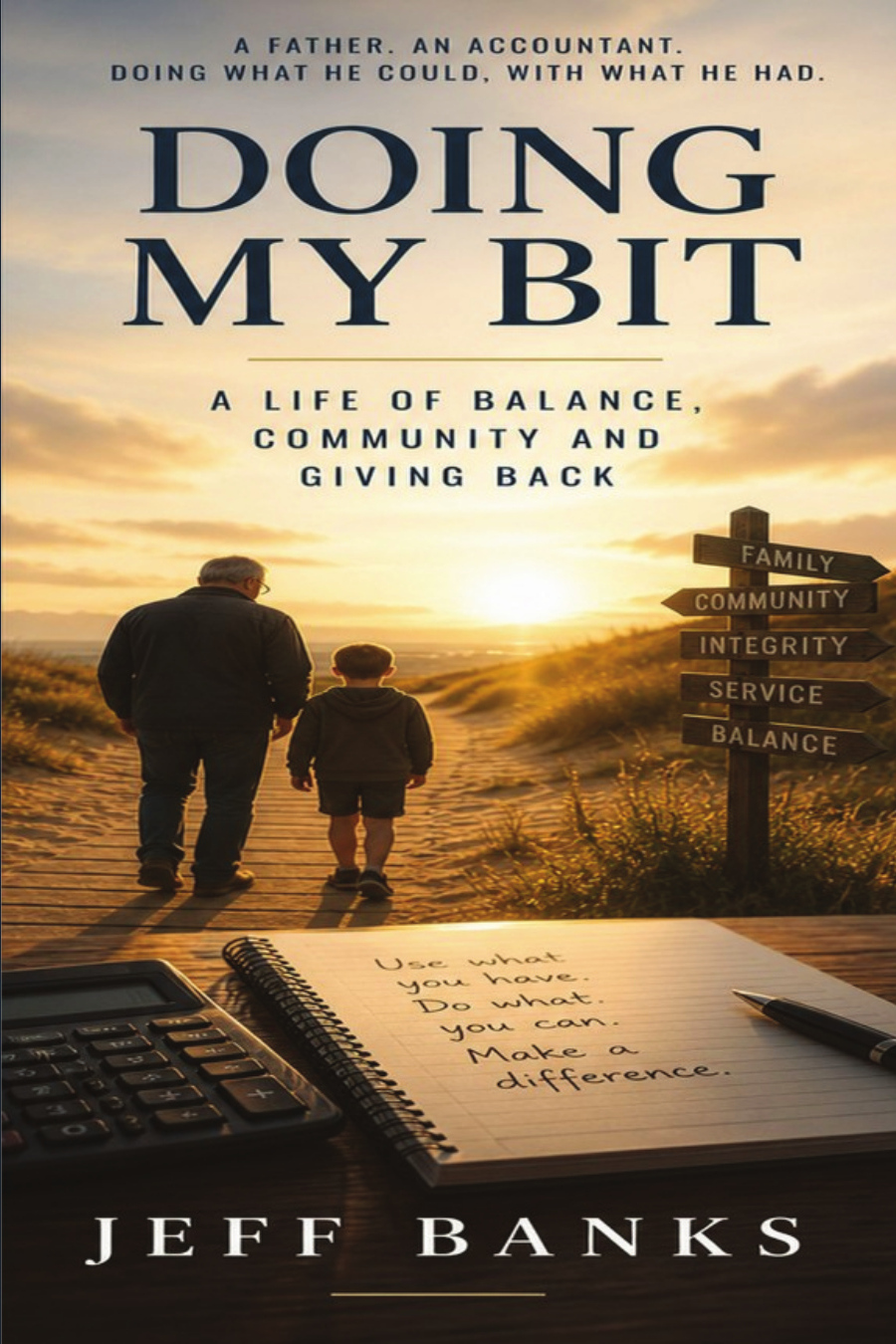
Giving back with what I had
by
A book about being thrust into service without a safety net
Some people give their entire lives to service. Others simply step forward when something needs to be done.
Doing My Bit is a deeply personal reflection on what it means to contribute within the realities of ordinary life, balancing work, fatherhood, responsibility, and the quiet expectations that come with being the person others rely upon.
Written by accountant, advisor, and community contributor Jeff Banks, this book explores the intersection between professional life and personal obligation through stories drawn from school communities, sporting clubs, volunteer organisations, business networks, and family life. It is not a story about heroism or grand sacrifice. Instead, it examines the quieter form of giving that happens in the background of everyday life: the meetings attended after long workdays, the roles accepted because no one else would take them, the systems built so others could simply arrive and participate.
At its heart, Doing My Bit asks a question many people quietly carry: how much of yourself can you continue to give before the balance begins to shift?
Blending reflection, humour, insight, and emotional honesty, Jeff Banks writes not as a polished public figure, but as a father and accountant trying to navigate the tension between service and sustainability, contribution and exhaustion, obligation and choice.
This is a book about practical service, quiet leadership, and the unseen cost of always stepping forward.
Because sometimes giving back is not about changing the world.
Sometimes it is simply about doing your bit.
Jeff Banks is an Australian accountant, advisor, and entrepreneur with more than 40 years’ experience helping small businesses and property investors navigate the practical realities of business and finance. Alongside his professional work, Jeff writes reflective and story-driven books that explore entrepreneurship, community life, and the lessons gathered from decades of working with people and organisations. His writing blends practical insight with personal observation drawn from everyday experiences.
Jeff Banks – Author Jeff Banks is an Australian accountant, advisor, entrepreneur and writer with more than four decades of experience working alongside small businesses, property investors and community organisations. Known for his practical approach to problem-solving and his belief that good advice should be both clear and useful, Jeff has spent much of his career helping people navigate the often complex world of business, tax and financial decision-making. Beyond his professional life, Jeff is a prolific writer whose work blends personal reflection, storytelling and observation drawn from everyday experiences. His books often explore themes of community, leadership, entrepreneurship, resilience and the lessons learned from a lifetime of working with people and organisations. Whether writing about business, life in regional Australia, community projects, or the quieter reflections that come with experience, Jeff’s work aims to capture the small moments that shape larger journeys. Jeff continues to write while gradually transitioning toward retirement, documenting the insights, humour and perspective that come from more than forty years spent helping others build their futures.
Songs, Stages and the Making of My Own Voice
The Words That Formed Me is the story of the poems, performances, characters and songs that arrived long before I understood why they mattered. Some came from schoolrooms and stages, others from radios, records and films, and many settled quietly into the background until life finally provided the experience needed to hear them properly. Together, they became the strange internal broadcast that has accompanied me through childhood, work, family, depression, retirement and the continuing argument between the man who searches for logic and the man who notices everything logic leaves behind.
This is not a collection of song reviews, nor an attempt to explain away a lifetime through borrowed lyrics. It is a memoir about the words that offered courage, comfort, humour and warning, while sometimes misleading me, challenging me or refusing to provide the neat answers their choruses appeared to promise. From Horatius and Hamlet to Leonard Cohen, Paul Simon, Harry Chapin and the songs that questioned war, wealth, justice, loneliness and responsibility, each source becomes a doorway into the life that followed.
At its heart, the book is about finding a voice of my own without denying the voices that helped create it. It examines the Black Dog that still waits nearby, the driven accountant who learned to speak plainly, the logical bystander who keeps asking inconvenient questions, and the stubborn belief that tomorrow may yet contain something extraordinary. The radio in my head is still playing, but I am no longer merely listening. I have finally begun to broadcast.
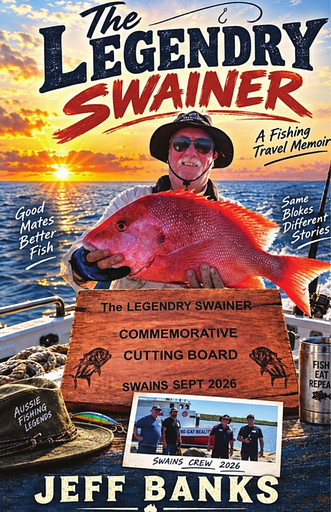
Four Mates, Seven Days and Far Too Much Confidence
The Legendry Swainer
Four mates. Seven days. One fishing trip to Swains Reef. Far too much confidence.
What begins as a week aboard Big Cat Reality quickly becomes something much more than a fishing charter. There are fish caught, fish lost, stories stretched beyond reasonable dimensions, card games treated with unnecessary seriousness and a competition that nobody admits matters until somebody starts keeping score.
At the centre of it all sits the Legendary Swainer Trophy, a piece of timber that somehow acquires the importance of a national sporting title. Trevor, Ian, Steve and Jeff bring different fishing styles, different strengths and remarkably similar levels of self-belief, while the reef has its own ideas about who deserves to succeed.
Warm, funny and unmistakably Australian, The Legendry Swainer is a story about fishing, mateship, rivalry, selective memory and the small absurdities that turn a good trip into one that gets talked about for years. The fish matter, of course, but as the week unfolds it becomes increasingly clear that the best part of the adventure is everything happening around them.
For anyone who has ever gone away with mates, competed over something that supposedly did not matter, or watched a lost fish grow larger with every retelling, this is a story that will feel very familiar.
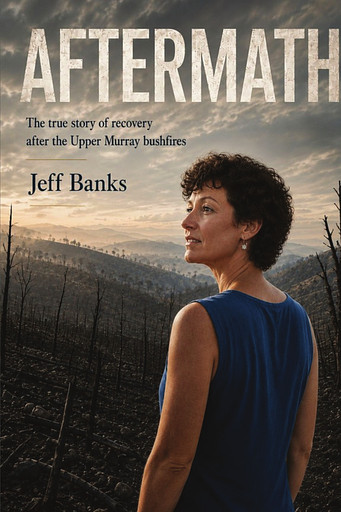
The true story of “recovery” after the Upper Murray Fires
When the Upper Murray bushfires tore through north-east Victoria, the flames were only the beginning. Long after the emergency crews had moved on and the headlines had faded, communities were left facing the slower, harder work of recovery.
Aftermath tells that story through the lived experience of Tracey Farrant, a Council Appointed Disaster Relief Liaison who worked alongside fire-affected families, farmers, volunteers and local communities as they tried to rebuild what had been lost. This is not a detached account of disaster from a distance. It is a deeply human story of blackened hills, exhausted people, government systems, quiet courage, grief, humour, frustration and the small acts of care that help people keep going.
Written by Jeff Banks from Tracey’s memories, reflections and firsthand experience, Aftermath looks beyond the flames to the emotional and practical toll of recovery, both on those who survived the disaster and those who came to help.
Honest, compassionate and unmistakably Australian, this is a tribute to resilience, service and the long road back after fire.
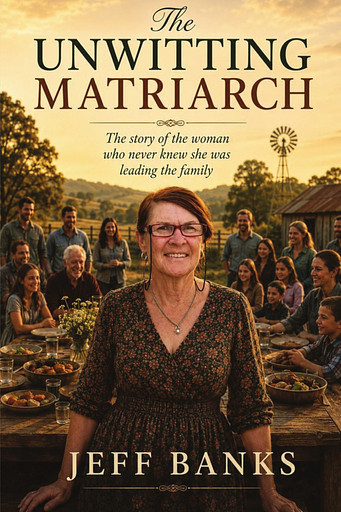
She never asked to lead. She simply never stopped showing up
The Unwitting Matriarch
Kerre never set out to become the centre of a family.
She never sought leadership, recognition or authority. She simply did what needed to be done. She helped when help was needed, answered the phone when others wouldn't, carried burdens without complaint and kept showing up, year after year, decade after decade.
Yet somewhere along the way, something remarkable happened.
Without ever realising it, she became the person everybody turned to.
Through laughter, hardship, family legends, rural Australian life, triumph, grief and countless ordinary moments, Jeff Banks pieces together the story of a woman whose influence was never measured by titles or achievements, but by the lives she touched and the family she helped hold together.
Warm, humorous, heartfelt and deeply Australian, The Unwitting Matriarch is more than the story of one woman. It is a celebration of the quiet heroes found in every family, the people whose greatest legacy is not what they achieved for themselves, but what they gave to others.
Because sometimes the most extraordinary lives are lived by people who never think they are extraordinary at all.
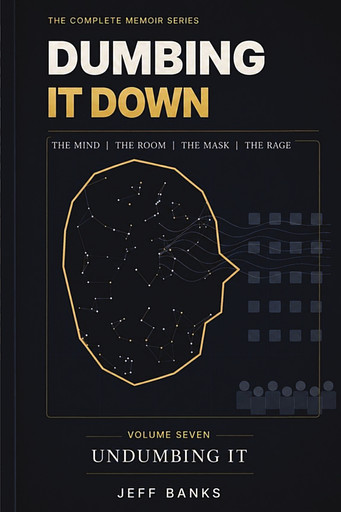
Volume 7 - Undumbing It
Retirement was supposed to bring relief, but when the noise of work began to recede, Jeff Banks found himself facing a more difficult question: who remained when fewer people needed the accountant, adviser and problem-solver? The empty room exposed how thoroughly usefulness had become entangled with identity, and how much of the man beneath the professional mask had been postponed while other people’s problems took priority.
Writing became the way back. By revisiting the isolated boy, the capable student, the sportsman, the rejected pilot, the young accountant, the adviser, the depressed man and the reluctant retiree, Jeff began naming the anger and disappointment that professional restraint had kept hidden. Undumbing himself did not mean proving that he had always been right; it meant refusing to keep cutting every thought, emotion and memory down to the size the room found comfortable.
Undumbing It is the seventh and final volume of Dumbing It Down, bringing together a lifetime of intelligence, conformity, depression, usefulness and rage. It is not a polished story of reinvention or a claim that every old wound has been resolved. It is the honest account of a man finally allowing himself to return to full size, speaking in his own voice and entering the next part of life without first reducing himself for permission.
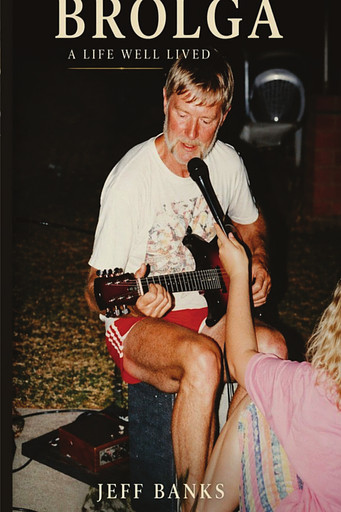
Conversations Beside Galari
Brolga is not simply the story of a man. It is the story of a conversation, unfolding slowly beside the waters of the Lachlan River, where memory rises as naturally as mist off the morning current.
What begins as two men fishing on a quiet riverbank gradually reveals something far deeper: a life shaped by family, hardship, humour, hidden heritage, country towns, sport, music, survival, and the changing face of rural Australia. Through unhurried conversations with his uncle “Brolga,” author Jeff Banks captures the rhythms of a generation that learned resilience not from self-help books or slogans, but from work, community, and the practical realities of everyday life.
Told with warmth, honesty, and a distinctly Australian voice, Brolga moves effortlessly between laughter and reflection. Stories of cricket matches, river camps, shearing sheds, family legends, hidden Aboriginal heritage, country pubs, music, fishing, and bush wisdom combine to create a portrait of a man who never sought importance, yet quietly carried it all the same.
This is a book about the conversations that matter most — the ones that are never planned. The ones that happen beside rivers, around campfires, in sheds, and over long afternoons where silence is allowed to breathe. It is about memory, identity, belonging, and the quiet dignity of ordinary people whose stories are too often left untold.
Richly observational, deeply human, and filled with the dry humour and emotional honesty of regional Australia, Brolga is both a personal family story and a broader reflection on country life, generational change, and the enduring connection between people and place.
Sometimes the most important lives are the ones that never ask to be noticed.
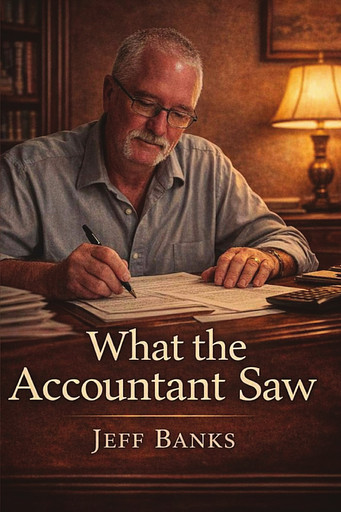
What the Accountant Saw is not an expose or a text book, its more a revelation around and accountant running a practice, with the tagline Not Your Ordinary Accountant and the pressures brought to bear
The Full Book
For most of his life, Jeff Banks became the person others called when the numbers stopped making sense, a business began to fail or a difficult decision could no longer be avoided. He learned to translate complexity, soften uncomfortable truths and remain useful even when his advice was resisted. What remained largely unseen was the cost of continually reducing the full thought to the version the room could tolerate.
From an isolated childhood on a grazing property through school, sport, rejected ambitions, accounting, depression and the uncertain approach to retirement, the same struggle kept returning. Ability could open doors, but it could also create distance, and belonging often seemed to depend upon restraint. Competence became a mask behind which anger, fatigue, loneliness and the constant pressure to fit in could continue without interrupting the work.
Dumbing It Down is not a claim that one man was always right and everyone around him was wrong. It is an honest memoir about usefulness mistaken for understanding, conformity adopted as survival and a mind repeatedly cut down to fit the available space. In writing the story, Jeff Banks makes his first deliberate refusal to keep presenting only the acceptable version, revealing instead the full weight of the mind, the room, the mask and the rage.

Volume 1 - The Boy Who Knew the Answers
Before the accountant, adviser and writer, there was a boy growing up on a grazing property seven miles from the nearest settlement and beyond voice reach of the nearest farm. In that physical isolation, usefulness was noticed more readily than inner life, and a child who could observe, remember and solve problems learned early that being little trouble was its own form of approval.
Primary school appeared perfectly suited to the way his mind worked. Rote learning rewarded memory, order and correct answers, yet beneath the ease of achievement lay the first signs of a lifelong struggle: being right could bring praise, but standing out could also create distance.
The Boy Who Knew the Answers traces the childhood beginnings of Dumbing It Down. It is the story of a capable boy beginning to understand that intelligence does not always produce belonging, and that every answer can carry consequences far beyond the classroom.

Volume 2 - Keep It to a Dull Roar
High school began three months late after mumps removed Jeff Banks while everyone else was learning the rhythms, friendships and unwritten rules of the new world. The orderly certainty of primary school had disappeared, replaced by noise, hierarchy and a classroom where Richard Jones’ instruction to “keep it down to a dull roar” seemed to describe far more than the students around him. It became an early lesson in how a mind seeking clarity must adapt to rooms that operate according to very different rules.
Sport provided an accepted way to stand out, while academic ability required more careful handling. The footballer, cricketer and athlete could belong through performance, but the clever student learned to soften answers, use humour and make his intelligence useful to others. Nowhere was the contradiction clearer than when four of the school’s leading footballers asked him to write economics essays for a subject he was not even studying.
Keep It Down to a Dull Roar follows the moment when thought begins translating itself for acceptance. It explores school, sport, belonging and the gradual discovery that ability can be valued without the person carrying it being fully understood. This is the second volume of Dumbing It Down, the story of a mind learning not merely how to answer the question, but how much of the answer the room is prepared to hear.
Volume 3 - Scoreboards and Near Misses
Some doors open just far enough to reveal the life that might have been. Jeff Banks reached the final stages of selection to become an Air Force pilot, only to have the opportunity disappear after a psychological assessment raised concerns about sleep-talking and sleepwalking. Beneath the dry humour of the rejection sat the loss of a future he had already begun to imagine.
The official scoreboards offered little comfort. An HSC result of 215 out of 500 appeared to define academic potential, even though it measured almost none of the pattern recognition, judgement, resilience and practical intelligence that would later shape Jeff’s working life. As school ended, possibility gave way to necessity, and earning a living became more urgent than discovering what kind of life he might have chosen.
Scoreboards and Near Misses is the third volume of Dumbing It Down, an honest exploration of ambition, rejection and the narrow measurements used to judge a person. It follows a young man whose direction is repeatedly altered by decisions made in examination rooms and selection processes, while the qualities those systems fail to recognise remain quietly intact. This is the story of the doors that closed, the numbers that appeared to explain everything and the life that continued beyond them.
Volume 4 - The Rabbit Hole
Accounting did not begin as destiny for Jeff Banks. It began as a practical doorway into adult life and quickly became an arena filled with human behaviour, ambition, risk, fear and consequences hidden behind numbers. The deeper he travelled into the profession, the more he discovered that the figures were often the simplest part of the story.
As the youngest man in the room, and later a partner at only twenty-five, Jeff learned that early competence could create doubt as readily as respect. Clients wanted confidence, but not too much; quick answers, but not answers that arrived so quickly they appeared careless. He became a translator, turning tax law, business structures and financial chaos into language people could understand without confronting more truth than they were prepared to hear.
The Rabbit Hole is the fourth volume of Dumbing It Down, tracing the transformation of intelligence into professional usefulness. It explores the satisfaction of solving difficult problems, the burden of becoming responsible for other people’s decisions and the gradual merging of work with identity. This is where simplifying complexity becomes part of the job, and where dumbing it down begins to consume far more than the explanation.
Volume 5 - The Rage Behind the Professional Voice
Professional composure can conceal a great deal. Behind the calm accountant and trusted adviser, Jeff Banks carried the growing frustration of dealing with half-informed certainty, ignored advice, avoidable consequences and clients who questioned the value of professional judgement only after the work had been completed. The voice remained measured, even when the internal response was anything but calm.
Years of translating difficult truths into language people could tolerate had created a man who was useful to many but fully understood by few. The Mensa call returns as a symbol of a life in which curiosity was repeatedly pushed aside by obligation, while responsibility for other people’s problems became almost inseparable from identity. Being needed could resemble belonging, yet still leave the person beneath the competence largely unseen.
The Rage Behind the Professional Voice is the fifth volume of Dumbing It Down, exploring advice resisted, value questioned and anger carefully contained behind professional restraint. It is an honest account of the cost of endlessly softening the full thought for the room, and of the dull roar that develops when a person remains dependable long after the price of dependability has become too high.
Volume 6 - The Cost of Fitting In
By the time Jeff Banks had built a successful professional life, usefulness had become both his greatest strength and his most convincing disguise. He could solve problems, carry responsibility and continue functioning when the internal machinery was beginning to fail. To clients, colleagues and family, competence looked like resilience, even when it was little more than depression wearing a business shirt.
Years of adapting to the room had taught Jeff how to soften difficult truths, suppress frustration and provide the version of himself most likely to be accepted. Conformity was rarely a conscious surrender; it was a practical strategy that protected relationships, preserved work and kept the obligations moving. The cost appeared gradually in exhaustion, resentment and the growing uncertainty of whether people valued the man himself or merely the problems he could remove from their path.
The Cost of Fitting In is the sixth volume of Dumbing It Down, exploring depression hidden behind productivity, belonging confused with dependence and the private consequences of remaining useful at almost any price. It is an honest account of a life that continued to function while becoming increasingly difficult to inhabit, and of the moment when adaptation begins to resemble disappearance.
Calling out that we all put up with
How Did We Get Here is not a book about politics, economics, technology, or society in isolation. It is a book about the quiet moments where common sense slowly gives way to momentum, where ideas become accepted simply because they are repeated often enough, and where ordinary people find themselves participating in systems they no longer fully understand.
Written through the eyes of “The Logical Bystander,” Jeff Banks examines the everyday absurdities of modern life with a blend of observation, humour, reflection, and uncomfortable honesty. From boardrooms to barbecue conversations, from government policy to social media outrage, from artificial intelligence to economic theory, the book explores how societies drift away from logic while still believing they remain firmly in control.
Each chapter begins with something recognisable: a conversation, a decision, a process, or an event that at first appears ordinary. Yet beneath the surface sits something larger — a gradual surrender of scrutiny, accountability, and independent thought. What follows is not outrage for the sake of outrage, but a calm and deliberate unpacking of how people, businesses, communities, and governments can slowly move from reason toward reaction.
Blending storytelling with analysis, How Did We Get Here challenges readers to step back from the noise and reconsider the assumptions shaping modern life. It is reflective without being preachy, critical without being cynical, and deeply grounded in lived experience rather than theory.
This is not a book that claims to have all the answers. It is a book that asks whether enough people are still willing to ask the questions.
A book of a Dynasty
The Quiet Magicians is not a history book, a family tree, or a collection of carefully polished memories. It is something far more intimate.
Through a series of deeply reflective and emotionally observant portraits, Jeff Banks explores the quiet forces that shape families across generations — loyalty, resilience, misunderstanding, humour, sacrifice, silence, and grace. These are stories about ordinary people whose lives, when viewed closely enough, reveal something extraordinary.
Told with warmth, honesty, and the insight of someone who has spent a lifetime observing people rather than judging them, the book moves through the branches of a sprawling family dynasty. Relationships shift and evolve. Old wounds linger beside enduring affection. New generations emerge carrying both the strengths and burdens of those who came before them.
Rather than presenting perfect heroes or simple villains, Banks captures family as it truly exists: complicated, contradictory, frustrating, loving, and deeply human. Every chapter becomes a window into an individual life while simultaneously contributing to a much larger story — one about belonging, identity, memory, and the invisible threads that continue to hold people together long after circumstances change.
Written in a conversational and richly narrative style, The Quiet Magicians blends memoir, storytelling, humour, and emotional reflection into a work that feels both deeply personal and universally recognisable.
Because every family has its quiet magicians — the people who somehow keep the whole thing together without ever asking for applause.
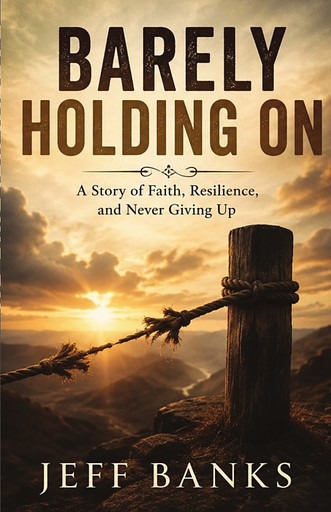
Barely Holding On
What if the things that shaped you were the very things nobody ever talked about?
In Barely Holding On, Jeff Banks takes readers on a deeply personal journey through childhood, family, depression, resilience, and the invisible scars that shape a life. Growing up on a remote property in rural New South Wales, Jeff learns early that survival is often measured not by dramatic victories, but by the quiet determination to endure another day.
Through vivid memories of farm life, family tensions, schoolyard pressures, unspoken expectations, and the ever-present shadow of the Black Dog, he explores how a child learns to navigate a world where love, hardship, responsibility, and fear often occupy the same space.
This is not a story of blame. Nor is it a story of easy answers or miraculous recoveries. Instead, it is an honest exploration of why people become who they are, how generational wounds are passed forward, and how understanding can exist alongside accountability.
Written with warmth, vulnerability, and remarkable insight, Barely Holding On examines the small moments that define us: the night light that keeps the darkness at bay, the chores that teach responsibility, the teachers who offer encouragement, and the memories that continue to echo long after childhood has passed.
For anyone who has ever struggled with depression, questioned their place in the world, carried burdens they could not explain, or simply wondered how others manage to keep going, this book offers something powerful and increasingly rare: recognition.
At its heart, Barely Holding On is a reminder that survival is not always dramatic. Sometimes it is simply the decision to get up, face another day, and keep moving forward.
Because behind every quiet life is a story worth telling, and behind every struggle is the possibility that someone else may finally realise they are not alone.
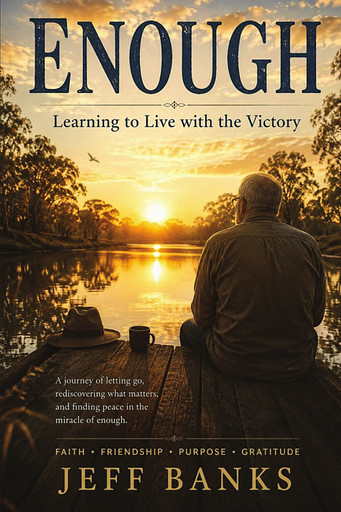
Learning to Live with Victory
Enough – Learning to Live with the Victory
What if the thing you have been searching for all your life was never missing in the first place?
In Enough – Learning to Live with the Victory, Jeff Banks sets out on what appears to be a simple journey to regional New South Wales. There is fishing to be done, family to visit, timber to collect, and old stories to share. Yet beneath the surface lies a far deeper question—how do you find peace when you have spent a lifetime chasing “more”?
As retirement approaches, Jeff finds himself wrestling with many of the challenges familiar to countless Australians: the fear of letting go, the struggle to define purpose beyond work, the weight of responsibility, and the persistent feeling that no matter how much has been achieved, it is somehow never enough. Through conversations with family, friends, and strangers, alongside reflections beside rivers and campfires, he begins to uncover unexpected lessons about friendship, belonging, resilience, and perspective.
Part travel memoir, part personal reflection, and part exploration of life’s deeper questions, Enough is a warm, humorous, and deeply honest account of one man's search for meaning in the twilight years of life. It is a story about family ties that endure across generations, the healing power of country Australia, and the quiet wisdom found in slowing down long enough to see the bigger picture.
This is not a book that promises easy answers. Instead, it offers something far more valuable—the reminder that purpose, friendship, family, and meaning may already be present if we are willing to stop staring at the walls and look up at the landscape beyond.
For anyone who has ever questioned where they fit, wondered whether they have done enough, or searched for happiness just beyond the next horizon, this book offers a gentle and reassuring message:
Perhaps the victory is not in winning the battle. Perhaps the victory is learning to live with the life you have already built.
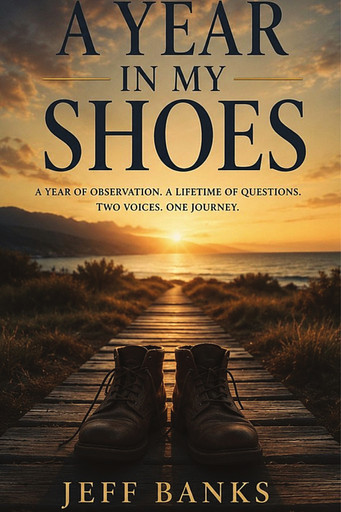
Follow me If You Dare
A Year in My Shoes is not a story about retirement. It is a story about what happens when a man who has spent a lifetime solving problems, building businesses, helping others and carrying responsibility discovers that stepping back is far harder than he ever imagined.
Across twelve months, Jeff Banks invites readers into the realities of life beyond the corporate brochures and retirement fantasies. Through family, friendship, community service, business frustrations, golf club politics, travel, films, music, gardening and the daily battle with the Black Dog of depression, he explores the uncomfortable space between who we were and who we are becoming.
At times humorous, at times confronting, and always deeply honest, this memoir captures the contradictions of modern ageing. It is about purpose when work no longer defines you. It is about finding meaning in ordinary days. It is about resilience, self-doubt, laughter, loss, and the quiet victories that rarely make headlines.
Written with warmth, insight and a uniquely Australian voice, A Year in My Shoes is a book for anyone who has ever wondered what comes next, and whether they are truly ready for it.
Sometimes the greatest journey is not towards something new. Sometimes it is learning to live with the life you have already built.
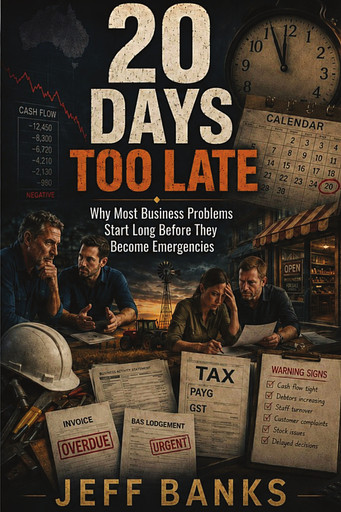
The Business Warnings You Ignore Until They Become Expensive
20 Days Too Late is a practical and deeply human business book about the problems that begin long before they become emergencies. Drawing on more than forty years as an Australian tax accountant and business adviser, Jeff Banks reflects on the patterns he saw repeated across small businesses, family enterprises, farms, trades, investors and professional practices.
This is not an accounting textbook or a taxation manual. It is a book about cash flow, revenue, customers, staff, structures, tax and the uncomfortable warning signs business owners often ignore because they are too busy, too hopeful, or too trapped inside the microcosm of their own existence to hear what their business is trying to tell them.
Written in the voice of a seasoned adviser rather than a guru, 20 Days Too Late reminds readers that the best business owners are not fortune tellers. They simply pay attention, ask difficult questions and act before circumstances remove their ability to choose.
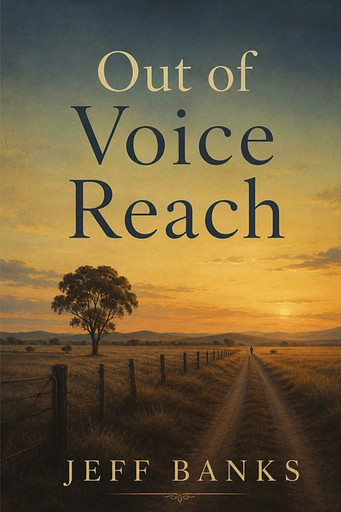
A Life Spent Trying to Belong
Out of Voice Reach is a reflective memoir about distance, belonging, and the quiet emotional patterns that can follow a person long after childhood has ended. Jeff Banks begins with a life on a remote grazing property, seven miles from the nearest settlement and beyond shouting distance of the nearest farm, but the story soon becomes about far more than geography.
From schoolyards and sporting fields to work, business, family, community and the uncertain edge of retirement, this book traces the feeling of being nearby yet somehow outside the circle. It explores how achievement, usefulness and responsibility can become both a source of pride and a convenient hiding place for loneliness, depression and the fear of never quite belonging.
Written in an honest, conversational Australian voice, Out of Voice Reach is understated, thoughtful and quietly humorous, even when it walks through painful ground. It is not a story of complaint or easy recovery, but one of looking back with enough distance to see what was carried, what was survived, and what might finally be understood.
This is a book for anyone who has ever wondered why success did not always feel like arrival. It is for those who have stood close enough to hear the laughter, but far enough away to wonder whether stepping in would be welcomed.

The Little Blue School Book looks at life as an entrepreneur from the outside looking in from the persepctive of an accountant who is also a devotee of the Business Blueprint program
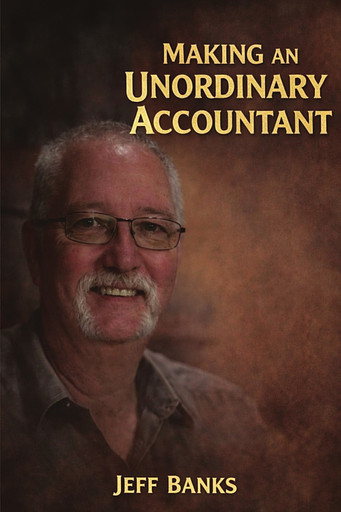
The building blocks of "Not Your Ordinary Accountant"
What happens when the noise begins to fade?
For most of our lives, we measure ourselves by movement. The next meeting. The next client. The next deal. The next obligation. Productivity becomes identity, and somewhere along the way, being busy starts to feel suspiciously like being valuable.
But what happens when that rhythm changes?
This is not a book about retirement in the traditional sense. It is not a financial handbook, a checklist for downsizing, or a glossy promise that life somehow becomes simpler once the alarm clock is retired.
This is a far more honest conversation.
Written with warmth, humour, candour, and the occasional uncomfortable question, Jeff Banks reflects on the strange emotional terrain that sits between full-throttle working life and whatever comes next. Through anecdotes, observations, moments of introspection, and the hard-earned perspective that only decades of business, community involvement, family life, and lived experience can provide, he explores what it really means to slow down without disappearing.
At its heart, this is a book about identity.
About contribution.
About purpose.
About the quiet fear that if we stop doing, we may have to confront who we are without the doing.
It asks questions many think but rarely say aloud. Was all the effort worth it? Does contribution need recognition to matter? What do we owe our families, our communities, and ourselves as life shifts shape? And perhaps most importantly, is retirement an ending, or simply the beginning of a different kind of usefulness?
This is a book for anyone standing at the edge of transition, already in it, or quietly wondering what comes after the version of life they have always known.
Thoughtful, grounded, and deeply human, this is not a roadmap.
It is a companion for the journey.

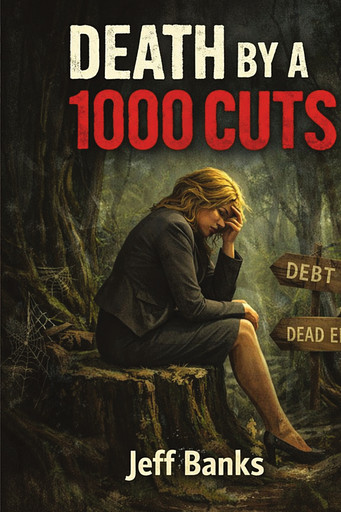
Death by a 1000 Cuts is not a story about a single catastrophic business failure. It is about something far more common, and far more dangerous.
The slow bleed.
The tiny compromises no one notices. The bad advice accepted because it sounded easier. The mentor who inspired but never truly understood. The social media promises that looked like strategy but were little more than noise. The mounting pressure to appear successful while the foundations quietly cracked beneath the surface.
At the centre of this story is Mandy, an entrepreneur who did not fail because she lacked passion, intelligence, or effort. She failed because business collapse rarely arrives as a dramatic event. More often, it comes disguised as optimism, distraction, exhaustion, ego, hope, and denial.
Each poor decision becomes another cut.
Each ignored warning sign allows the forest to grow thicker.
Each well-meaning voice adds confusion rather than clarity.
Written through the eyes of an accountant, advisor, and friend, Death by a 1000 Cuts is both an intimate business tragedy and a brutally honest examination of modern entrepreneurship, where the dream of success is too often sold without equal discussion of the cost.
For business owners, entrepreneurs, advisors, and anyone who has ever felt trapped between ambition and reality, this book offers a confronting reminder:
Sometimes businesses do not die from one fatal wound.
Sometimes they simply bleed out.
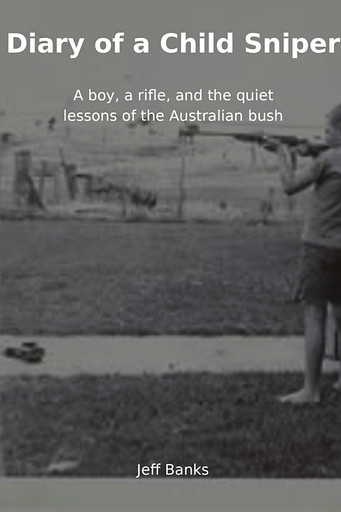
Before he became “Not Your Ordinary Accountant,” Jeff Banks was simply a boy growing up in the wide-open spaces of regional New South Wales.
In Diary of a Child Sniper, Jeff Banks steps away from business, balance sheets, and the adult world to revisit a childhood shaped by the Australian bush, family, freedom, and the kinds of adventures that would make modern parents reach for the smelling salts.
This is not a war story, despite the provocative title. It is a deeply personal memoir of growing up in a different Australia—one where paddocks became playgrounds, imagination was currency, and lessons about responsibility, independence, danger, and consequence often arrived long before adulthood.
With humour, honesty, and the reflective eye of a storyteller looking back across decades, Jeff explores the experiences that shaped the man he would become. Along the way, readers are invited into a world that feels both unmistakably Australian and increasingly lost to time.
Diary of a Child Sniper is a memoir about childhood, memory, resilience, and the strange, formative moments that quietly define us long before we understand their significance.
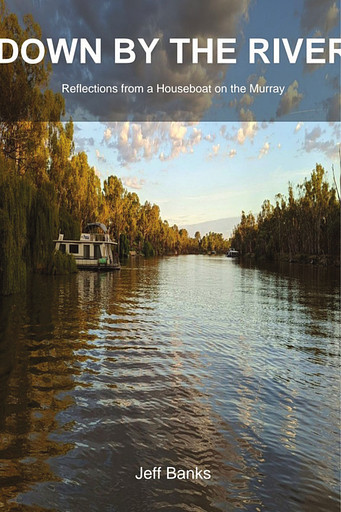
Down by the River is not a travel guide, nor is it simply a memoir. It is a journey through the bends and backwaters of the Murray River, where a houseboat holiday becomes something far richer than time away.
With Jeff Banks’ trademark blend of humour, observation, nostalgia, and hard-earned reflection, this book drifts between the practical realities of small business owners who can never quite switch off, the camaraderie of lifelong friendships, family stories that surface unexpectedly, fishing tales both triumphant and ridiculous, and the quiet moments that only a river seems capable of extracting.
From storm fronts rolling across the Murray to lazy afternoons at wineries, from the absurdity of battling endless carp to memories triggered by the Australian landscape, Down by the River captures something uniquely familiar to anyone who has ever set out for a holiday only to discover the real journey was happening internally.
Warm, conversational, and deeply Australian in its soul, this is a book about mateship, ageing, memory, resilience, and the strange way stillness can make us confront the things we usually outrun.
If you’ve ever found peace near water, laughed at life’s absurdities, or wondered whether retirement really means slowing down, this book will feel like sharing a drink with an old friend who always has one more story to tell.