 WESAM SALEH | W.S.
Powered by Books.by
WESAM SALEH | W.S.
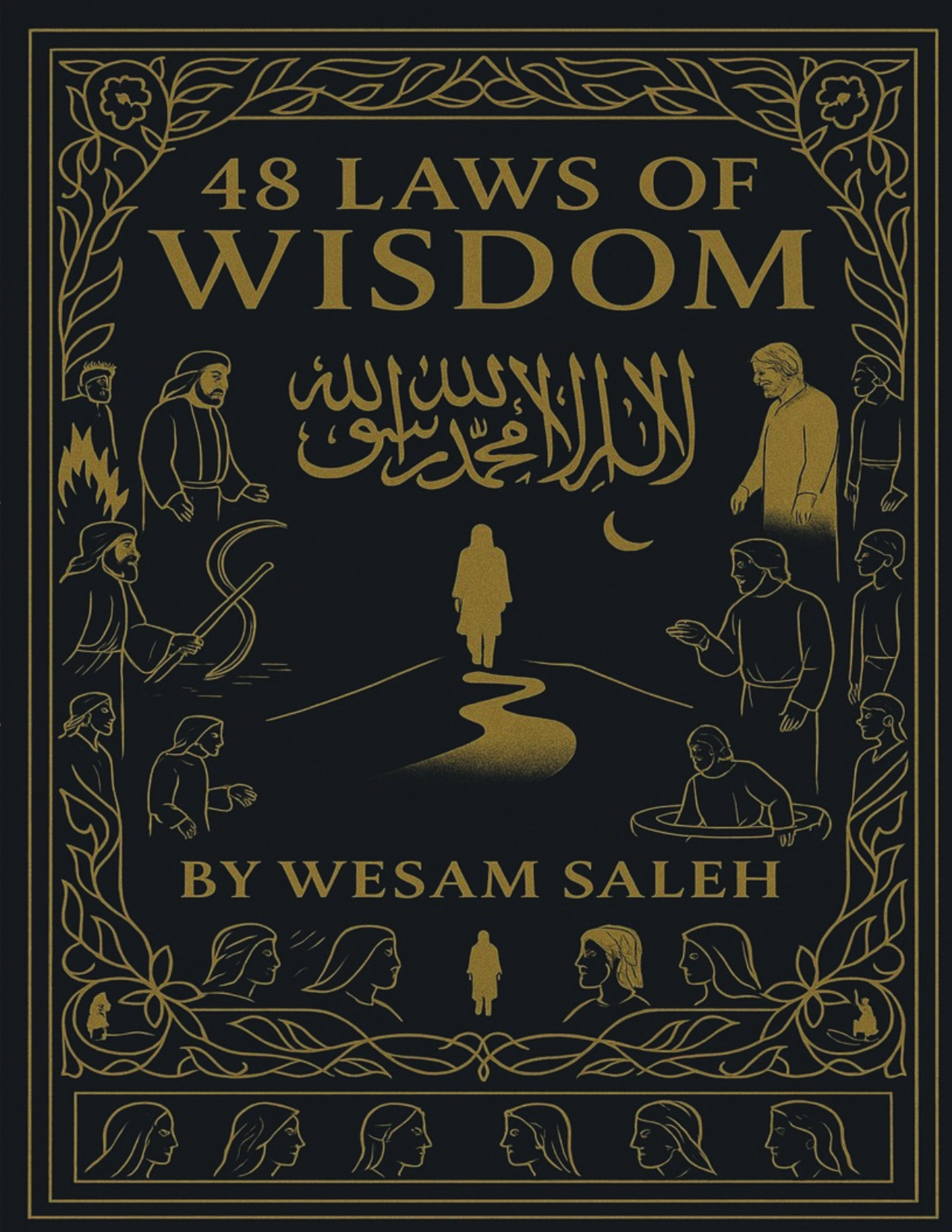
By Wesam Saleh – Inspired by the Prophets: Their Trials, Triumphs & Timeless Teachings
by WESAM SALEH | PHARAOH W.S.
A SALEH | OAI PRODUCTION
The Genesis of a Counterweight The 48 Laws of Wisdom was forged in the crucible of personal trial and relentless intellectual pursuit. Its author, Wesam Saleh, spent formative years transforming recovery from injury into a polymathic education across politics, economics, technology, and moral philosophy. The seminal spark ignited at age sixteen, when he was given Robert Greene’s 48 Laws of Power. He recognized its strategic mastery but also its profound incompleteness. Informed by a deep study of prophetic teachings, he understood that power alone is a dangerously one-sided coin. This book is the other side—the essential counterweight that has been missing for a generation of strategic thinkers.
More Than a Sequel: An Integrated System This work is not merely a philosophical companion or a collection of aphorisms. It is a meticulously engineered system for living. The book opens by establishing its foundational "Why"—"Why the Prophets?"—and frames itself as "A Weapon – But Not of War," designed for a specific reader seeking meaningful mastery. It provides clear Reader’s Guidance and a Framework of Divine Wisdom before presenting its core: the 48 Laws of Wisdom, supplemented by Bonus Laws. Each law is explored not in isolation, but through a multi-lens apparatus that includes Prophetic Principles, psychological impacts, and illustrative Marginalia.
The Architecture of Evidence and Application What truly distinguishes this volume is its empirical and analytical backbone. It contains a full Expert Investigation Report on the scientific and social impact of implementing these laws, and a detailed Comparative Analysis titled "Wisdom Beyond Power," which directly and respectfully engages Greene's work to complete the intellectual coin. This is supported by a rigorous Evidence Map linking Laws to Constructs, Outcomes, and Metrics, and validated by an Expert Partner Review. The book is structured as a practical manual, featuring a Glossary of Key Terms, a Master Index, and a detailed guide on How to Read and Apply Them.
The Complete Volume The journey concludes with Closing Insights, a Dedication that balances the divine, the prophetic, the personal, and the reader, and is capped by comprehensive scholarly apparatuses including a Selected Bibliography and Index. The 48 Laws of Wisdom is, therefore, both a timeless moral compass and a modern toolkit. It answers the critical question left unaddressed by treatises on power: How should the soul move within the world once it understands how the world moves? This is its mission—to provide the inner architecture for a life of influential, purposeful, and balanced power.
Over the past four years, I dedicated myself to writing the other half of that coin—The 48 Laws of Wisdom. While Greene’s work explores strategy, influence, and the mechanics of power, my work turns toward inner development, ethics, and higher understanding. It asks not only how power works, but how it should be guided. Rooted in prophetic teachings, moral principles, and the lessons of hardship and recovery, it emphasizes character, balance, responsibility, and the alignment of intellect with conscience.
Together, the two perspectives form a complete view of human striving: power explains how the world moves, while wisdom explains how the soul should move within it. My first edition of The 48 Laws of Wisdom now invites readers to walk that full path — strength with conscience, ambition with meaning, and power guided by wisdom.
Robert Greene’s The 48 Laws of Power focuses on strategy, influence, and the mechanics of power in human relationships and institutions. It studies history’s rulers, diplomats, generals, and courtiers to show how power is acquired, defended, and exercised. The book emphasizes realism, human nature, and the often-cold logic of strategy, highlighting how people compete, manipulate, and position themselves in the world.
Wesam Saleh’s The 48 Laws of Wisdom completes the other half of the picture. While acknowledging the reality of power dynamics, it turns toward inner development, ethics, and higher understanding. Rather than only asking how power works, it asks how power should be guided. This work draws from prophetic teachings, timeless moral principles, and lived experience through hardship and recovery. It emphasizes character, balance, responsibility, and the alignment of intellect with conscience.
In contrast
1. Greene writes about power as an external force; Saleh writes about wisdom as the inner compass.
2. Greene’s laws teach how to win in the world; Saleh’s laws teach how to live with meaning while doing so.
3. Greene documents historical strategies; Saleh focuses on moral insight, self-mastery, and higher purpose.
4. Greene shows how to navigate ambition; Saleh shows how to elevate ambition with guidance and restraint.
Greene writes about power as an external force, while Saleh writes about wisdom as the inner compass. Greene’s laws teach how to win in the world; Saleh’s laws teach how to live with meaning while doing so. Greene documents historical strategies; Saleh focuses on moral insight, self-mastery, and higher purpose. Greene shows how to navigate ambition; Saleh shows how to elevate ambition with guidance and restraint.
Together, the two works form a complete coin. Power explains how the world moves — wisdom explains how the soul should move within it.
Law Title – encapsulates timeless principle.
Judgment – universal moral reasoning.
Observance – proof through application.
Transgression – consequences of its violation.
Interpretation – philosophical deconstruction.
Keys to Wisdom – distilled essence.
Reversal – balance between extremes.
Prophetic Example – Qur’anic, Biblical, or historical case.
Wisdom Analysis – moral and scientific synthesis.
Modern Relevance – contemporary application.
Closing Insight – poetic and reflective ending.
Marginalia / Quotes – cross-textual reference to universal thought.
The 48 Laws of Wisdom by Wesam Saleh is a landmark work of prophetic philosophy, moral strategy, and literary mastery that distills the timeless trials of the Prophets into a universal guide for modern life. Built upon Qur’anic and Biblical revelation, sacred history, and psychological science, it transforms divine encounters into living principles of strength, patience, and leadership. Each of the forty-eight laws unfolds through a precise structure—Law, Judgment, Observance, Transgression, Interpretation, Prophetic Example, Wisdom Analysis, and Modern Relevance—making it both a moral framework and a literary achievement. Blending theology, psychology, and literature with prophetic cadence, the book speaks with equal power to scholars, seekers, and leaders, revealing that silence is strategy, patience is power, and trust in the unseen is the ultimate mastery of self.
Beyond a book, The 48 Laws of Wisdom is a divine framework for survival and transformation—a map for anyone navigating faith, hardship, or leadership in a world of noise and uncertainty. It redefines the concept of strategy by grounding it in justice, humility, and truth, offering a counterweight to worldly philosophies like The Art of War or The 48 Laws of Power. Each law connects sacred revelation with measurable human outcomes, integrating prophetic endurance with modern psychology, leadership science, and social resilience. Its multi-dimensional design allows it to be read sequentially or spontaneously, studied as scripture, applied as philosophy, and carried as a guide for every season of life.
Positioned as both a singular magnum opus and a lifelong body of thought, The 48 Laws of Wisdom meets and surpasses the Nobel criterion of “Lifetime Consistency or Singular Work of Ideal Direction.” It embodies literary excellence, cultural universality, and moral clarity—bridging divine revelation with modern intellect. With its synthesis of faith and reason, prophecy and psychology, this work stands as a transformative text for humanity—one that reclaims the prophetic voice as the compass of leadership, ethics, and civilization itself.
The 48 Laws of Wisdom
By Wesam Saleh
A SALEH | OAI PRODUCTION
A monumental contribution to world literature—uniting prophecy, psychology, and philosophy into one eternal blueprint for humanity.
It fulfills the literary, moral, and cultural requirements of a Nobel-level masterpiece: timeless in its message, universal in its reach, and divine in its foundation.
“Wisdom is the lost property of the believer; wherever he finds it, he is most deserving of it.”
— Hadith
“.VIRTUS ET IUSTITIA • PER HONOREM, INTEGRITATEM ET HUMILITATEM — SUBLIMIS CONSTANTIA, • OCULI DEI | 𓂀𓂀 𓊹”
W.S.
Qadr (قدر) Divine decree or destiny. The belief that all events unfold according to God’s knowledge and will.
Much of my life has been spent recovering from serious injuries and setbacks — yet those seasons became my greatest classrooms. During long periods of healing, I devoted myself to relentless self-education, reflection, and innovation. Over the years, that commitment resulted in a wide body of work spanning politics, economics, finance, technology, literature, law, energy, history, commerce, policy, defence, governance, science, trade, and philosophy. At sixteen, while recovering from my first major accident, my older brother gave me Robert Greene’s The 48 Laws of Power. I understood its lessons clearly, but I also recognized that it represented only one side of a greater truth. Raised studying the lives and teachings of the Prophets, I knew that power alone is incomplete. Power is one side of the coin; wisdom is the other.