 Williams STEM and Energy Consulting LLC
Powered by Books.by
Williams STEM and Energy Consulting LLC
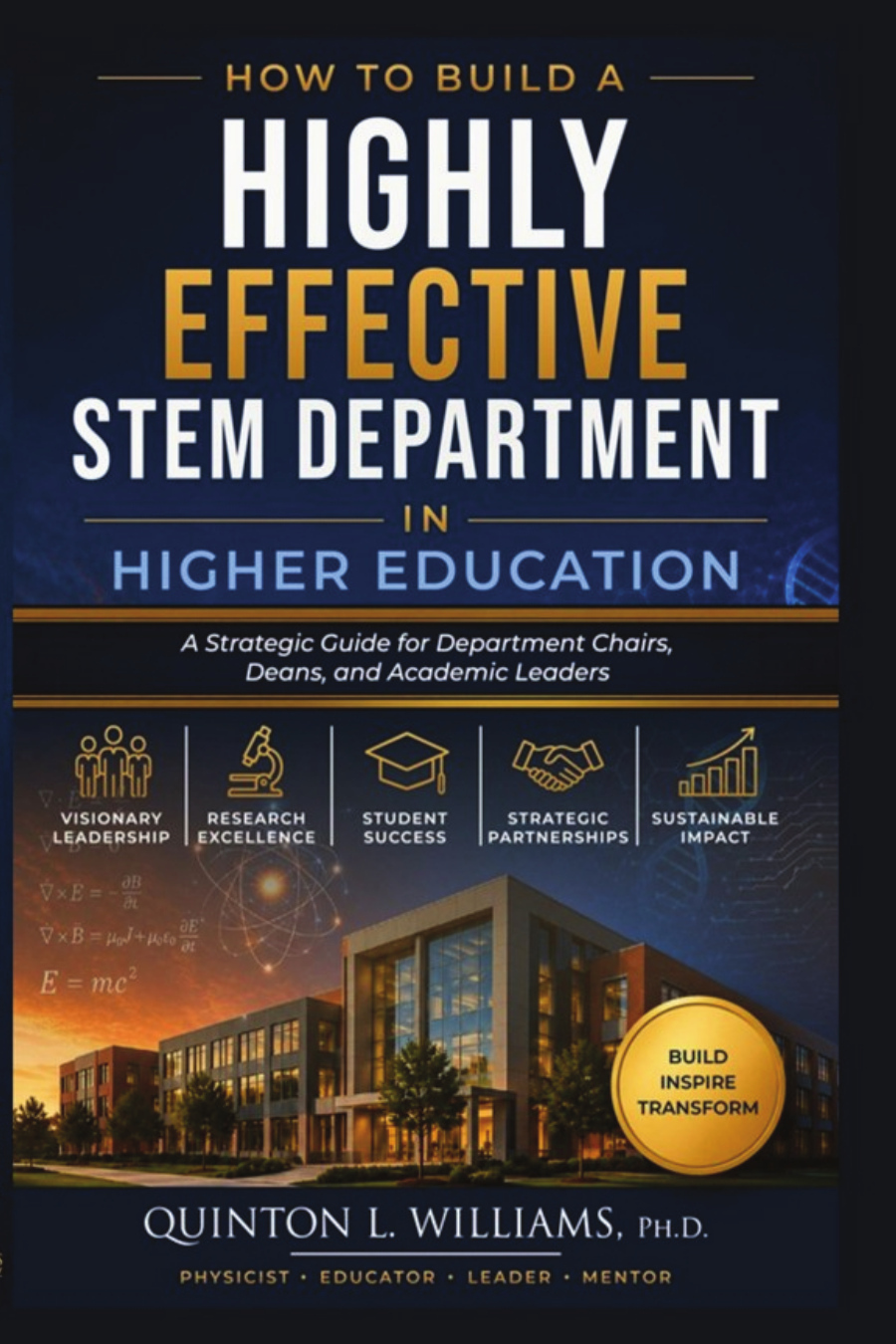
A Strategic Guide for Department Chairs, Deans and Academic Leaders
by Quinton L. Williams, Ph.D.
How to Build a Highly Effective STEM Department in Higher Education: A Strategic Guide for Department Chairs, Deans, and Academic Leaders is a practical leadership handbook for those seeking a playbook with a proven systems-based method for building stronger, more productive, and more sustainable STEM departments and programs.
How to Build a Highly Effective STEM Department in Higher Education: A Strategic Guide for Department Chairs, Deans, and Academic Leaders is a practical leadership handbook for academic administrators seeking to build stronger, more productive, and more sustainable STEM programs.
Drawing upon more than two decades of experience in higher education leadership, research administration, faculty development, and STEM workforce advancement, author Quinton L. Williams, Ph.D. presents a comprehensive framework for transforming departments into high-performing academic units. The book moves beyond theory to provide actionable strategies, proven leadership principles, and implementation tools that can be applied immediately in colleges and universities of all sizes.
At the heart of the book is the author's signature 8-Step Model for Building a Strong STEM Department, a systematic approach that helps leaders assess departmental performance, establish a shared vision, develop faculty talent, strengthen student success initiatives, expand research competitiveness, cultivate partnerships, secure resources, and create a culture of continuous improvement. The book also introduces a 10-Step Strategic Planning Process specifically designed for academic environments, enabling leaders to align departmental goals with institutional priorities and emerging workforce needs.
Through real-world examples, practical exercises, leadership insights, and evidence-based best practices, readers learn how to navigate common challenges facing STEM departments, including enrollment growth, faculty recruitment and retention, research development, budget constraints, accreditation, assessment, and organizational change. Special attention is given to fostering inclusive excellence, strengthening workforce development pathways, and preparing departments to thrive in an increasingly competitive higher education landscape.
Whether you are a new department chair, an experienced dean, a faculty leader, or an aspiring academic administrator, this book provides a roadmap for building a department that is academically excellent, financially sustainable, student-centered, and positioned for long-term success.
How to Build a Highly Effective STEM Department in Higher Education serves as both a leadership guide and an implementation manual for those committed to advancing excellence in STEM education, research, and institutional impact.
I am a professor of physics and STEM consultant for higher education.
Dr. Quinton L. Williams, Department Chair and Professor of Physics of the Department of Physics and Astronomy at Howard University in Washington, DC, has spent over two decades in higher education serving in various academic leadership positions. His specialty is delivering effective leadership and visionary strategic planning for initiating new degree programs, growing higher education programs, and creating revenue-generating opportunities. His leadership has led to unprecedented growth and stability for universities that have been nationally recognized. He leads professional development training and external program reviews for higher education institutions and professional organizations. Dr. Williams has served on several national task forces that have produced seminal reports to help increase diversity in STEM. He has directly supported and trained over thirty minority undergraduate and graduate students and postdoctoral fellows within his own research laboratories. During his career, he has published over 50 research papers in top-tier scientific journals. His current research is on renewable energy and the application of carbon nanomaterials to improve Li-ion batteries. Dr. Williams began his career in industry at Lucent Technologies – Bell Laboratories in fiber optics and also co-founded a venture capital-backed integrated optics company in Atlanta. He is a Past-President of the National Society of Black Physicists (NSBP), a Fellow of NSBP, and a former member of the Governing Board of the American Institute of Physics. Dr. Williams received his Ph.D. and M.S. degrees in physics from the Georgia Institute of Technology and his B.S. in physics from Jackson State University.