 CHM Publishing
Powered by Books.by
CHM Publishing
Tiny Trainings For Therapists - Foundations Collection
by Candice Hamilton-Miller, RP
Every therapist brings a self into the room. The question is not whether that self is present — it always is — but whether you know enough about it to choose what to do with it. Drawing from real supervision group conversations, this volume covers trigger identification, countertransference as clinical data, deliberate use of personal experience, scope-of-practice as self-protection, and what genuine self-care looks like for working clinicians. Honest, grounded, and supervision-informed throughout.
Every therapist brings a self into the room. The question is not whether that self is present — it always is — but whether you know enough about it to make it useful rather than intrusive.
This Tiny Training draws directly from real supervision group discussions about self-care, countertransference, and safe and effective use of self. It covers the kind of self-knowledge that clinical training rarely fully develops and solo practice alone rarely fully provides.
What this volume covers:
- How to identify your own clinical triggers and understand where they come from
- Countertransference as diagnostic information, not just interference to manage
- When and how to use personal experience deliberately in the clinical space
- How scope-of-practice functions as both an ethical and a self-protective tool
- What genuine self-care looks like for clinicians — as opposed to the wellness industry version most therapists find inadequate
- Reflective supervision as a developmental practice across all career stages
The material came from supervision conversations that were honest in the way that good supervision groups are honest: someone admitted their face gives too much away, someone worked through whether they were actually letting go at the end of the day or just performing the letting go. Nobody had all the answers. The learning happened in the asking.
This is not a self-help book. It is a clinical self-awareness guide for therapists who want to understand what they are working with when they are working with themselves — and why that understanding is essential to good clinical practice.
The Tiny Trainings series is a collection of focused, practice-based learning guides designed for therapists, clinical trainees, and mental health professionals who want deeper clinical reasoning, stronger intervention skills, and more confidence in real-world therapeutic decision-making. Rather than functioning as academic textbooks, the books are written in a supervision-informed style that explores what therapy actually looks like in session, including conceptualization, pacing, alliance considerations, intervention timing, and common clinical pitfalls. Each collection within the series focuses on a different aspect of practice, including Foundations, Conceptualization, Neurodivergence, Modalities & Techniques, Populations, Process Challenges, Interventions, and Professional Practice.
The full print edition includes the Continuing Education Training Pack at the back of the book. This section contains guided reflection prompts, applied clinical decision-making exercises, implementation planning questions, and CE completion pages designed to help readers translate conceptual understanding into practical clinical application. These materials are intended to support independent professional development and reflective practice for clinicians who wish to engage with the material at a deeper level.
From insight to intention to change.
Candice is a seasoned psychotherapist, clinical supervisor, and educator with nearly three decades of experience supporting clients across the lifespan—from young children to older adults navigating complex life transitions. Her work has spanned schools, hospitals, community settings, and private practice, giving her a deeply integrated and practical understanding of mental health care. Known for her grounded, human approach to therapy, Candice blends clinical expertise with lived experience, emphasizing presence, curiosity, and authentic connection over rigid adherence to any single modality. Her work is rooted in ethical, client-centered care and an intentionally eclectic framework that adapts to the unique needs of each individual. In addition to her clinical work, Candice has spent years supervising and mentoring therapists at all stages of their careers. Through this work, she recognized a gap between what therapists are taught in formal training and what they actually need in the therapy room. This insight became the foundation for her writing. Candice is the author of The Tiny Training for Therapists Series, along with a growing collection of clinical training resources designed to support therapists in building practical, ethical, and confident practices. She also writes a wide range of accessible mental health resources for clients of all ages, translating therapeutic concepts into language that is clear, relatable, and usable in everyday life. Her work is not intended to prescribe one “right” way to practice, but to offer a flexible, experience-based toolbox—bridging the gap between theory and real-world clinical work. Through her practice, CHM Therapy Services, as well as her online platform for clients, called Mindful Humans Studio, and clinical online platform, The Therapist Circle, Candice continues to work closely with both clients and therapists, with a focus on developing skilled, self-aware practitioners and creating resources that make therapy more accessible, human, and effective for everyone.
Tiny Trainings for Therapists - Foundations Collection
The most effective therapists in the room are often doing something that is hard to name. This Tiny Training makes it nameable. The Therapist's Bag of Tricks covers the invisible session engine: timing, pacing, therapeutic interruption, deepening moves, and the micro-decisions that create the conditions for clinical change without relying on technique delivery alone.
Tiny Trainings for Therapists - Conceptualization Collection
The visible work of therapy is possible only because of an enormous amount of invisible activity running underneath it. This volume covers the parallel cognitive track that experienced clinicians run alongside relational presence: building and revising formulation hypotheses in real time, reading clinical data across verbal and nonverbal channels, holding uncertainty without losing direction, and making the micro-decisions that turn information into intervention.
Tiny Trainings for Therapists - Conceptualization Collection
When therapy stalls, the easy explanation is motivation. The more accurate explanation is usually something else: a protective structure, an identity anchor, a pattern that is doing exactly what it was designed to do. This volume maps five distinct mechanisms that each produce the presenting picture of a stuck client, covering individual presentations across the lifespan, adolescent stuckness, and systemic stuckness in couples and family contexts.

A Traveler’s Guide to Gender, Attraction, and Identity
What if everything you have ever wondered about gender, attraction, and identity could be explored like a map? Adventuring Across the Atlas of Us takes older teens — and anyone still finding their place — on a guided tour of a world where gender is geography, attraction is a tradition you are born into rather than one you choose, and no one else gets to decide where you are from. Warm, plain-spoken, and never preachy, it turns big ideas into a journey you can hold in your hands — through sister countries and border towns, a sovereign Two-Spirit nation, an archipelago all about bodies, and a frontier where the words that do not exist yet are still being invented. It ends where it began: lead with love.

A Stage Adaptation in Three Acts
A company of travellers boards a bus and sets out across a world where gender is geography and attraction is a tradition you are born into rather than one you choose. The stage adaptation of Adventuring Across the Atlas of Us is a warm, plain-spoken journey for older teens and general audiences — a long one-act for a cast of twelve, with minimal touring-friendly staging and a real-history timeline appendix companies may reproduce in the program. It travels through sister countries, a sovereign Two-Spirit nation, an archipelago about bodies, and a frontier where new words are still being invented, and it ends where it begins: lead with love.
Tiny Trainings for Therapists- Neurodivergence Collection
Many of the most commonly used therapeutic interventions — visualization, mental rehearsal, imagery-based exposure, mindfulness body scans — assume a mental imagery capacity that some clients simply do not have. This volume covers aphantasia as a clinical variable, how to recognize it without direct disclosure, and how to adapt EMDR, CBT, mindfulness, and somatic interventions for clients whose inner experience is primarily verbal, sensory, or spatial rather than visual.
Tiny Trainings for Therapists - Neurodivergence Collection
Executive functioning deficits explain a significant proportion of the clinical presentations that therapists describe as 'can't follow through,' 'won't do homework,' or 'knows what to do but doesn't do it.' This volume covers the executive skill domains relevant to therapy, how to assess without pathologizing, and how to adapt goal-setting, homework design, psychoeducation, and session structure for clients whose planning, initiation, or working memory is genuinely impaired.
Tiny Trainings for Therapists - Modalities and Techniques Collection
Decades of research in developmental neuroscience, stress physiology, and affective neuroscience have produced a body of clinical evidence too significant to treat as peripheral. This volume covers the biological foundations of behaviour that every practising therapist needs — including how the stress response system shapes presenting problems, how early developmental experience gets encoded biologically, and what neuroscience actually tells us about psychological change.
Tiny Trainings for Therapists - Modalities and Techniques Collection
Language is the therapist's primary clinical instrument, and yet clinical training rarely examines it directly. This volume covers the language choices that open versus foreclose, that regulate versus dysregulate, that build alliance versus distance, and that make otherwise correct interventions land or miss. It addresses clinical vocabulary, hedging language, normalizing language, language pacing, and how to tailor word choice to the client's cognitive and emotional state.
Tiny Trainings for Therapists - Interventions Collection
Transference and countertransference show up differently depending on your modality, your client's attachment history, and what the therapeutic relationship is being used for. This volume covers how to read the relational dynamics of sessions, distinguish clinical instinct from projection, use the therapeutic relationship as diagnostic information, and decide when what is happening between you and your client is telling you something important about the presenting problem.
Tiny Trainings for Therapists - Interventions Collection
When interoception fails, we often do not notice at first — we keep offering body scans, breathing exercises, and somatic techniques to clients whose internal reporting system is either very quiet or so loud it has become unreadable noise. Volume 1 covers the foundational clinical science of interoception, how to recognize impaired interoceptive capacity, and how to adapt body-based therapeutic approaches accordingly.
Tiny Trainings for Therapists - Process Challenges Collection
Some clients go quiet exactly where the work should deepen. Others sit openly torn between wanting change and dreading it, or agree with everything in the room and change nothing outside it. Silence, ambivalence, and stalled engagement look alike on the surface, but each asks for a different response, and treating them as one thing is the most common clinical error. This concise, practice-ready guide gives therapists a differential framework for telling them apart, reading the client's nervous system, and responding in ways that lower resistance instead of rupturing the alliance.
A Practitioner's Manual
Single Session Therapy has a robust evidence base and a growing body of practice research — but few training resources that bring it all together for the working clinician. This manual does exactly that. Organized across three modules, it covers the origins, philosophy, and evidence base of SST; how to adapt nine therapeutic modalities (CBT, ACT, Narrative, Somatic, Solution-Focused, Integrative, IFS, EFT, and Jungian) to a single-session frame; and the core clinical skills needed to work effectively within it — rapid rapport, goal setting, time management, active closure, and session documentation. Sample scripts, reflection exercises, and integration activities support skill development throughout. An essential training resource for clinicians new to SST and experienced practitioners refining their approach.

A workbook to help couples nourish the space between them
Just Between Us is a workbook for two people who want to understand each other properly, whether that is for the first time or all over again. It is not a book you read so much as a book you do. It guides you and your partner through fourteen intentional conversations about the space between you, one part of it at a time: how you met and what you are each hoping for, the families and couples you learned from, the way you fight and find your way back, money and what it stands for, fairness and the invisible work nobody sees, trust, intimacy, the hard days, and the future you are choosing on purpose.
The rhythm is the same in each. Read a short opening together. Answer the questions on your own, separately and honestly, each of you with your own pages to write in. Then set aside unhurried time, come together, share what you found, and agree one small thing to do differently before the next one.
The conversations are ordered deliberately, from the ones that are easy to say out loud to the ones that are not, so that by the time a couple reaches money, trust and intimacy they have already had several experiences of telling each other something true and having it go well.
Written by a Registered Psychotherapist with three decades of clinical practice. It reflects the author’s clinical perspective and is not a substitute for professional mental health care.
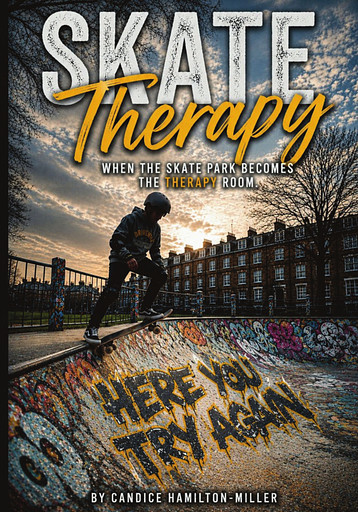
When the Skatepark Becomes the Therapy Room
"What do all the kids at the skate park know about courage, failure, and getting back up that most of us spend our entire lives trying to figure out?
Skate Therapy is a framework, a metaphor, and a practice — three things at once — for using skateboarding's embodied philosophy in clinical and educational work. Drawing on exposure work, narrative therapy, somatic approaches, cognitive-behavioral methods, polyvagal theory, attachment theory, and the research on play, mastery, and identity, this book takes seriously what skate culture has been teaching its kids implicitly for sixty years: that fear is information, that the ground is safety, that you act before you feel ready, that the basics are the destination, and that you do not regulate yourself — you regulate yourself through other people.
Each chapter pairs a principle from skate culture with the therapeutic concept that lives underneath it, grounded in research and in the lived practice of two composite teenagers — Adam, who cannot drop in, and Quinn, who cannot fill out the scholarship application — who teach each other across a single summer what an entire field has been trying to articulate for a century.
For clinicians, parents, teachers, coaches, and anyone who has ever been stuck at the top of their own bowl. The work is already happening. Everything you need is already under the wheels of your board.
Here, you try again."
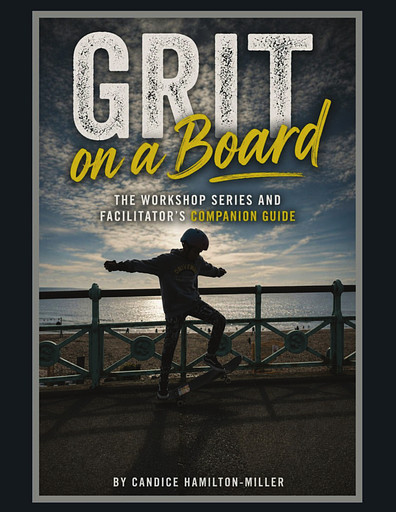
The Workshop Series and Facilitator's Companion Guide
Most kids don't need to be told to try harder. They need to be shown how to fail without it becoming the whole story.
Grit on a Board is a twelve-lesson resilience workshop for children ages 7–12, built on what the skate park already knows about falling, getting up, and going again. Designed for camp counsellors, teachers, youth workers, and clinicians alike, it pairs a practical curriculum with a facilitator’s companion explaining the psychology underneath every lesson.

A Caregiver's guide to Navigating ARFID
"Tiny Bites, Big Feelings: A Caregiver's guide to Navigating ARFID
You have probably been told to try harder. To offer more variety. To not make it a big deal. You have probably also watched those strategies make everything worse.
This book was written for you.
Supporting Your Child with ARFID is a comprehensive guide for parents and caregivers navigating avoidant/restrictive food intake disorder — written by a registered psychotherapist who is also an ARFID parent. That combination matters. The clinical knowledge in these pages is grounded in the real experience of sitting at a table where every meal is a negotiation, every birthday party is a logistical challenge, and every well-meaning family member is a variable you can't control.
This guide covers: what ARFID actually is and how to explain it to others; why common approaches fail and what works instead; how to navigate schools, medical providers, and clinical teams; how to protect family relationships, partnerships, and siblings; practical meal strategies that reduce pressure without increasing rigidity; how to support your child's autonomy and self-advocacy; and how to take care of yourself while caring for a child with complex needs.
This book does not promise a cure. It does not offer a meal plan or a trick to get your child to eat more. What it offers is understanding — a clear explanation of what is happening in your child's nervous system and how to respond to it in a way that builds safety rather than resistance.
You are not failing. You are navigating something genuinely hard. This book walks with you."
Tiny Trainings for Therapists - Modalities and Techniques Collection
Graduate training provides exposure to theoretical frameworks and practice in specific modalities. It rarely provides a framework for thinking about integration. This volume covers the principles of intentional eclecticism, how to evaluate whether your combination of approaches is coherent or merely familiar, how to build an integration rationale, and how to move between modalities without losing theoretical clarity.