Powered by Books.by
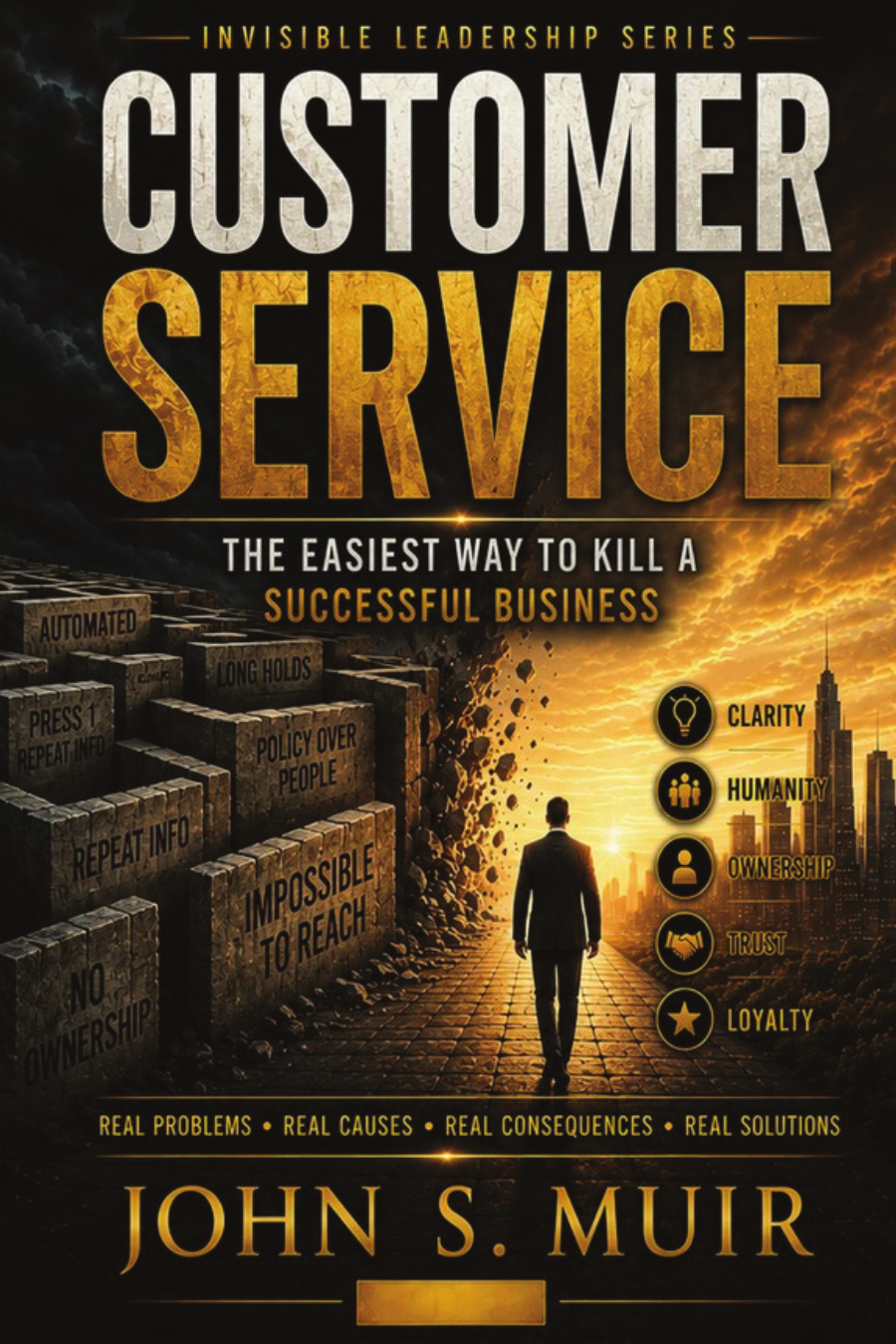
Customer Service: The Easiest Way to Kill a Successful Business argues that decline rarely comes from scandal—it comes from hold music, forgotten policies, and customers who quietly stop calling. Every failing business insists it still cares about service, and that’s exactly how the problem survives.
Drawing on real corporate failures and a detailed case study inside a fictional company, John S. Muir reveals fourteen patterns that slowly destroy customer trust: disappearing ownership, policies replacing judgment, technology that blocks instead of connects, metrics that reward the wrong behaviors, and the quiet complicity that lets it all continue. Each chapter ends with a clear, practical fix for leaders who still have time to act.
The floor for customer service has never been lower. The companies willing to do the basics—answer the phone, remember the customer, fix the problem—have never had a bigger advantage.
This is Book 5 in the Invisible Leadership Series, and a wake‑up call for any business relying on customer silence to survive.
It won't be a scandal that kills your business. It will be forty minutes of hold music, a policy nobody remembers writing, and a customer who decided, quietly, never to call back.
Every failing business insists it still cares about customer service. That's precisely the problem this book takes apart.
Customer Service: The Easiest Way to Kill a Successful Business argues that decline is almost never the work of one bad decision or one bad actor. It's the accumulated residue of a thousand individually reasonable choices — the metric that rewarded speed over resolution, the policy that replaced judgment, the technology built to deflect instead of connect — compounding quietly for years until the damage is irreversible. And it survives as long as it does for a reason most books on this subject won't say out loud: businesses built this decline, and customer silence is what let it become permanent.
Drawing on real, documented failures — Wells Fargo's cross-sell scandal, United Airlines' infamous "re-accommodation," Klarna's public reversal on AI-only support — and a closely observed case study inside one fictional company followed from its first diagnosis to its most stubborn, unresolved fights, author John S. Muir traces fourteen distinct failure patterns that quietly kill good businesses:
The disappearance of a single point of contact
Hold times and the death of "I'll be right with you"
Policy replacing judgment
The vanishing owner
Hiring for availability instead of aptitude
Metrics that reward the wrong number
Technology built as a wall instead of a bridge
The apology without the fix
The loss of the follow-up
The machine that answers first
What happens when government finally steps in
The quiet complicity that lets it all continue
Each chapter closes with a concrete "How to Fix This" — practical, specific, and built for leaders who still have time to act.
The floor for customer service has never been lower. Which means the businesses willing to do the basics — answer the phone, remember who you are, fix the problem instead of apologizing for it — have never had a bigger opportunity.
Customer Service is Book 5 in the Invisible Leadership Series, following MDI: The Origin Story and Invisible Architecture. It can be read on its own or as part of the series.
Businesses built this decline. Customer silence is what let it become permanent. This book is about the moment a business decides to stop counting on that silence.