 Regenerations
Powered by Books.by
Regenerations
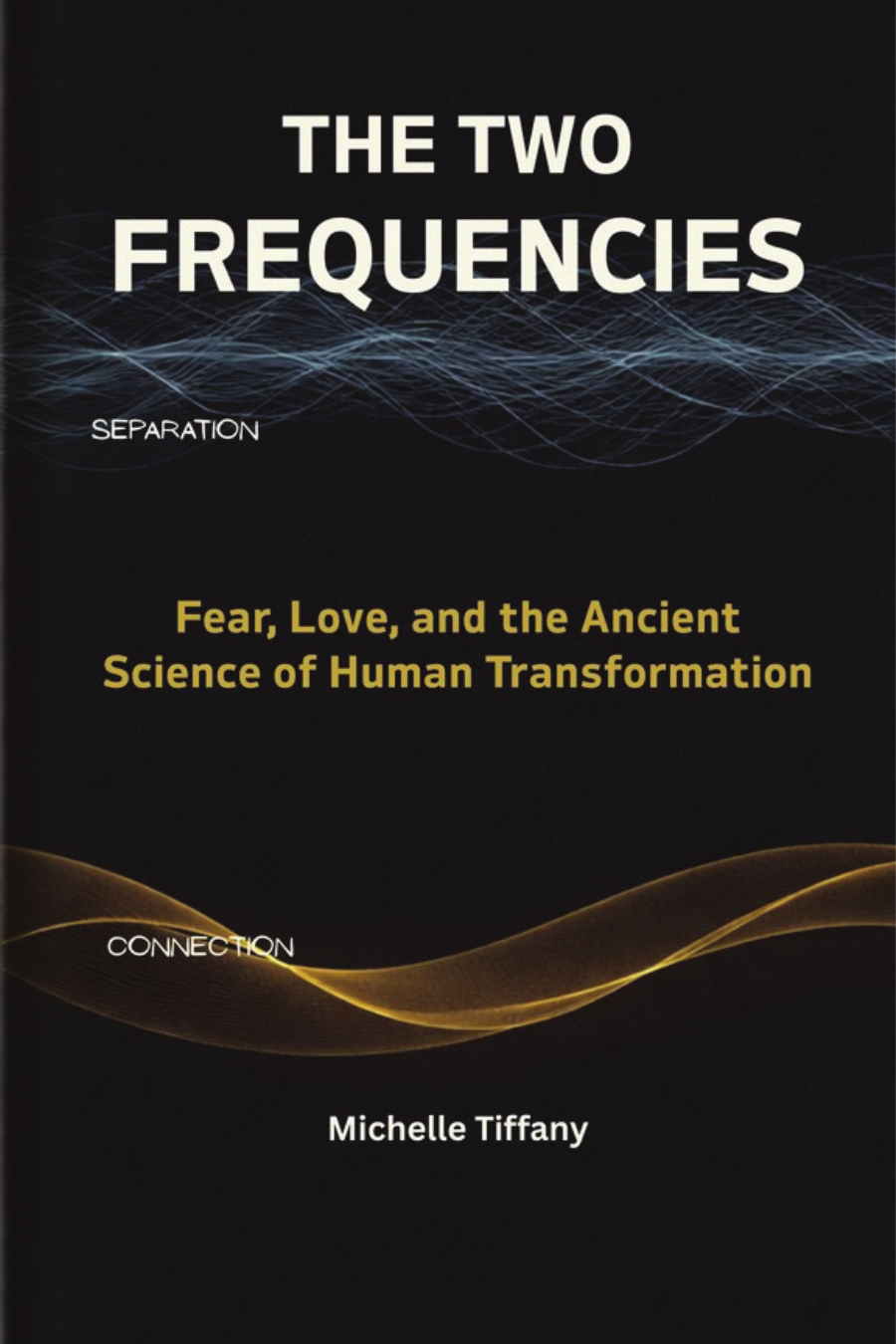
Fear, Love, and the Ancient Science of Human Transformation
by Michelle Tiffany
Every human being is operating from one of two places: fear or love. Not as a metaphor — as a neurological reality that shapes every relationship, every choice, and every life.
The Two Frequencies brings together behavioral science, ancient wisdom, and the groundbreaking work of Chase Hughes, Jamie Winship, and Taylor Welch to map the two worldviews that drive all human behavior — and show you exactly how to cross from one to the other.
What if almost everything about your life — your relationships, your choices, your capacity for genuine happiness, your experience of meaning — could be traced back to a single question: which of two fundamental orientations are you living from right now?
Not as a philosophical abstraction. As a neurological reality. As a daily, measurable, consequential fact about how your brain perceives, how your body responds, and how your life unfolds.
The Two Frequencies makes a bold and carefully argued claim: beneath the extraordinary complexity of human behavior, there are really only two root states. The separation worldview — organized around scarcity, conditional worth, and fear — and the connection worldview — organized around abundance, genuine identity, and love. Every thought, every relationship, every institution, every civilization is an expression of one or the other. And the difference between them is not a matter of personality or theology. It is a matter of biology, of history, of the worldview that was installed in you before you were old enough to choose it — and that you have the power, with the right map and the right practice, to change.
A convergence of sources unlike any other book in this space
Three contemporary researchers provide the book's spine, arriving at the same essential map from radically different directions.
Chase Hughes — one of the world's leading experts in behavioral science and human influence — has spent decades studying what actually happens in the human nervous system when people operate from fear versus genuine connection. His work provides the behavioral mechanics: why fear-based compliance and love-based rapport are not merely different styles of relating but different physiological states, with different consequences for every relationship and every life.
Jamie Winship — former law enforcement officer and conflict resolution expert who spent nearly twenty-five years working in the world's highest-conflict environments, including Iraq, Jordan, Palestine, and Indonesia — developed what he calls the Identity Method: the discovery that almost all human conflict traces back to people living from a false identity in a scarcity-organized world, and that the recovery of true identity can dissolve what no political intervention can touch. His two-worldview framework — separation versus connection — gives the book its organizing architecture.
Taylor Welch — host of The Deep End podcast and a thinker who bridges biblical revelation, trauma neuroscience, and practical transformation — provides the bridge between the scientific and the spiritual, the seen and the unseen. His work on strongholds of the mind, trauma-coded identity, and the daily practices that rewire the brain away from the fear orientation gives the book its most practical and urgent voice.
Behind all three: four thousand years of ancient wisdom. Because the Hebrew prophets, the Buddhist teachers, the Stoic philosophers, the Sufi mystics, and the shamanic traditions of multiple continents all arrived, independently, at the same map. That convergence — across traditions that never consulted each other, in languages that share no common roots — is not coincidence. It is the oldest empirical finding in the human record.
What the book covers
Part One establishes the framework in clear, accessible terms — what the separation worldview and the connection worldview actually are, what each one does to the brain, the body, and the life, and why the distinction matters more than almost anything else a person can understand about themselves.
Part Two travels through four of the world's great wisdom traditions — the Abrahamic faiths, the Eastern traditions, the Greek philosophical schools, and the indigenous and shamanic traditions of multiple continents — asking whether they found what we have been describing. In every case, the answer is yes. The chapter on the Abrahamic thread examines why the tradition most devoted to casting out fear has so often been used to manufacture it. The chapter on the Eastern traditions maps Buddhist craving and aversion as the oldest precise clinical description of the separation worldview ever written. The chapter on the Stoics explores why the most rational philosophical tradition in Western history arrived at the same conclusion as the mystics. The chapter on the shamanic map examines soul loss, contraction and expansion, and why Winship's work transforming gang members and ISIS recruits is, in the most essential sense, the oldest healing work on earth.
Part Three turns to the harder question: if the map is this old and this consistently confirmed, why does the separation worldview still dominate? The answer requires an honest look at how fear has been deliberately cultivated as a social technology — from Pharaoh's Egypt to the modern attention economy — and at the specific, recognizable patterns through which fear-based influence operates in daily life. This section includes a practical field guide to seven patterns of manipulation, each paired with its connection-worldview antidote.
Part Four makes the scientific case for the connection worldview as not merely morally preferable but biologically necessary. The Harvard Study of Adult Development — eighty years of data — the social genomics research showing how loneliness rewrites gene expression, the HeartMath coherence findings, Gottman's relationship research, and the neuroscience of meditation, gratitude, forgiveness, and awe all converge on the same conclusion: love is not a luxury. It is the primary variable.
Part Five is where the theory becomes practice. A nuance chapter addresses the complications — what healthy fear looks like, how the connection worldview's vocabulary gets weaponized, why codependency is not love, and why the framework is a spectrum rather than a binary. A thresholds chapter maps the three stages that every genuine crossing involves: awareness, choice, and embodiment — and what work each stage requires. The book closes with a forty-day protocol, structured around all three primary voices and the ancient traditions, for actually making the crossing in the texture of a real life.
Who this book is for
This is a book for the person who has read enough self-help to know that positive thinking doesn't reach far enough — and enough theology to know that belief alone doesn't reach far enough either. It is for the person who suspects, somewhere beneath the performance, that the worldview they are living inside is not quite true — and who is ready for a map that is rigorous enough to trust and honest enough to actually use.
It is for practitioners and leaders who want to understand, at the deepest level, what is actually happening in the people they work with and why genuine connection produces what coercion never can. It is for people of faith who want the ancient wisdom of their tradition held up against the modern science and confirmed. It is for secular readers who want the science presented without the theology — and who will find, perhaps to their surprise, that the science keeps pointing at the same things the theologians have always pointed at.
And it is for anyone who has ever felt the glass wall — the invisible barrier between themselves and genuine presence, genuine connection, genuine love — and wondered whether it is permanent or whether it can come down.
It is not permanent. It can come down. The map is real. The crossing is possible. And this book is, in its entirety, the most complete account of both that currently exists.
Joined books.by 3 months ago.
How Creativity Heals the Human Mind
Creativity is not a talent. It is a fundamental human healing mechanism — and most of us lost access to it long ago. Becoming True shows how to find the way back, one mark at a time.