Twenty to the Mile
The Overland Telegraph Line
The greatest engineering problem facing Australia – the tyranny of distance – had a solution: the electric telegraph, and its champion was the sheep-farming state of South Australia. In two years, Charles Heavitree Todd, leading hundreds of men, constructed a telegraph line across the centre of the continent from Port Augusta to Port Darwin. At nearly 3,000 kilometres long and using 36,000 poles at ’20 to the mile’, it was a mammoth undertaking, but at last, in October 1872, Adelaide was linked to London. The Overland Telegraph Line crossed Aboriginal lands first seen by John McDouall Stuart just 10 years before and messages which previously took weeks to cross the country now took hours. Passing through eleven new repeater stations, built in the remotest parts of Australia, the line joined the vast global telegraph network, and a new era was ushered in. Each station held a staff of six and they became centres of white civilization and the cattle or sheep industry as the Aborigines were displaced. The unique stories of how men and women lived and/or died on the line range from heroic, through desperate, to tragic, but they remain an indelible part of Australia’s history.
- 320 pages
- Paperback
- 5.8in × 8.3in
- Black & White
- 979-890262697-8
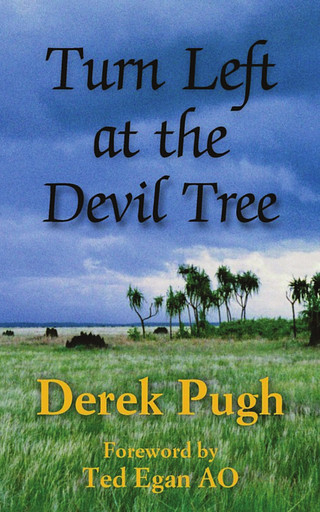
Turn Left at the Devil Tree
The title words were the only directions Derek Pugh had to find Wurdeja Homeland Centre in the vast forests of central Arnhem Land, but find it he did and he founded and ran a school there for four years. Pugh’s story describes his love affair with the bush, the characters who live there and its wildlife. Working with Indigenous Australians in the most remote parts of the country has its share of challenges and successes but life as a visiting teacher in Arnhem Land is tremendously fulfilling.
Derek Pugh, an ex Kakadu ranger, a teacher, naturalist and bushman worked in several homelands schools and joined a lifestyle as old as time. His memoir is by turns reflective, tragic and hilarious and describes a life in remote Aboriginal Australia which gave him an insight into a traditional culture which has been witnessed by only a few outsiders.
Spending more than 20 years among the people and wildlife of the Top End of the Northern Territory, and accompanied by his ‘rough-tough hunting dog’ named Turkey, Derek Pugh revelled in the lifestyle and freedom of the bush. Told with respect and candour Turn Left at the Devil Tree is Pugh’s ‘slice of history’.
Life there was "frustrating at times, but always a challenge and Derek has recorded his experiences beautifully in this delightful book". Ted Egan AO
- 251 pages
- Paperback
- 5in × 8in
- Black & White
- 979-890262702-9
The Ragged Thirteen
Territory Bushrangers
Northern Territory history is a lot of different things to different people. Most people know of the gold rush years, the bombing of the Top End during the war, extraordinary adventures of men and women in the cattle industry, and the overland telegraph line. But who knew the Territory had its own desperate gang of bushrangers riding the ranges from Mataranka to Halls Creek?
When Ned Kelly and Ben Hall were roaming through the bush down south, the Ragged Thirteen were raiding the cattle stations of the north. In my research on this gang of outlaws for a recent book, I travelled the trails they took in 1886 as they headed west to the gold fields of Halls Creek. From a picturesque tropical billabong just north of the must-see tourist destination of Mataranka Hot Springs, I drove a modern 4-wheel-drive, but the gang did it on horseback – using mostly stolen horses. They were young men from South Australia, Queensland, New South Wales, New Zealand and even Scotland, with very few resources – hence their ‘ragged’ look. They had met on the trail and quickly became mates and they were out for a party at the expense of the bush stores and cattle-stations they passed on the way. They duffed cattle when they were hungry, held up wayside pubs or paid with dud cheques when thirsty, and raided cattle stations when their growing herd of horses needed shoes.
They were probably the only bushranger gang in the Northern Territory’s colourful history, and they are mostly forgotten, and this may be because they were not ‘bad’ enough. They were more larrikins than criminals because they never killed anyone, and probably never used their firearms in anger. At Victoria River Downs, for example, the leader, a cattleman named Tom Nugent, played cards with the acting-manager of the station and got him drunk, while the rest of the gang took the back wall off the station store and stole 5 hundredweight of horseshoes, and as much flour, sugar, tea, jam and tobacco as they could carry.
As a result of these crimes, some called them ‘Tea and Sugar Bushrangers,’ but they were also ‘brilliant horsemen, consummate bushmen, lovers of bush poetry and champions of the underdog’.
When the gang finally arrived in Halls Creek, their fame and reputation had arrived before them, but all they had to do to avoid the traps was to break up into anonymous ‘ragged twos’ or ‘ragged threes’ or perhaps bought a new shirt and had a haircut. Whatever they did, none of the thirteen were ever arrested.
After little or no success in the goldfields, some went on to illustrious careers in the cattle industry: Tom Nugent founded Banka Banka Station near Tennant Creek, and Bob Anderson founded Tobermory Station in Queensland, for example. Another, a big bloke named Sandy MacDonald, became a hotelier at the small mining town of Arltunga, east of Alice Springs. Many had families, and their descendants are spread across the continent.
I wrote The Ragged Thirteen: Territory Bushrangers because their story has been an almost forgotten part of the history of the Northern Territory and Kimberley. A century ago, stories told of their exploits abounded around campfires, but these days few people recall the Territory even had bushrangers. To uncover the real story of the Ragged Thirteen, I followed their 138-year-old trail across the rugged Top End. Their story wasn’t just history; it was an adventure.
- 226 pages
- Paperback
- 5.8in × 8.3in
- Black & White
- 979-890262706-7
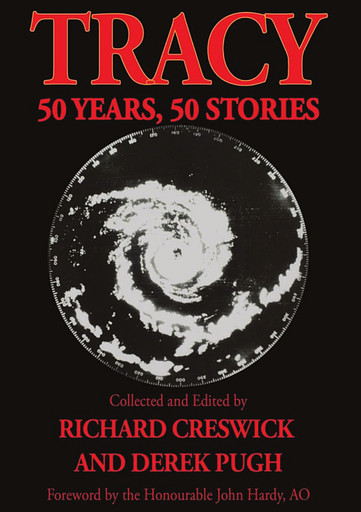
Tracy
50 Years 50 Stories
Cyclone Tracy demolished Darwin, capital of the Northern Territory when it struck during the night of Christmas Eve and Christmas Morning, 1974. Over almost ten hours the small, intense, but slow-moving weather system left a swathe of destruction across the entire town. Few buildings escaped.
Sixty-six people died, many of them on vessels which put to sea, while many hundreds were injured.
The destruction of essential services made a reduction in the population of about 40,000 imperative and what followed was the greatest peacetime evacuation of an Australian community with nearly 10,000 leaving by road and more than 20,000 evacuated by air.
Every survivor has a story and just over 50 of them have responded to the invitation to tell theirs, some for the first time, in their own words.
We admire them for their resilience and thank them for their contribution to this remarkable collection.
- 334 pages
- Paperback
- 5.8in × 8.3in
- Black & White
- 979-890262707-4
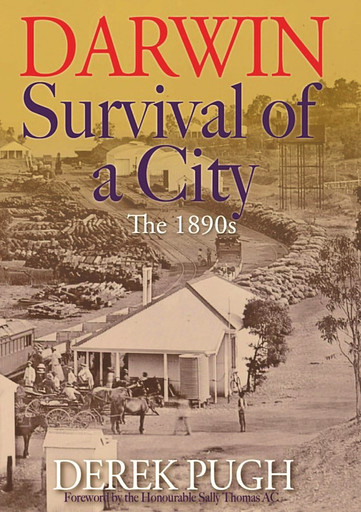
Darwin
Survival of a City, The 1890s
Derek Pugh brings the Darwin of the 1890s alive. (Hon Sally Thomas AC). In the 1890s, Darwin was in the doldrums. The town, then known as Palmerston, was succumbing to the worldwide depression with mining, pastoralism, and agriculture suffered from downturn, disease, and distance. The gold price plummeted and Redwater disease struck cattle - many pastoral operations closed. This is the story of South Australia’s Top End settlement in the last decade of the nineteenth century. It was a tough time, and the South Australian Government had had enough of their ‘white elephant’. When Palmerston blew away in the Great Hurricane of 1897, many called for the Territory’s return to the British Colonial Government.
But the Territory, as ever, was full of resilient and resourceful characters. Many appear in these pages: judges, railway gangers, bushmen, murderers, buffalo hunters, hoteliers, Chinese miners, Aboriginal station hands, explorers, cross-country cyclists, and more.
Territorians were, as Banjo Patterson described them, full of ‘booze, blow and blasphemy’ – but even he couldn’t wait to get back there.
- 308 pages
- Paperback
- 5.8in × 8.3in
- Black & White
- 979-890262709-8
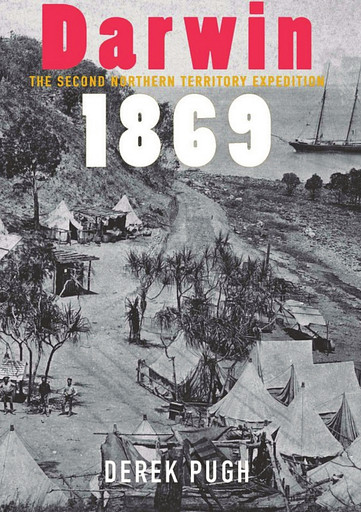
Darwin 1869
The Second Northern Territory Expedition
DARWIN 1869: The Second Northern Territory Expedition.Buy Derek Pugh Books
George Woodroffe Goyder was the man for the job. The Adelaide media pushed and pushed and he finally agreed to lead the Second Northern Territory Expedition. Within 8 months, 1000 square miles of the Northern Territory of South Australia was surveyed and ready for the new colony of Palmerston. This is the story of Goyder's expedition, and the men who at last cut a city out of the bush, against tremendous odds, and at a furious speed.
- 168 pages
- Paperback
- 5.8in × 8.3in
- Black & White
- 979-890262711-1
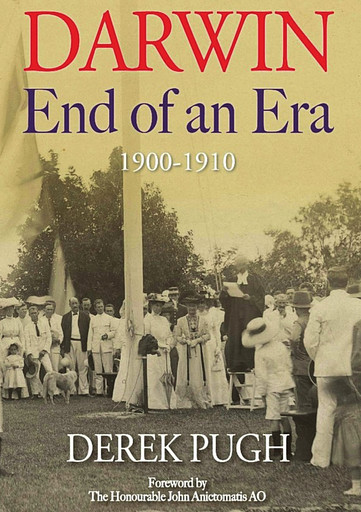
Darwin
End of an Era 1900-1910
In Darwin: End of an Era, Derek Pugh has completed his decade-by-decade history of the settlement of the Top End of the Northern Territory under the management of the South Australian government.
Then known as Palmerston, Darwin at the dawn of the 20th century was a remote and volatile frontier town considered a white elephant by its distant government. Cyclones raged, supplies were scarce, and the promised railway never came, but despite their struggles, many Territorians chose to stay, clinging to the boundless possibilities they believed in—if only the Commonwealth would take control and build the railway.
Northern Territory historian and educator Dr Derek Pugh brings to life the untamed years of this rugged outpost. Darwin: The End of an Era, explores the struggles of the town’s diverse inhabitants— European settlers, Chinese merchants, Indigenous Australians—against a backdrop of government neglect, racial tensions, and environmental challenges. Pugh captures the resilience and determination of those who called this rugged frontier home and, more than a history of a town, this is a tribute to those pioneers whose strength transformed Palmerston from a collection of tin shacks on a storm-lashed coast to the gateway to Australia’s north.
- 314 pages
- Paperback
- 5.8in × 8.3in
- Black & White
- 979-890262712-8
Escape Cliffs
The First Northern Territory Expedition 1864-69
This is a story of the start of South Australian colonisation of the Northern Territory. It is a story of greed, courage, exploration, murder, wasted efforts, life and death struggles, insubordination, incredible seamanship, and extraordinary bushmanship, amid government bungling and Aboriginal resistance.
Escape Cliffs was an attempt by South Australia to become the premier state of the country. It would open up a trading route across the country to Asia, and exploit the agricultural and mining opportunities of the interior. It would be at no cost to the state, as the land was sold, unsurveyed and unseen, to investors prior to the First Northern Territory Expedition even setting out. But then, as the saying goes, the fight really started…
The settlement at Escape Cliffs was the fourth attempt to settle the north by Europeans. The first three, at Fort Dundas, Fort Wellington, and Port Essington, were military settlements designed to preclude other European nations from claiming a part of the north coast of Australia for their own colonies, and as a contact point for trade with the four hundred or so Macassan Prahus.
Escape Cliffs was different to the British military settlements, in that it was a part of an attempt by an Australian Colony, South Australia, to become the premier state of the country. The South Australian government, in competition with Queensland, had taken over the land to the north, calling it the Northern Territory of South Australia, in 1863. Events then moved remarkably quickly. The South Australians wanted to open a trading route across the country to Asia and exploit any agricultural and mining opportunities they could from the interior. They hoped to do this at no cost to themselves, and therefore sold the land, unseen and unsurveyed, prior to the First Northern Territory Expedition even setting out.
A part of the plan, which linked South Australia to the rest of the world with an overland telegraph line, would mean that the point of entry of news and business, for the whole of Australia, would be through Adelaide. Thus the colony had national significance, and was of great interest to the big states of New South Wales and Victoria, particularly.
There was much work to do, and no time was wasted. Within a few months, the forty members of the First Northern Territory Expedition were recruited and sent, in three ships, to survey and establish a city on the north coast. Led by a retired politician and ex-soldier, Colonel Boyle Finniss, and including a mostly poorly selected group of officers and men, it was funded by investors from Adelaide and London, and farewelled with optimism, but it was doomed to fail from the outset. Arguments between powerful personalities begun even before the ships were loaded, and they continued, more and more bitterly, even after reinforcements were sent later the same year.
The city was to be called ‘Palmerston’, as was its successor. Although it is now called, since 1911, Darwin. Darwin’s modern satellite city, some 20 kilometres south, is the third settlement to carry the name Palmerston.
The early military settlements along the north coast existed too early to be photographed, and in the 1860s photography was still in its infancy, particularly in remote areas. There were few cameras anywhere but, incredibly, two found their way to Escape Cliffs. The few surviving photographs from these cameras are remarkable because they were taken in the Northern Territory within a very few months of its declaration and takeover by South Australia. There is, therefore a photographic record of the Northern Territory’s entire colonial existence, and all the known photographs of the Escape Cliffs years are reproduced in this book.
Escape Cliffs, at the mouth of the huge Adelaide River, is remote and unreachable without a boat or a helicopter, so it’s not on any tourist itinerary, and few visitors climb up to the brick and metal remains of the first Northern Territory capital. As a result, its story is one that is rarely told, but those who wonder at the origin of the names of the Finniss, King and Howard Rivers, Litchfield National Park, Manton Dam, Fred’s Pass, Lake Bennett, and dozens of Darwin’s streets will find the answers here. They were named after real people, with aspirations and hopes for the future, who lived in extraordinary times. This book is about them and those times.
- 242 pages
- Paperback
- 5.8in × 8.3in
- Black & White
- 979-890262713-5
SCHOOLIES
If you always sleep under a ceiling fan the moving air becomes necessary to get a good night’s sleep—at least in the build-up. I live in Darwin where the air gets so hot and humid, for two or three months every year, that anyone sleeping without a fan risks waking in a pool of sweat. If my fan is turned off, I’ll wake before it stops moving, so Mum sometimes gets me out of bed on time just by turning it off. I heard the click of the fan’s controller a few minutes ago and have been trying to ignore the still air to get a little more snoozing in. without much success. The switch is near the door, she didn’t even have to come in, but now I can hear her shouting down the hall.
“Hurry up, Ras, school starts in half an hour. Don’t forget to lock the door.” I hear her car start under the house and then she’s gone.
I groan, but I am awake now...
- 118 pages
- Paperback
- 4.3in × 6.9in
- Black & White
- 979-890262715-9
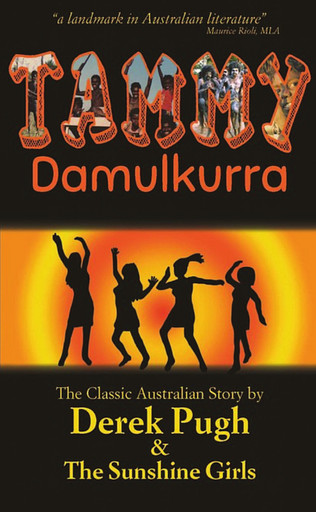
Tammy Damulkurra
Derek Pugh and The Sunshine Girls published Tammy Damulkurra with ASP in 1995. The book was written with and for Indigenous teenagers and remains a “landmark in Australian literature” for Indigenous students and of interest to all.
Tammy Damulhurra is a year 9 reader for the country of Kiribati.
Originally released in 1995 this second edition celebrates two decades of literacy education in remote communities in Australia.
- 97 pages
- Paperback
- 4.3in × 6.9in
- Black & White
- 979-890262716-6
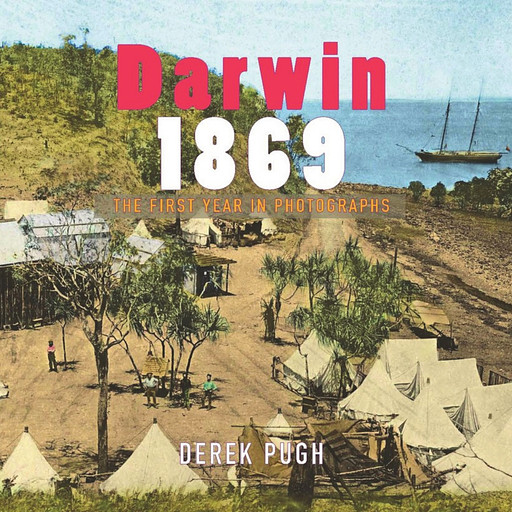
Darwin 1869
The First Year in Photographs
Darwin is the only Australian pre-Federation capital young enough to be photographed from the beginning. These precious photographs are a celebration of the work of the surveyors establishing the city, then called 'Palmerston', 150 years ago.
'Darwin 1869: The First Year in Photographs' is an illustrated celebration of Darwin’s 150 year history.
The photographs of two men allow us to peer into the lives of our first settlers from the very first days of the settlement:
JOSEPH BROOKS arrived in Adelaide at the age of nine. He became a draftsman with the SA Department of Survey and Crown Lands in 1864 and was chosen by Goyder to join the Northern Territory Expedition when he was 21 years old. As well as draftsman, he was the official photographer for the expedition until he left the settlement in September with Goyder on the Gulnare. He used a stereographic camera that took two images which could be seen in 3D when used a viewer of paired
lenses. In later years he moved to New South Wales for a further career in surveying and then took up astronomy, travelling the Pacific Ocean to chase of solar eclipses. He died of Bright’s disease in 1918 in Woollahra, aged 70.
CAPTAIN SAMUEL WHITE SWEET was a keen amateur photographer and he was able to help Brooks take the official photographs, as well as take his own that he could then sell to the public back in Adelaide. As Brooks’s drafting duties became more time consuming, Sweet took over much of the role of ‘official’ photographer. Sweet’s photographs can usually be identified by a small anchor-shaped scratch etched onto the plate before printing.
Captain Sweet brought the Gulnare five times from Adelaide to Port Darwin, but in October 1821 she hit a reef near the Vernon Islands while carrying telegraph line equipment to the Roper River. She was able to limp back to Port Darwin, but Government Resident Douglas, who found her slow and unwieldy, was delighted to condemn the little ship. She was stripped of anything useful and left to rot on the beach below Fort Hill. Her masts were recycled, and were later strapped to the side of the Springbok to take south. Captain Sweet returned to Adelaide to captain the Wallaroo, carting coal for the Black Diamond Line, until she run aground in a storm in 1875. He then retired from the sea and opened a photography business off Rundell Street, Adelaide. He was one of South Australia’s most prominent documentary photographers through the 1870s to January 1886, until he collapsed and
died near Riverton, South Australia, apparently of sunstroke. He was survived by Elizabeth Tilly, with whom he had four daughters and five sons.
Since both Brooks and Sweet left the colony on September 28, there was no photographer in Palmerston until Sweet’s return at the end of January, 1870. All their images in these books were therefore made between February 5 and September 28, 1869. They are precious—Darwin is unusual in that it is the only pre-Federation Australian capital to have been photographed from the very beginning.
- 64 pages
- Paperback
- 8.5in × 8.5in
- Black & White
- 979-890262717-3
Hanged
Execution in the Top End
HANGED: EXECUTION IN THE TOP END
By Derek Pugh
In the late nineteenth and early twentieth centuries, the Northern Territory of Australia stood at the outer edge of the British Empire—vast, sparsely governed, and brutally unforgiving. Here, the machinery of law operated far from oversight, and capital punishment was carried out in conditions almost unimaginable elsewhere in the imperial world.
"Hanged: Execution in the Top End" is the first comprehensive history of judicial execution in Australia’s tropical frontier. Drawing on court records, prison files, official correspondence, and contemporary newspapers, historian Dr Derek Pugh reconstructs the cases of men condemned to death in a place where the authority of the state was fragile and the consequences final.
These were not theatrical executions designed for crowds or moral spectacle. They were quiet and functional — carried out in remote settlements where race, isolation, and administrative neglect shaped justice as much as statute law. Aboriginal prisoners, Chinese gold miners, and the socially marginal were disproportionately caught in a system struggling to impose order on an environment it barely controlled.
Written with forensic clarity and grounded in primary sources, this book challenges romantic myths of the Australian frontier. Instead, it reveals a legal world where punishment was swift, appeals were rare, and mercy was uncertain.
"Hanged" is essential reading for anyone interested in colonial justice, the history of punishment, and the realities of empire at its limits.
——Quotes
“Preface: A Hanging Carnival. In July 1893 the Northern Territory Times was exultant, screaming “A HANGING CARNIVAL” in capital letters. What was going on? In the 23 years since white settlement, there had never been a legal hanging. Of course, there had been murders, and trials of the guilty. In fact, death was never very far away. There were numerous retribution massacres, men shot while attempting to escape, deaths from crocodiles, disease, accident and thirst, but few of these ended in a trial. They were all too common, but a hanging carnival? Justice Charles Dashwood had excelled in the court that year. In February he was on the bench for three murder cases in three days. After the juries had declared the accused to be guilty, Dashwood took the bit between his teeth and sentenced ten of them to death. Fortunately for most of them, Dashwood also had the power to recommend commuting their sentences and eventually did so for all but two of the condemned, and those two did indeed hang for their crime. Early in the morning of the 14th of July, John Archibald Graham Little, the long-term telegraph and postmaster and deputy sheriff of the tiny South Australian colony of Palmerston, on the north coast of Australia, shared a memo with the press. The date for the executions of the men currently lounging on death row in Fannie Bay Gaol had been set. First was Charlie Flannigan (aka McManus), who had been found guilty of murder at his six-hour trial, five months earlier. He had spent the time since then, alone in his cell, sketching his memories of working as a stockman in the cattle stations of the north. He would be hanged the very next day, he was told, and Reverend W. A. Millikan arrived to attend to him in his last hours. The other nine on the row waited. One was a Larrakia man named Warrima, who had killed a Chinese market gardener named Ah Kim in 1892. The rest were a group of eight Iwaidja men who had brutally murdered six Malay fishermen. They were to be hanged and left hanging in their own lands as a warning to their clan: even “tribal Aborigines” would face the full force of the white man’s law. The deputy sheriff was to accompany them some 250 kilometres eastwards along the shores of Arnhem Land to Malay Bay for the execution. Wandy Wandy, Goolarguo, Capoondur, and Mintaedge and the others thus believed that their fate was “practically settled”, as the Times put it, and they had ten days left to live. But oh, how the South Australian Press howled. The South Adelaide Register thought that hanging the Aborigines would “be a wicked, cruel, and useless act.” It would be better to flog them and send them home, where the “poor creatures… would relate how they had suffered.” This, the writer reasoned, “would have a more salutary effect than hanging any quantity of them.” Dashwood may have agreed to a certain extent. He was to comment later that “it is very unsatisfactory to say the least of it, that we should be here to try two creatures who stand there utterly ignorant of what is going on.” Plus, there was real concern that capital punishment was unfairly given to the guilty depending on how dark their skin was. About the same time as Flannigan climbed the gallows steps, Charles Page, who had slain his niece, had his sentence commuted to “penal servitude for life.” Page was a white man with friends in high places, including Premier John Downer. Flannigan was a brown man with no friends at all. The argument, according to the Adelaide Observer, was that if both were undoubtedly guilty, they should both be treated the same. As the paper put it: … Page was a civilized and fairly educated white man; Flannigan, offspring of a degraded lubra and a probably unrefined European, [who] never had a chance to do well. He was bred in degradation and cradled and trained in lawlessness. Society must be protected against such men; but the scales of justice must weigh equally, and the sins of the less cultured must not be deemed worse than those of the more cultured. Whilst capital punishment is the legal penalty of murder, both Page and Flannigan ought to be handed over to the public executioner, but if the one is spared so should the other be. And what of the Aborigines who were facing the noose? Wandy Wandy, the English-speaking recidivist, was the only one who seemed to admit the crime and understand the punishment that they were facing. Anyway, much of the evidence was circumstantial, and if the others were less guilty than Wandy Wandy, and even if “they are only blackfellows,” the Observer pointed out that: … if they are hanged whilst Page escapes the gallows, their fate will make a still darker stain upon our judicial annals than the execution of Flannigan. The arguments in Adelaide became more bitter. When the decisions of the Executive Council regarding capital punishment were discussed in Parliament, Territory Representative Walter Griffiths and some of his parliamentary colleagues declared that a grave injustice had already been made by hanging Flannigan, and they pressed the Executive Council to rethink their decisions before it was too late. The South Australian Chronicle pointed out that modern attempts for a community to go without capital punishment had only ended in greater crime. In Switzerland, for example, eight of the Swiss cantons had reintroduced the death penalty after five years. The long arm of the law, said the Chronicle, needed to fall equally across a civilised nation, no matter how far removed, or remote, were the crimes. Nothing would more swiftly tend to make attempts at civilisation a complete failure than the spread of a conviction that the arm of justice was too short and feeble to reach wrongdoers and inflict upon them the penalty due to their crimes. But, they reminded their readers, it was a serious affair: … human life, even though it be that of an aboriginal, is too sacred to be lightly taken away. Territorians, through their only weekly paper, the Northern Territory Times and Government Gazette, appeared bemused by the “antagonistic criticism from the Press of South Australia proper.” The paper’s editor, Charles Kirkland, felt sure that most Territorians would be in favour of capital punishment. “Not that there is any strong feeling here as to the unqualified merit of the gallows as a deterrent to crime” he suggested, “but it may be argued that while capital punishment remains an institution among us there are certain cases which demand its rigours.” Five months before, with ten men on death row, the paper could find no sympathy for Flannigan and encouraged his hanging for, if the sentence was not carried out, “the gallows [was] doomed as an instrument of justice in South Australia.” In the end, as we shall see, Wandy Wandy was hanged alone because Dashwood and the Executive Council in Adelaide caved in to the pressure and commuted the sentences of the others. The Hanging Carnival thus never occurred, and the arguments for and against capital punishment continued. They were so passionately presented, on both sides, that executions became an increasingly rare event, and it was a brave judge who ordered them. From 1884 to 1911 the Judge of the Northern Territory exercised the full powers of the Supreme Court under the Northern Territory Justice Act. There were four of them: Thomas Pater, Charles Dashwood, Charles Herbert and Samuel Mitchell, and they only dealt with criminal trials. After the administration of the Territory was moved to the Commonwealth of Australia, the Supreme Court of the Northern Territory was established, with Justice David Bevan presiding. The judicial concern over racism came to a head in 1913. Both Chief Protector of Aboriginals William Stretton and Justice Bevan agreed that there was a problem with the jury system in the Territory because of racism and the small population that was available to draw the jury from. In a letter to the Administrator in September 1913, Stretton pointed out that two very similar cases had just been tried but had very different outcomes: a white man, Carl Lindroth was acquitted of murdering an Aboriginal man named Dick (after a three-minute retirement to discuss the case!), but the Aboriginal men accused of killing a white man named Clare Ernest Campbell were found guilty. Stretton pointed out that five of the jury were the same for both cases and he regretted to say, ‘without any hesitation,’ that: … the verdicts in these cases are inconsistent and in one case at least ill-considered. Justice Bevan followed up the Protector’s letter to the Administrator on 25 September 1913. The three-minute consideration of Lindroth’s guilt, or otherwise, he said, was ridiculous: To say they “considered” their verdict would be to introduce an element of the farcical into the administration of justice. Bevan requested a discussion with Administrator John Gilruth about the idea of dispensing with the jury altogether in capital cases because: Juries will not convict a white man for an offence against a black, certainly if the evidence is that of blacks, whereas on black evidence, there is no difficulty in the way of securing conviction against a black for an offence against a white man… I feel confident,” he wrote … that the judge sitting with two assessors would be far more likely to arrive at an honest decision, than twelve men picked indiscriminately whose sole interpretation of a “White Australia” is that the “nigger” is something a good bit lower than a dog, to be exploited and used for his own particular purposes. Gilruth ‘candidly’ agreed that the jury system was “not suitable for the Territory in its present stage of development ” and he held the opinion that the Minister, Judge Bevan and himself should have a personal discussion about the abolition of the jury system. Unfortunately, if this discussion ever took place, it is not in the records, and the jury system continued for another 8 years. It was finally abolished for all crimes except murder in 1921, although this was repealed in 1930. There were 39 murder trials held in the Palmerston Court between 1884 and 1913, and Justice Bevan provided a list of them to External Affairs Minister Glynn (see Appendix 1) on his request. Some of the accused were acquitted, and of those found guilty and condemned to death, most had their sentences commuted to life in prison. Such ‘luck’ continued through the twentieth century: Nemarluk, Minemarra, Mangulmangul, Nargoon, Marragin and Mankee, for example, were all condemned to death in 1933 after being found guilty of the murder of three Japanese fishermen, but each of the sentences was commuted to imprisonment for life. Nemarluk, now famous as an Indigenous resistance leader, died in Fannie Bay Gaol in 1940, possibly of tuberculosis. Of those who were executed, Flannigan and Wandy Wandy were only the first. Eight others paid the final price for their crimes, and it took eighty years to finally end the practice of capital punishment in the Territory. Ninety-one years after Flannigan died, all the states and territories in Australia had outlawed the death penalty. The Northern Territory waited until 1973, but the last was Western Australia, in 1984. There, Brenda Hodge was sentenced to death for killing her abusive policeman husband in Kalgoorlie. Luckily for her, her sentence was commuted, and she was paroled in 1995. There were 114 people legally executed in the Commonwealth of Australia after Federation in 1901. The last two to hang in Darwin dropped to their deaths at Fannie Bay Gaol in 1952. The last to hang in Australia was Ronald Ryan in 1967, after he had killed a prison guard while escaping from Pentridge Gaol. Back in 1893, waiting for death in Fannie Bay Gaol, Charlie Flannigan was given paper and pencils in his cell to fill in time, and he is now known for his art as much as the murder of a cattleman. In 2023, Library and Archives Curator Don Christophersen exhibited Flannigan’s drawings from his time locked in solitary confinement before his final day. Flannigan must have rolled in his grave! Christophersen also researched and compiled a book on Charlie Flannigan’s story titled A Little Bit of Justice, and for the first time in 130 years, Flannigan’s life was revealed in all its tragic details. Christophersen left it to his readers to decide whether the punishment was justified, or whether Flannigan deserved a commuted sentence like most others received. This book does the same with all ten felons who were legally executed in the Northern Territory – six of them condemned by Justice Charles Dashwood. Murder was not the occupation of any one race, but it was, and is, more likely to be perpetrated by men. In his 9 years on the bench in Darwin, for example, Justice Kriewaldt presided over 39 murder trials involving men. Just over half involved Aboriginal people, but the others were from a range of other groups. His first, in 1952, were the two Czech immigrants who appear in this book. They were hanged for murdering a taxi driver (see Ch 7) and Kriewaldt was so shocked by the event that none of his following 37 murder trials ended in the death penalty. In fact, Kriewaldt became a vocal opponent of it. Of the ten who were hanged in the Northern Territory, six were Aboriginal men, two were Chinese, and (after a gap of 39 years) two were Czech ‘New Australians.’ Seven were hanged at Fannie Bay Gaol, and three on the same ground that had witnessed the murders (see Map 1). The stories of these ten men are rarely told nowadays, but they survive in the archives and newspapers of the times. Discovering them was an adventure. ”
- 194 pages
- Paperback
- 5.8in × 8.3in
- Black & White
- 979-890310631-8