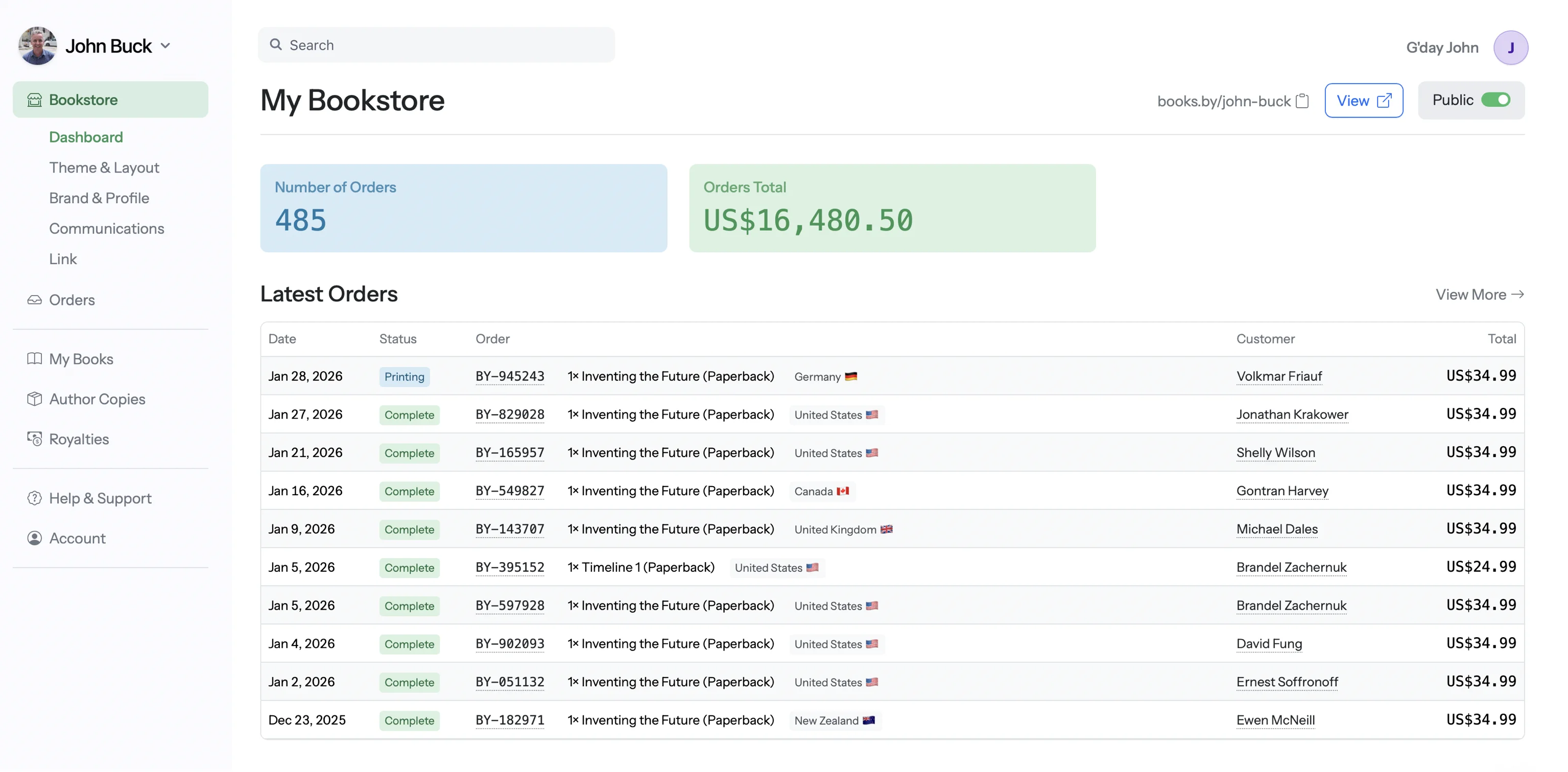
Print on demand (POD) is a printing technology where books are printed individually, one at a time, only after a customer places an order. No inventory, no warehousing, no minimum print runs — just books printed when they're sold.
Before print on demand existed, publishing a book meant gambling thousands of dollars on a print run. You'd order 1,000 or 2,000 copies, store them in your garage, and hope you could sell them all before the boxes started gathering dust. Most self-published authors couldn't afford this. Many who could, lost money.
POD changed everything. Now you can publish a book for under $100 and have it printed only when someone buys it. The economics flipped from "invest heavily upfront and pray" to "pay nothing until you sell." That's not just convenient — it's revolutionary.
How Print on Demand Works
The POD process is elegantly simple:
- You upload your files. Your print-ready interior PDF and cover go to a POD platform like Books.by, Amazon KDP, or IngramSpark.
- Customer places an order. Someone buys your book through your storefront, Amazon, or wherever you're selling.
- Book is printed. A digital press prints a single copy of your book — usually within 24-48 hours.
- Book ships directly. It goes from the print facility straight to your reader. You never touch it.
- You get paid. The printing cost is deducted, and you receive your royalty.
The entire system runs without you lifting a finger. No inventory management, no trips to the post office, no bubble wrap. Just orders flowing in and books flowing out.
Print on Demand Costs: Real Numbers
POD pricing has a consistent structure across platforms: a base cost plus a per-page cost. Here's what printing actually costs on Books.by:
| Interior Type | Base Cost | Per Page | 200-Page Book |
|---|---|---|---|
| Black & White | $1.26 | $0.016 | $4.46 |
| Standard Color | $1.379 | $0.036 | $8.58 |
So a typical 200-page novel costs about $4.46 to print. Price it at $15.99 and you're looking at $11+ profit per sale — assuming you're on a platform that doesn't take a massive cut of that remaining amount.
Here's where it gets interesting: Amazon KDP takes 40% of your list price before you see a cent. Books.by doesn't take a percentage — just the printing cost plus payment processing (~2.9% + $0.30). On a $15.99 book, that's the difference between keeping $5.74 (KDP) and keeping about $11 (Books.by).
Print on Demand vs Offset Printing
The POD vs offset question comes up constantly. Here's the honest breakdown:
Print on Demand
- Zero upfront investment
- No inventory risk
- Update your book anytime (free)
- Never go "out of stock"
- Test market demand safely
Offset Printing
- $2,000–$10,000+ upfront
- Stuck with unsold inventory
- Can't fix typos without reprinting
- Need storage & fulfillment
- Only makes sense at 1,000+ copies
Offset printing wins on per-unit cost — around $1-3 per book versus $3-8 for POD. But that only matters if you can sell enough copies to justify the upfront gamble and handle the logistics.
The honest take: offset printing makes sense for established authors with proven demand, speaking gigs, or corporate bulk orders. For everyone else — especially first-time authors — POD is the only sensible choice. You can always switch to offset later if your book takes off.
POD Print Quality: The Truth
This concern comes up constantly: "But is POD quality as good as 'real' printing?"
Yes. Next question.
Okay, a bit more nuance: modern digital presses produce books that readers genuinely cannot distinguish from offset-printed books. The technology has matured dramatically. Cover finishes (matte and gloss), paper quality, binding — all professional grade.
Where you might notice differences:
- Color accuracy: POD color can be slightly less vibrant than premium offset color. For photography or art books, this may matter. For children's books or standard color interiors, it's fine.
- Special finishes: Offset offers embossing, foil stamping, spot UV, and other fancy touches. POD doesn't.
- Paper options: Offset has more paper choices. POD offers cream or white, typically 50-60lb.
For 95% of books — novels, memoirs, self-help, business books, most nonfiction — POD quality is indistinguishable from traditionally published books sitting next to them on the shelf.
Who Uses Print on Demand?
Here's a surprise: it's not just indie authors.
Major publishers including Penguin Random House, HarperCollins, and Simon & Schuster use POD for backlist titles, low-volume reprints, and academic books. It's simply more economical than maintaining warehouse inventory for slow-selling titles.
For self-publishers, POD has become the default. Amazon's dominance in book sales is built on their KDP Print POD system. IngramSpark prints for bookstores and libraries worldwide. And platforms like Books.by let authors sell directly to readers with POD fulfillment built in.
Getting Started with POD
Ready to print on demand? Here's what you need:
- A print-ready interior PDF — Properly formatted with correct margins, bleed (if needed), and embedded fonts. See our formatting guide.
- A print-ready cover PDF — With correct dimensions including spine width. Books.by has a Cover Builder that handles this automatically.
- An ISBN — Required for print books. Books.by includes free ISBNs; otherwise expect to pay $125+ from Bowker.
- A POD platform — Choose based on your goals. See our POD comparison.
On Books.by, most authors go from files to live storefront in under 30 minutes. Upload, configure, publish — your print-on-demand book is for sale.
Frequently Asked Questions
Print on demand (POD) is a printing method where books are printed individually only after a customer orders them. Unlike traditional offset printing which requires bulk orders of 500-2,000+ copies, POD prints one book at a time. This eliminates upfront inventory costs and storage needs for authors and publishers.
POD printing typically costs $2-8 per book depending on page count, trim size, and interior type. A standard 200-page black and white paperback costs approximately $4.46 on Books.by ($1.26 base + $0.016 per page). Color interiors cost more, around $1.379 base + $0.036 per page.
Yes, for most self-publishers POD is the only sensible option. It eliminates the $2,000-10,000+ upfront cost of offset printing, removes inventory risk, and allows you to update your book anytime. The per-unit cost is higher than offset, but you only pay when you sell.
Offset printing requires ordering hundreds or thousands of copies upfront at a lower per-unit cost ($1-3 per book). POD prints one book at a time at a higher per-unit cost ($3-8) but with zero upfront investment. Offset makes sense only if you can reliably sell 1,000+ copies and have storage/distribution.
POD books typically print in 1-3 business days, then ship to customers. Total delivery time is usually 5-10 business days depending on shipping method and destination. This is slower than shipping pre-printed inventory but fast enough for most reader expectations.
For Amazon sales, KDP Print is the standard choice. For direct-to-reader sales with maximum royalties, Books.by offers 100% royalties with daily payouts. IngramSpark is best for bookstore distribution. Many successful authors use 2-3 POD platforms strategically.
Yes, through IngramSpark or similar distributors. However, most bookstores prefer returnable books with a 55% wholesale discount, which significantly reduces author profits. POD is better suited for online sales and direct-to-reader models than traditional bookstore distribution.