You wrote the book. You designed the cover. You formatted the interior, chose your trim size, and hit publish. Now comes the part nobody warned you about: marketing.
Writing a great book is necessary but not sufficient. With over 4 million books self-published every year, discoverability is the #1 challenge indie authors face. You don't need a massive budget, a publicist, or a lucky viral moment. You need a system. A repeatable set of strategies that compound over time.
This guide covers 15 proven marketing strategies, from free tactics you can start today to paid advertising approaches that scale. We'll tell you straight what works, what doesn't, and where most authors waste their time and money. Based on 12,000+ books published through Books.by, these are the strategies that actually move the needle.
From our team: "Our median author earns back their $99 subscription within 47 days. The ones who earn it back fastest aren't the best writers. They're the ones who treat marketing as a system, not an afterthought." — Ash Davies, Founder
1. Build Your Author Platform
Your author platform is your home base — the place readers go to find everything about you and your books. Without one, you're entirely dependent on retailer algorithms and social media platforms you don't control.
What an Author Platform Includes
- An author website or storefront — your owned space on the internet. This is non-negotiable. Whether you use Books.by (which gives you a ready-made storefront), WordPress, Squarespace, or a simple landing page, you need a URL you control.
- An email list — your most valuable marketing asset (more on this in Strategy 2).
- Social media profiles — pick 1–2 platforms where your readers hang out. You don't need to be everywhere.
- An "about the author" bio that's consistent across all platforms.
Why Your Own Storefront Matters
Most indie authors default to Amazon as their primary (or only) sales channel. Amazon is important for discovery, and we'll cover optimizing it in Strategy 4. But Amazon doesn't give you customer data. When someone buys your book on Amazon, you don't get their email address. You can't contact them when your next book launches. You can't build a relationship. More than 70% of Books.by authors also sell on Amazon, but they use Books.by for the direct relationship.
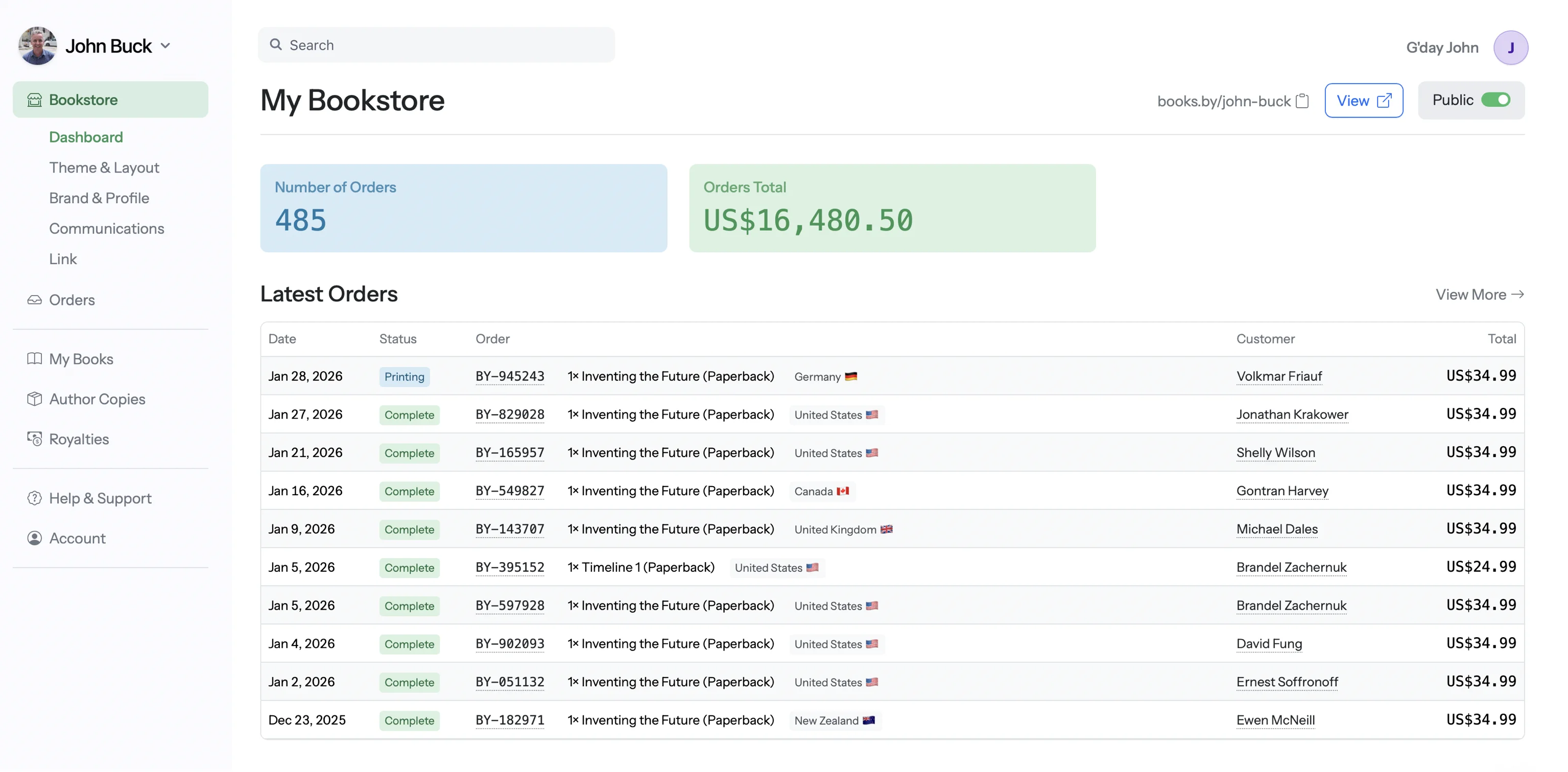
With your own storefront on Books.by, every sale gives you the reader's email address and purchase history. You can send them a personal thank-you, notify them about your next book, offer them signed copies or special editions. This is the difference between renting an audience and owning one.
2. Email List Building — Your #1 Long-Term Asset
If you take one thing from this entire guide, let it be this: build an email list. An email list is the single most valuable marketing asset a self-published author can own. Social media followers are borrowed. Amazon rankings are temporary. Your email list is yours forever.
Why Email Beats Everything Else
- You own it. No algorithm can hide your emails or throttle your reach. If someone subscribed, they see your email.
- Conversion rates are 5–10x higher than social media. A well-maintained email list converts at 2–5% on book launches. Instagram posts convert at 0.1–0.5%. The math is overwhelming.
- It compounds. Every reader you add stays on your list. By book 3 or 4, you have thousands of people you can contact directly on launch day.
- It's platform-independent. Amazon changes its algorithm? TikTok gets banned? Your email list doesn't care.
How to Build Your Email List From Zero
Create a reader magnet
A reader magnet is a free piece of content you offer in exchange for an email signup. The best reader magnets are directly related to your book: a prequel novella, a bonus epilogue, a deleted chapter, a character backstory, or a companion short story. Generic magnets ("sign up for my newsletter") convert at 1–2%. Specific magnets convert at 15–30%.
Choose an email platform
MailerLite (free up to 1,000 subscribers) is the best option for most indie authors — simple, affordable, and built for creators. ConvertKit (free up to 10,000 subscribers with limitations) is another popular choice. Don't overthink this — pick one and start.
Put signup links everywhere
The most important placement is your book's back matter — the last page of your book, right after "The End." This is when readers are most emotionally engaged. Also add it to your Books.by storefront, your website, your social media bios, and your Goodreads profile.
Email consistently (but don't spam)
Send 1–2 emails per month minimum: book updates, behind-the-scenes content, reading recommendations, personal stories. Your goal is to build a relationship, not just sell books. Authors who email only when they have a book to sell train readers to ignore them.
3. Social Media Strategy
Social media is where many authors spend the most time and see the least return. The key is to be strategic: pick 1–2 platforms where your readers actually are, and ignore the rest.
Platform-by-Platform Breakdown
| Platform | Best Genres | Content Type | Effort Level |
|---|---|---|---|
| TikTok (BookTok) | Romance, Fantasy, Thriller, YA | Short-form video, book recs, trope content | Medium — videos can be simple |
| Instagram (BookStagram) | All genres, especially literary & non-fiction | Reels, Stories, book photography | High — visual quality matters |
| Facebook Groups | Romance, Mystery, Sci-Fi | Community engagement, promo sharing | Low — participate, don't create |
| Twitter/X | Non-fiction, Literary, Writing community | Threads, commentary, engagement | Medium — consistency matters |
| YouTube (BookTube) | Non-fiction, How-to, Deep-dive genres | Long-form reviews, author vlogs | High — production required |
The 80/20 Rule of Author Social Media
80% of your content should provide value (entertainment, information, connection). 20% can be promotional (buy my book). Authors who flip this ratio build no audience and sell no books. The authors who thrive on social media are the ones who are interesting beyond their books.
4. Amazon Optimization
Even if you sell direct through Books.by (and you should), Amazon remains the world's largest bookstore. Optimizing your Amazon presence is essential for discovery — think of it as your public-facing bookshelf while your Books.by store is your private shop where you keep the relationship.
Categories and Keywords
Amazon allows you to select up to 3 browse categories and enter 7 keyword phrases (each up to 50 characters). This is the most underused lever in indie publishing.
- Choose niche categories. Being #1 in "Science Fiction > Space Opera > Military" is vastly more valuable than being #500,000 in "Books." Use Publisher Rocket or browse Amazon's category tree manually to find categories with bestseller ranks of 5,000–50,000 — these are competitive enough to have buyers but niche enough to rank in.
- Use all 7 keyword slots. Think like a reader searching, not an author describing. "books like Outlander" is better than "Scottish historical romance." Include comp author names, subgenre terms, and reader-language phrases ("enemies to lovers," "slow burn romance," "page-turner thriller").
- Write your description for conversion, not information. Your Amazon description should read like the back cover of a bestseller — hook, stakes, intrigue. Not a Wikipedia summary. Use HTML formatting (bold, line breaks) to make it scannable.
A+ Content (Brand Registry)
If you have a Kindle ebook, you can apply for Amazon's A+ Content feature — free enhanced product pages with images, comparison charts, and formatted text. This replaces your plain text description with a visual, magazine-style layout. Authors who use A+ Content report 3–10% higher conversion rates.
5. Book Launch Strategy
A well-executed launch can generate months of momentum. A poorly planned launch — publishing and hoping — guarantees obscurity. Here's the timeline that works.
12 Weeks Before Launch
- Finalize your cover and back-cover copy
- Set up pre-orders on Amazon and your Books.by store
- Create a dedicated landing page for the book
- Begin teasing on social media — cover reveal, chapter excerpts, behind-the-scenes
8 Weeks Before Launch
- Send advance review copies (ARCs) to your launch team — 20–50 dedicated readers who'll post reviews on launch day
- Reach out to BookTok/BookStagram reviewers in your genre
- Schedule newsletter swaps with other authors (see Strategy 10)
- Email your list: "My new book is coming — here's the cover and first chapter"
Launch Week
- Email your full list on launch day with direct buy links (your Books.by store first, Amazon second)
- Activate your launch team — they post reviews on Amazon and Goodreads
- Run a time-limited promotion: launch price, bonus content, or signed copies (direct sales only)
- Post across all social channels
- Consider a small Amazon Ads campaign to boost ranking during launch week
6. Paid Advertising (Amazon Ads, Facebook, BookBub)
Paid advertising accelerates what's already working. It doesn't fix a bad cover, a weak description, or a book nobody wants. Get your fundamentals right first — then use ads to pour fuel on the fire.
Amazon Ads
Amazon Sponsored Products ads are the most accessible paid channel for indie authors. You pay only when someone clicks your ad (cost-per-click, typically $0.20–$0.75), and ads appear in Amazon search results and on other book product pages.
- Start with Sponsored Products, manual targeting. Target specific books (comp titles in your genre) and specific keywords. Automatic targeting wastes budget on irrelevant placements.
- Set a daily budget of $5–$10. Don't go higher until you've learned what converts. Run campaigns for at least 2 weeks before evaluating performance.
- Track your ACoS (Advertising Cost of Sales). For a $4.99 ebook earning ~$3.50 royalty, an ACoS under 70% means you're profitable on the first sale. For series authors, you can tolerate higher ACoS because readers buy your other books (read-through revenue).
- Kill keywords that spend without converting. After 20+ clicks with zero sales, that keyword isn't working. Reallocate the budget.
Facebook and Instagram Ads
Facebook/Instagram ads work best when driving traffic to a landing page or your email list — not directly to Amazon. Use them to build your audience, then convert that audience through email. Target readers of comp authors, genre-specific interests, and BookTok/BookStagram hashtag interests.
BookBub Featured Deals
A BookBub Featured Deal is the gold standard of book promotions — a single email blast to BookBub's massive subscriber base (millions of genre-specific readers). These are competitive to get (acceptance rate is ~10–20%), but a single Featured Deal can generate hundreds or thousands of sales in a day. Apply at bookbub.com. Even if rejected, keep applying — persistence pays off.
7. BookTok & BookStagram
BookTok (TikTok's reading community) and BookStagram (Instagram's reading community) have become the two most powerful organic discovery channels for books. A single viral BookTok video has turned unknown self-published authors into bestsellers literally overnight.
How to Get Featured on BookTok
- Create your own BookTok content as an author. Share your writing process, behind-the-scenes moments, the emotional journey of creating your book, trope discussions, reading recommendations in your genre. Authenticity wins — polished production doesn't.
- Send free copies to BookTok reviewers. Search for creators who review books in your genre (use hashtags like #BookTok, #[YourGenre]BookTok). DM them with a genuine, non-pushy message offering a free copy. Most won't respond — that's fine. The ones who do can generate massive exposure.
- Lean into tropes and hooks. BookTok thrives on tropes: "enemies to lovers," "morally grey characters," "who did this to you" scenes, "found family." If your book fits popular tropes, create content around them. "If you liked [popular book], you'll love [your book]" is a proven format.
- Post consistently, not constantly. 3–4 videos per week is enough. BookTok's algorithm rewards consistency and engagement, not volume.
How to Use BookStagram
- Invest in Reels. Instagram's algorithm heavily favors Reels over static posts. Repurpose your BookTok content — most of it works on both platforms.
- Use Stories for daily engagement. Polls, questions, cover reveals, writing updates, reading recommendations. Stories build the parasocial relationship that drives sales.
- Engage with the community. Comment on other BookStagram posts with real interest. Join engagement pods if you find good ones. The algorithm rewards accounts that engage, not just post.
8. Book Pricing Strategy
Pricing isn't just about margins — it's a marketing tool. The right pricing strategy can dramatically increase your total revenue, especially if you're writing a series.
The Loss-Leader First Book Strategy
The most proven pricing strategy in indie publishing is simple: price your first book low (or free) to hook readers, then earn on the rest of the series.
| Book | Ebook Price | Purpose | Typical Royalty |
|---|---|---|---|
| Book 1 (series) | $0.99 or Free | Reader acquisition — hook them into the series | $0.35 (or $0 if free) |
| Book 2 | $4.99 | Revenue generation — readers are now invested | ~$3.50 |
| Book 3+ | $4.99–$5.99 | Full-price revenue — loyal readers pay full price | ~$3.50–$4.19 |
| Direct sale (Books.by) | You set any price | Maximum royalty — no retailer cut | 100% minus payment processing |
This works because reader acquisition is the expensive part. Once someone loves your writing, they'll happily pay $4.99–$5.99 for the next book. Your first book is an investment, not a product.
Print Book Pricing
Print books should generally be priced between $12.99–$17.99 for standard paperbacks. Price too low and you look amateur. Price too high and you lose impulse buyers. Check comp titles in your genre on Amazon for the going rate.
9. Getting Reader Reviews (Ethically)
Reviews are social proof. Books with 50+ reviews on Amazon convert dramatically better than books with 5. But getting those first reviews is one of the hardest parts of self-publishing. Here's how to do it without breaking any rules.
Ethical Review Strategies That Work
- Build a launch team (ARC team). Before your book launches, recruit 20–50 readers who agree to read an advance copy and post an honest review on launch day. Find them through your email list, social media, or genre-specific Facebook groups. Make it clear: you want honest reviews, not guaranteed five stars.
- Ask in your back matter. The last page of your book should include a simple request: "If you enjoyed this book, I'd be incredibly grateful if you left a review on Amazon. Even one sentence helps other readers discover it." This single line generates more reviews than any other tactic.
- Follow up with your email list. One week after someone buys your book (you know they bought it because you sold it through Books.by and have their email), send a friendly follow-up asking if they enjoyed it and linking to your Amazon review page.
- Use BookSirens, NetGalley, or Booksprout. These platforms connect authors with reviewers. BookSirens ($10/book) and Booksprout (free tier available) are the most cost-effective for indie authors.
- Goodreads giveaways. Running a Goodreads giveaway generates exposure and often results in reviews from winners.
10. Newsletter Swaps & Cross-Promotion
Newsletter swaps are one of the most underrated and effective free marketing tactics in indie publishing. The concept is simple: you recommend another author's book to your email list, and they recommend yours to theirs. Both authors gain new readers at zero cost.
How Newsletter Swaps Work
- Find authors in your genre with similar list sizes. Use platforms like StoryOrigin, BookFunnel, or BookSweeps to find swap partners.
- Agree on terms. Typically, both authors include a brief recommendation (cover image, 2–3 sentence description, link) in their next newsletter.
- Track results. Use UTM parameters or unique links to measure how many clicks and signups each swap generates.
Multi-Author Promotions
Beyond 1:1 swaps, join multi-author promotions where 10–30 authors in the same genre create a shared landing page featuring all their books. Each author promotes the page to their list, and everyone benefits from the collective audience. StoryOrigin and BookFunnel both facilitate these group promos.
11. Local Marketing
Digital marketing gets all the attention, but local marketing can generate meaningful sales, build your author brand, and create experiences that deepen reader loyalty. Don't overlook the physical world.
Independent Bookstores
Most indie bookstores will consider stocking local authors — especially if you approach them professionally. Bring a finished copy of your book, a sell sheet (one-page PDF with cover, description, pricing, ISBN, and ordering info), and be prepared to discuss consignment terms (typically 60/40 — the store keeps 40% of the cover price). Having an ISBN and professional printing (not obviously self-printed) is essential.
Libraries
Libraries are more receptive to local authors than most people realize. Contact your local library system and ask about their process for adding locally published books to their collection. Many will accept a donated copy. Some library systems have formal local author programs. Being in the library system also makes you eligible for library events and author talks.
Book Signings and Events
- Local bookstore signings — contact the events coordinator. Saturdays typically work best. Bring your own supplies (table sign, bookmarks, pens).
- Farmers markets and craft fairs — surprisingly effective for certain genres (children's books, cookbooks, local interest, romance). A table costs $25–$75 for a day.
- Library author talks — free to organize and great for building local credibility.
- Book clubs — offer to attend book club meetings (in person or via Zoom) when they read your book. Readers love this, and each book club member becomes a potential evangelist.
12. SEO for Authors
Search engine optimization might seem irrelevant for book marketing, but authors who invest in SEO build a long-term discovery engine that generates traffic and sales for years — with no ongoing ad spend.
Your Books.by Storefront SEO
Your Books.by store page is indexed by Google. Optimize it by writing a keyword-rich book description (include your genre, tropes, comp titles, and themes), adding alt text to your cover image, and using a descriptive store URL. When someone searches "best enemies to lovers fantasy book," your storefront can appear if it's optimized correctly.
Author Blog or Website SEO
Consider publishing blog posts on topics your target readers search for. A romance author might write about "best enemies to lovers books" or "books like Colleen Hoover." A non-fiction author writing about productivity might publish articles about the exact topics their book covers. Each blog post is a potential entry point for new readers discovering you through Google.
SEO Quick Wins for Authors
- Claim your Google Knowledge Panel (search your author name and use the "Claim this knowledge panel" option)
- Create a Google Books profile for your book
- Optimize your Books.by storefront description with genre keywords and comp titles
- Write 2–3 blog posts targeting searches your ideal readers make
- Ensure your author name appears consistently across all platforms (Amazon, Goodreads, Books.by, social media)
13. Goodreads Strategy
Goodreads is the world's largest social platform for readers — 150 million members. It's also owned by Amazon, which means your Goodreads presence can influence your Amazon visibility. Most authors set up a Goodreads profile and forget about it. That's a missed opportunity.
Goodreads Optimization
- Claim your Goodreads Author Profile. Go to goodreads.com/author/program and follow the verification process. This gives you control over your bio, photos, and book listings.
- Write a compelling author bio. This is one of the first things readers see. Make it engaging, not a dry list of credentials.
- Link your books correctly. Ensure all editions (ebook, paperback, hardcover) are linked to the same book page so reviews aggregate properly.
- Run Goodreads giveaways. Ebook giveaways cost $119 and typically generate 500–2,000 "Want to Read" additions — which boosts your visibility in Goodreads' recommendation algorithms. Print giveaways are free but require you to ship the books.
- Engage in Goodreads groups. Join genre-specific groups and participate in discussions. Don't spam your book — build relationships with readers first.
14. Series Strategy — Writing More Books Is the Best Marketing
The single most effective marketing strategy is writing your next book. Every successful indie author says the same thing. More books mean more entry points for new readers, more revenue per reader, and better ROI on every marketing dollar. We see this in the data constantly.
From our team: "We ran the numbers across all Books.by authors. Authors with 3+ published books earn 4.7x more per month than single-book authors, even controlling for time on the platform. Your back catalogue is your best marketing asset. Full stop." — Ash Davies, Founder
Why Series Outperform Standalones
This doesn't mean you must write a 10-book series. Even loosely connected books in the same genre (same world, different characters) capture many of the same benefits. The key is giving readers a reason to come back — and more books to buy when they do.
15. Direct-to-Reader Sales — Own the Customer Relationship
We've referenced this throughout the guide, but it deserves its own section because it's the most important strategic shift in indie publishing right now: selling direct to readers.
The Case for Selling Direct
When you sell exclusively through Amazon, here's what happens:
- Amazon keeps the customer's email address and purchase history
- Amazon decides when (and whether) to recommend your book to that customer again
- Amazon takes 30–65% of your list price in fees
- Amazon can change its algorithm, its royalty rates, or its policies at any time — and you have zero recourse
- You have no way to contact your own buyers
When you sell through your own storefront on Books.by:
- You get the customer's email address — automatically, with every sale
- You can email them directly when your next book launches
- You keep higher royalties — 100% of ebook price minus payment processing
- You control the experience — pricing, bundling, special editions, signed copies
- You build an asset — a customer list that grows in value with every sale
Direct Sales Don't Mean Leaving Amazon
This isn't about choosing one or the other. The smartest indie authors use Amazon for discovery and their own storefront for relationship building. Readers who find you on Amazon can be funneled to your direct store through your back matter, email list, and social media. Over time, a growing percentage of your sales shift to direct — where the margins and the data are both better.
What You Can Do on Books.by That You Can't on Amazon
- Collect customer emails with every sale — automatically
- Offer signed copies, special editions, and bundles
- Set your own prices with no minimum or maximum restrictions
- Run flash sales with full margin control
- Create a branded author storefront that looks professional
- Access customer purchase history to personalize your marketing
- Sell print books with global fulfillment at up to 100% royalty on your markup
Frequently Asked Questions
You can market a self-published book effectively for $0 using organic strategies like email list building, social media, newsletter swaps, and cross-promotion. If you add paid advertising (Amazon Ads, Facebook Ads), most authors start with $5–$20/day. A realistic first-year marketing budget is $500–$2,000, though many successful authors spend far less by focusing on direct-to-reader sales and owned platforms like Books.by.
Building an email list is the single most effective long-term marketing strategy for self-published authors. Unlike social media followers, you own your email list — no algorithm changes can take it away. Combine email with a direct sales storefront (like Books.by) where you collect customer data, and you have a marketing engine that compounds over time. Writing more books in a series is the second most effective strategy.
Start with Amazon optimization (categories, keywords, compelling description), then build outward: create a BookTok or BookStagram presence, join newsletter swap groups with other authors in your genre, run a proper launch with advance review copies, and build an email list from day one. The key is not doing everything at once — pick 2–3 channels and execute well before expanding.
No. Many successful indie authors sell thousands of books with minimal social media presence. Email marketing, Amazon Ads, newsletter swaps, and SEO can all drive sales without social media. That said, platforms like BookTok (TikTok) and BookStagram (Instagram) can create massive visibility spikes. The key is choosing platforms you enjoy — forced, joyless posting won't sell books.
Most organic marketing strategies (email, social media, SEO) take 3–6 months to show meaningful results. Paid advertising (Amazon Ads) can generate sales within days but requires ongoing optimization. The compounding effect is real: authors with 3+ books and an established email list typically see marketing efforts pay off much faster than single-book authors. Patience and consistency matter more than any single tactic.
Amazon Ads can be effective, especially for genre fiction with clear comp titles. Start with Sponsored Products ads targeting specific book titles in your genre, set a daily budget of $5–$10, and monitor your ACoS (Advertising Cost of Sales). Aim for an ACoS below 70% for ebooks. However, remember that Amazon Ads drive sales on Amazon — where you don't get customer data. Balancing Amazon Ads with direct-to-reader marketing gives you the best of both worlds.
Direct-to-reader selling means selling your books through your own storefront (like a Books.by store) instead of exclusively through retailers like Amazon. The key advantage is data: when someone buys from Amazon, Amazon keeps the customer's email and purchase history. When someone buys from your Books.by store, you get their email, you can remarket to them, and you keep higher royalties. Every marketing strategy works better when you own the customer relationship.
Create a compelling reader magnet — a free novella, short story, bonus chapter, or character guide related to your book. Offer it in exchange for an email signup. Place the signup link in your book's back matter, on your Books.by storefront, on your website, and in your social media bios. Use a service like MailerLite or ConvertKit (both have free tiers). Even 100 engaged subscribers are more valuable than 10,000 social media followers.
Yes. BookTok remains one of the most powerful organic discovery channels for books, particularly in romance, fantasy, thriller, and YA genres. The key is authenticity — readers can spot forced promotion instantly. Focus on genuine book enthusiasm, reading vlogs, trope discussions, and behind-the-scenes author content rather than hard selling. A single viral BookTok video can sell thousands of copies.
Marketing works from book one, but it gets dramatically easier with more books. The industry rule of thumb is that your backlist is your best marketing asset. Authors with 3+ books in a series see significantly better ROI on advertising and organic marketing because each new reader has more books to buy. Many successful indie authors treat their first book as a loss leader — pricing it low or free to hook readers into a series.