Most publishing advice on this topic is tribal. Traditional publishing advocates talk about prestige and "real" authorship. Self-publishing advocates talk about freedom and royalties. Both sides cherry-pick data to support their position.
Neither path is universally better. We're obviously biased — we built Books.by for self-publishing authors — but we've worked with enough hybrid and traditionally published authors to give you an honest breakdown. The right choice depends on your goals, genre, and timeline. This guide gives you the data to decide.
The Basics
The Big Picture: Two Very Different Models
Self-publishing means you are the publisher. You make all the decisions — and take all the responsibility. You hire your own editor, commission your own cover, choose your distribution platforms, set your prices, and handle marketing. In return, you keep the vast majority of revenue (35–100% depending on platform) and maintain complete creative control.
The barrier to entry is essentially zero. You can publish a book in a day. The challenge is publishing a good book that sells — which requires investment in editing, design, and marketing.
Key platforms: Amazon KDP (largest marketplace), Books.by (direct-to-reader, 100% royalties), IngramSpark (bookstore distribution), Draft2Digital (wide ebook distribution).
Traditional publishing means a publishing house acquires your manuscript, typically through a literary agent. The publisher handles editing, cover design, interior layout, printing, distribution, and (theoretically) marketing. In return, they keep 85–90% of revenue and gain significant control over your book's appearance, title, pricing, and release schedule.
The barrier to entry is very high. You need a literary agent (typical acceptance rate: 1–2%), then the agent must sell your book to a publisher (another bottleneck). The process from query to bookshelf typically takes 2–4 years.
Key publishers: The "Big Five" (Penguin Random House, HarperCollins, Simon & Schuster, Hachette, Macmillan) plus hundreds of smaller independent presses.
The Money
Royalty Comparison: Who Earns More Per Book?
This is the metric that gets the most attention — and for good reason. The per-book earnings difference is dramatic:
| Metric | Self-Published | Traditional |
|---|---|---|
| Print book royalty | 35–100% (platform dependent) | 10–15% of list price |
| Ebook royalty | 35–70% (Amazon) / 100% (Books.by) | 25% of net receipts |
| On a $15.99 paperback | $5.60–$11.53 | $1.60–$2.40 |
| On a $4.99 ebook | $1.75–$4.99 | $0.87 |
| Advance | None | $5,000–$10,000 (median debut) |
| Payout timing | Daily (Books.by) to monthly | Twice yearly (after earning out advance) |
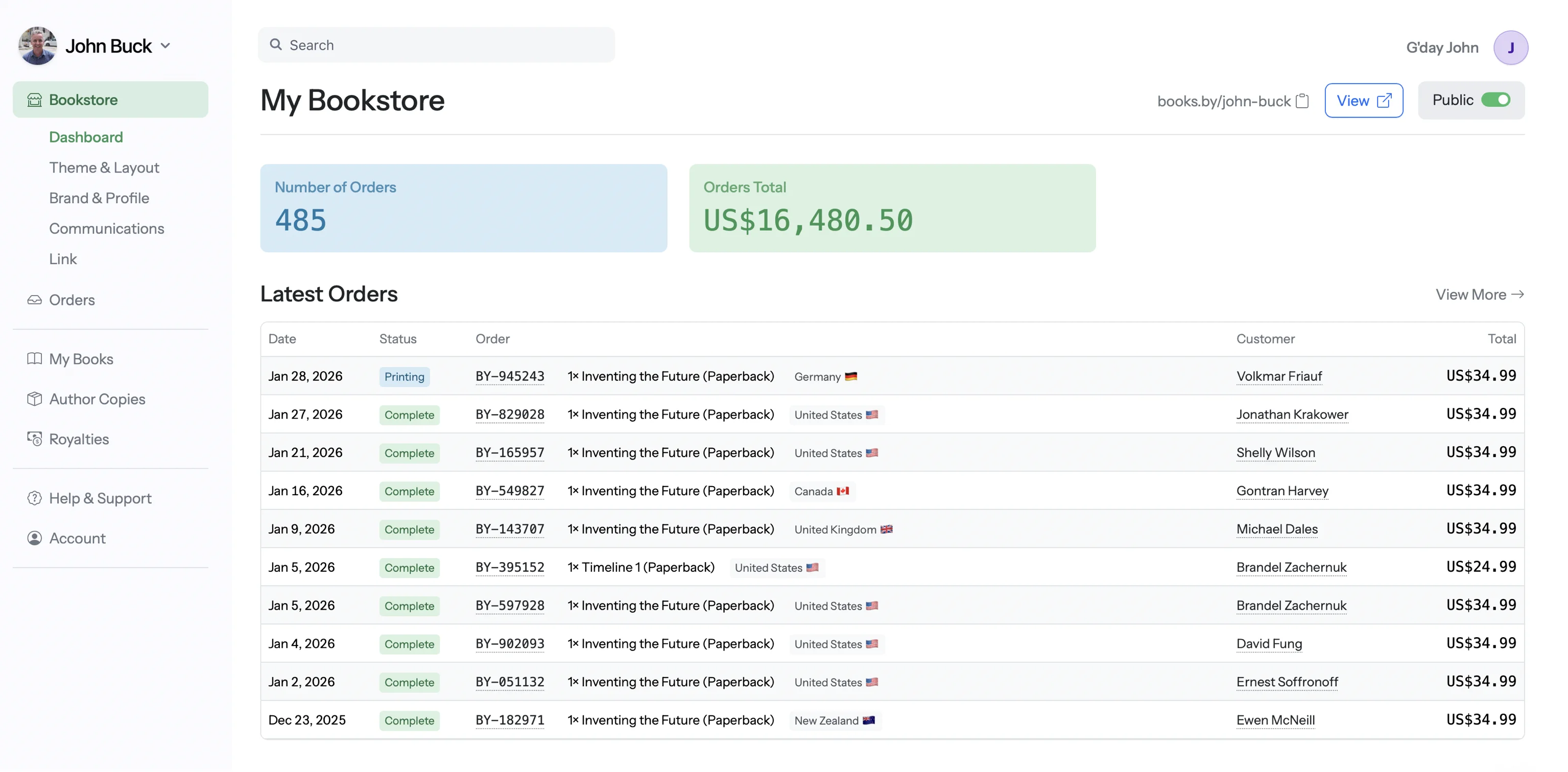
On Books.by, where authors sell direct and keep 100% of royalties after print costs, a $15.99 paperback earns approximately $11.53 per sale. Authors who sell direct through Books.by keep an average of $4.73 more per paperback sale compared to Amazon. The same book traditionally published earns you $1.60–$2.40. That's a 4–7x difference per sale.
From our team: "When we launched Books.by in 2022, the debate was whether self-publishing was 'legitimate.' That conversation is over. The debate now is about which kind of self-publishing — Amazon-exclusive, wide distribution, or direct-to-reader — gives authors the best outcome." — Ash Davies, Founder
The Clock
Timeline: How Long Does Each Path Take?
📕 Traditional Publishing
📗 Self-Publishing
The speed difference is staggering. Self-published authors can go from finished manuscript to live book in 4–12 weeks. Traditionally published authors are looking at 2–4 years — assuming they get a deal at all.
For genre fiction authors writing series (romance, thriller, fantasy), speed is a massive competitive advantage. Readers want the next book quickly. Self-publishing lets you release 2–4 books per year, building momentum and revenue. Traditional publishing typically produces one book every 12–18 months.
Your Vision
Creative Control: Who Decides What?
The Data
Income & Earnings: Real Numbers
Let's look at actual income data — not cherry-picked success stories, but realistic medians and distributions:
The honest truth: most authors — self-published or traditional — don't make a living wage from writing alone. The Authors Guild's 2023 survey found that the median annual income from writing was approximately $12,000–$15,000 for full-time traditionally published authors. For self-published authors, the data is scattered, but studies suggest the top 10% earn over $10,000/year while many earn much less.
However, the trajectory is different. Traditionally published authors typically see their best income in the first few months after release, then it fades. Self-published authors who continue writing and marketing can build a growing catalog where older books continue selling — creating compounding income over time.
Where Self-Publishing Wins on Income
- Per-book earnings are 3–7x higher due to royalty rates
- Catalog compounding — each new book drives sales of previous books
- Speed to market — more books per year means faster income growth
- No advance to "earn out" — every sale pays royalties immediately
- Price control — you can run promotions, raise prices, and optimize dynamically
Where Traditional Publishing Wins on Income
- Advances — upfront guaranteed money ($5,000–$10,000+ for debut; six figures for major deals)
- Subsidiary rights — foreign editions, audiobook deals, and film/TV options handled by the publisher
- Bookstore placement — physical bookstore presence drives impulse purchases
- Literary prizes — many major awards only consider traditionally published books
The Balance Sheet
Pros & Cons of Each Path
Self-Publishing
✅ Pros
- Higher per-book royalties (35–100%)
- Complete creative control
- Speed — publish in weeks, not years
- No gatekeepers or rejection
- Own your rights forever
- Direct reader relationships & customer data
- Flexible pricing and marketing
- Faster income from each sale
- Global availability from day one
❌ Cons
- Upfront investment required ($500–$5,000)
- You handle everything (or hire it out)
- No advance — you invest first, earn later
- Harder to get into physical bookstores
- Still carries a (fading) stigma in some circles
- Marketing is 100% your responsibility
- Quality depends entirely on your investment
- No support team — you're the CEO
Traditional Publishing
✅ Pros
- Advance payment (guaranteed income)
- Professional editing, design, production at no cost to you
- Bookstore placement and retail distribution
- Prestige and perceived credibility
- Subsidiary rights managed for you
- Access to major literary prizes
- A team working on your book
❌ Cons
- Very low royalty rates (10–25%)
- Extremely competitive — 1–2% acceptance rate
- Takes 2–4 years from manuscript to bookshelf
- Limited creative control
- Rights locked up for years (often life of copyright)
- No customer data — you don't know who buys
- Slow payments (twice yearly, after earning out)
- Most of the marketing still falls on you
- Books go out of print — rights reversion is slow
Find Your Path
Which Publishing Path Is Right for You?
Answer these 5 questions honestly, and we'll suggest the best publishing path based on your priorities.
1. What matters more to you?
2. How important is speed to market?
3. How do you feel about creative control?
4. Do you have an existing audience?
5. What's your primary goal?
📗 Self-Publishing Is Your Best Fit
You value speed, control, and maximizing income per sale. Self-publishing gives you all three — plus the ability to build a sustainable writing business with compounding catalog revenue. Books.by is built exactly for authors like you: 100% royalties, daily payouts, and your own branded storefront.
Start Your Books.by Store →📕 Traditional Publishing May Be Your Best Fit
You value prestige, bookstore placement, and professional support. Traditional publishing — if you can land a deal — gives you a team and an advance. Consider querying agents while also exploring self-publishing for other projects. Many authors do both!
🔀 The Hybrid Approach Is Your Best Fit
You see value in both paths — and the good news is you don't have to choose. Self-publish some books (for speed and income) while pursuing traditional deals for others (for reach and prestige). Books.by is perfect for your self-published titles: $99/year for unlimited books.
Start Your Books.by Store →Best of Both Worlds
The Hybrid Approach
You don't have to choose one path forever. The hybrid approach is increasingly common — and, in our view, often the smartest strategy.
Common hybrid strategies:
- Self-publish your series, query your standalone. Fast-moving genre series (romance, thriller, fantasy) thrive in self-publishing. A standout literary novel might be worth querying agents.
- Self-publish while querying. Don't wait 2–3 years for a "maybe" from a publisher. Self-publish one book, start building an audience, and continue querying agents with your next project.
- Reclaim backlist rights. If your traditionally published book goes out of print, revert the rights and self-publish it. Many authors earn more from their backlist self-published than they ever did traditionally.
- Use self-publishing success to land a deal. Strong self-publishing sales are the best query letter. Many agents now scout successful self-published authors.
Frequently Asked Questions
In traditional publishing, a publisher acquires your manuscript, handles editing, design, printing, distribution, and marketing — in exchange for most of the revenue (authors earn 10–15% royalties). In self-publishing, the author handles or hires help for these tasks but keeps 35–100% of royalties and maintains full creative and business control.
Traditionally published authors typically earn 10–15% royalties on print and 25% on ebooks. The median advance for debut authors is $5,000–$10,000, though most books don't earn out. The Authors Guild found the median income for full-time traditionally published authors is approximately $12,000–$15,000/year.
Yes. Traditional publishing requires querying literary agents (acceptance rate ~1–2%), then the agent must sell to a publisher. Self-publishing has no gatekeepers — you can publish immediately on platforms like Books.by or Amazon KDP. However, self-publishing requires you to invest in editing, cover design, and marketing.
Yes — this is called hybrid publishing and it's increasingly common. Check your traditional contracts for non-compete clauses, but many authors self-publish some titles while pursuing traditional deals for others.
From finished manuscript to bookstore shelves: 2–4 years. Querying agents (3–12 months), agent selling to publisher (3–12 months), publisher production (12–18 months). Self-publishing can be done in 4–12 weeks.