Ash Davies
Founder of Books.by · Helped 50,000+ authors self-publish since 2014
Amazon KDP dominates online book sales. Lulu offers flexibility, direct sales, and more print options. Both are free to use. Here's when to choose each — and why smart authors often use both.
| Feature | Amazon KDP | Lulu | Books.by |
|---|---|---|---|
| Platform Type | Marketplace (Amazon only) | POD + Marketplace + Distribution | Direct-to-reader storefront |
| Setup Cost | Free | Free | $99/year (unlimited titles) |
| Royalty Rate | 60% minus print cost | 80% (direct) / ~50% (retail) | 100% (minus print + processing) |
| Typical Royalty* | $5.74 | $5.99 (direct) | $9.60 |
| Payout Speed | 60 days | Monthly ($20 min) | Daily |
| Amazon Sales | ✓ Native (best ranking) | ✓ Via distribution (worse ranking) | ✗ Not applicable |
| Direct Sales Option | ✗ | ✓ Lulu Bookstore | ✓ Your branded store |
| Hardcover Options | ✓ Limited formats | ✓ Casewrap + dust jacket | ✓ |
| Trim Size Options | 15+ sizes | 30+ sizes (more flexibility) | 15+ sizes |
| Free ISBN | ✓ (KDP-imprinted) | ✓ (Lulu-imprinted) | ✓ (unrestricted) |
| Customer Data | ✗ Anonymous | ✓ Direct sales only | ✓ Full details |
| Cover Builder | ✓ | ✓ | ✓ |
| Global Printing | USA, UK, EU, AU, JP | USA, UK, EU, AU | USA, UK, EU, AU |
| Best For | Amazon marketplace sales | Flexibility, direct sales, niche formats | Your own traffic, highest margins |
*Based on a 200-page B&W paperback at $19.99 retail. Lulu assumes direct sale through Lulu Bookstore.
Here's what most comparison articles won't tell you: KDP and Lulu are solving different problems.
Amazon KDP is a marketplace. It exists to sell books on Amazon. That's its strength — Amazon is where most people buy books online. But you're locked in. No direct sales. No customer emails. No selling anywhere else through KDP. When you publish with KDP, you're renting shelf space in Amazon's store.
Lulu is a printing and distribution platform. It can distribute to Amazon, but that's just one channel. You can also sell directly through Lulu's bookstore, order author copies at print cost, and access retail channels KDP can't reach. Lulu treats you more like a publisher than a vendor.
The strategic difference? KDP gives you access to Amazon's customers. Lulu gives you flexibility to reach customers however you want. Most authors who sell consistently use both — KDP for Amazon visibility, Lulu (or a direct sales platform like Books.by) for everything else.
Let's break down the math on a $19.99 paperback (200 pages, black & white, 6"×9").
For direct sales, Lulu beats KDP. But here's the catch: Lulu's Bookstore has virtually no organic traffic. You're not going to get discovered there. It's only useful if you're driving your own traffic — and at that point, why give Lulu 20% when platforms like Books.by let you keep 100%?
For Amazon sales specifically, you must use KDP. Lulu can distribute to Amazon, but your book won't rank as well, won't qualify for Prime, and you'll earn less due to the wholesale discount.
Use KDP for Amazon — it's the only way to properly compete on the world's largest bookstore. Use Lulu for specialty formats, author copies, and non-Amazon distribution. And for your own traffic — your email list, social media, website visitors — use a 100% royalty platform like Books.by instead of either.
Neither KDP nor Lulu is built for the author who has their own audience.
If you've built an email list, have a social media following, run a podcast, or speak at events — you have your own traffic. Sending that traffic to Amazon or Lulu means giving away 20-40% of every sale to a middleman.
Think about it: someone on your email list already knows you. They don't need Amazon's recommendation algorithm to find you. They don't need Lulu's marketplace. They're ready to buy — the only question is where you send them.
This is where direct sales changes everything.
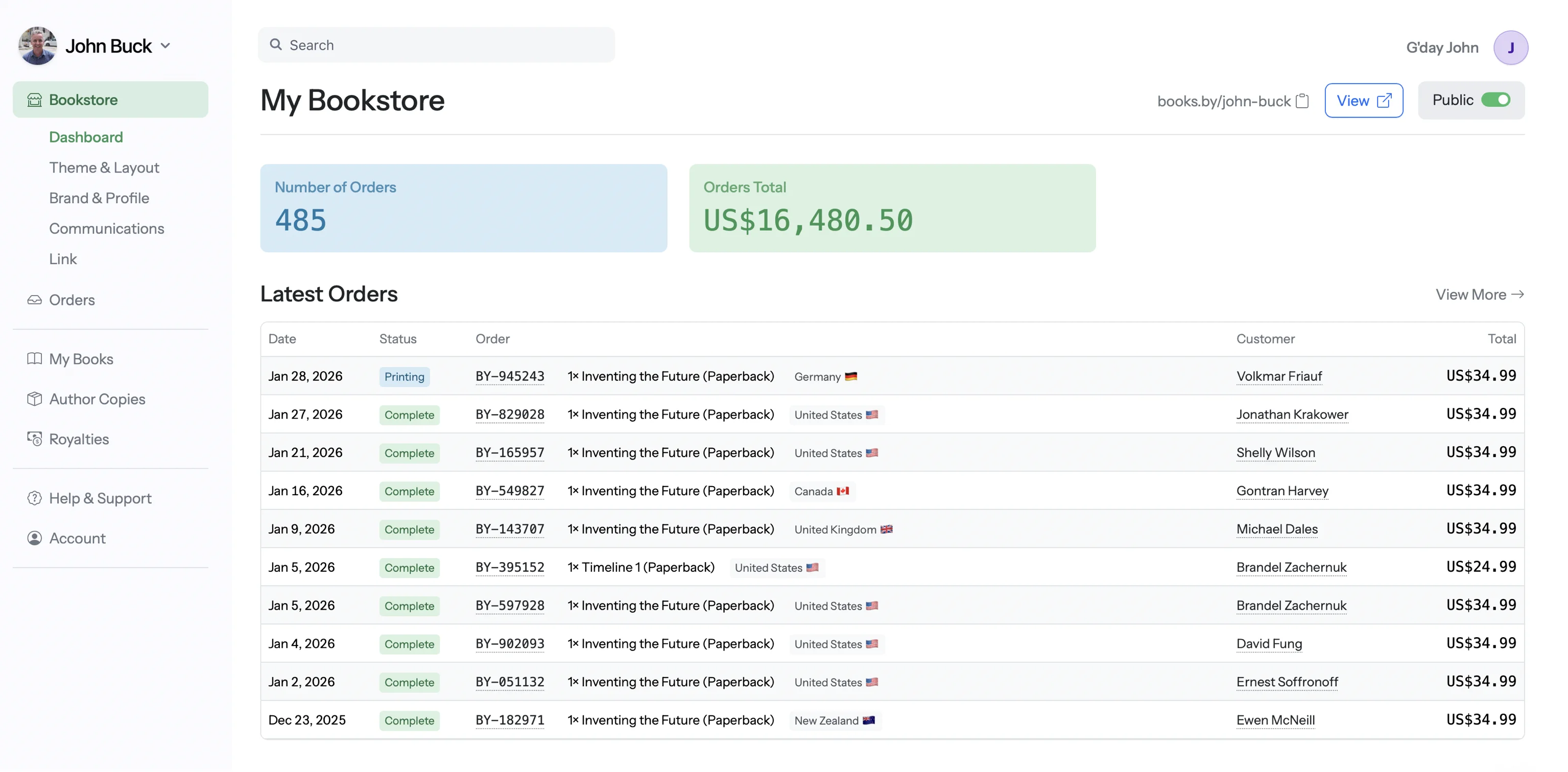
With a direct sales platform like Books.by, you keep 100% of royalties, get customer emails with every order, and get paid daily — not 60-90 days later. Use KDP for Amazon discovery. Use Lulu for specialty formats. Use Books.by for everyone who already knows your name.
Both KDP and Lulu produce professional-quality books. Lulu has a slight edge for color printing and premium finishes. KDP is excellent for standard black and white paperbacks. Honestly, most readers couldn't tell the difference.
Lulu wins here. More trim sizes (including square formats), more paper options, casewrap and dust jacket hardcovers, and support for specialty products like calendars and photo books. If KDP's standard options don't work for your project, Lulu probably has what you need.
KDP wins here. Kindle dominates ebook sales. Lulu offers ebook distribution, but it goes through third parties and isn't competitive with KDP for Amazon ebook sales. For ebooks, you want KDP for Amazon, and Draft2Digital or direct publishing for other retailers.
Both offer author copies at print cost. Lulu's global fulfillment can be handy for international authors. KDP limits author copies to your home marketplace, which can be frustrating if you're traveling or doing international events.
It depends on your priorities. KDP is better for Amazon sales and marketplace reach. Lulu is better for direct sales flexibility, hardcover options, and global distribution beyond Amazon. Many authors use both strategically.
Yes, KDP now offers hardcover printing for most markets. However, Lulu has offered hardcovers longer and provides more trim size options, including casewrap and dust jacket finishes. For specialized hardcover formats, Lulu may offer more flexibility.
Both produce professional-quality books. Lulu is often praised for slightly better print quality on premium options and color books, while KDP offers consistent quality for standard paperbacks. The difference is minimal for most black and white fiction.
Lulu's direct sales give you 80% of retail price (minus print cost), compared to KDP's 60% (minus print cost). For global distribution, both end up similar after wholesale discounts. For direct sales from your own traffic, Lulu — or even better, Books.by at 100% — pays more than KDP.
Yes, but be strategic. Use KDP for Amazon sales (it ranks better than third-party distribution). Use Lulu for direct sales from your website, or for formats KDP doesn't support. You'll need different ISBNs for each if you want separate tracking.
Lulu pays monthly with a $20 minimum threshold. KDP pays 60 days after the end of the month in which the sale occurred. If speed matters, direct sales platforms like Books.by pay daily.
Yes, Lulu can distribute to Amazon through their Global Reach network. However, books distributed this way don't perform as well in Amazon's algorithm as books published directly through KDP. For Amazon sales, KDP is the better choice.
Use KDP for Amazon. Use Lulu for specialty formats. Use Books.by for your own traffic — and keep everything you earn.
Start Your Bookstore →