Everyone has a story worth telling. But not everyone knows how to tell it well — or how to navigate the particular minefield of writing about real people, real events, and real emotions. Memoir isn't fiction, but it's not journalism either. It occupies uncomfortable middle ground where truth meets craft, and where your family might actually read what you've written.
The good news: more people are successfully self-publishing memoirs than ever before. Print-on-demand means you can create a professional book without ordering thousands of copies or investing your life savings. You can start with fifty copies for family and see what happens. Or you can aim for wider audiences and build a real readership.
Either way, memoir has specific challenges that fiction and nonfiction don't share. This guide covers what memoirists specifically need to know: writing about real people without getting sued (or disowned), finding structure in the chaos of a real life, making personal stories universal, and producing a book that looks as professional as anything from a major publisher.
How to Write About Real People in a Memoir
This is where memoir gets complicated. You're not making people up — you're describing people who have their own memories, their own perspectives, and their own lawyers.
The Legal Landscape
Three potential legal issues arise when writing about real people:
- Defamation: Publishing false statements that harm someone's reputation. Truth is an absolute defense — if it happened, you can write about it. But "I remember it this way" isn't the same as provable truth.
- Invasion of privacy: Disclosing private facts about someone that would be offensive to a reasonable person and aren't matters of public concern. Yes, your ex-husband's affair happened, but does the world need to know?
- Right of publicity: Using someone's name or likeness for commercial gain without permission. Less relevant for memoir, more for celebrity subjects.
The Practical Reality
Most memoirists don't get sued. But some get disowned. The legal question and the relational question are different. You might be legally clear to write about your mother's alcoholism, but doing so might end your relationship with your entire family.
Consider your actual goals. If this memoir is primarily for future generations — a record of what happened — family harmony might matter more than complete disclosure. If it's therapeutic or meant for public audiences, you may need to prioritize the story over the relationships.
Strategies for Navigation
- Change names and identifying details: A simple disclaimer stating you've changed names to protect privacy gives you significant protection. Change locations, professions, and physical descriptions if the real identity isn't essential.
- Get consent: For living people who feature prominently, consider showing them their sections before publication. This isn't required, but it prevents surprises and gives them opportunity to correct genuine factual errors.
- Focus on your experience: "I felt abandoned when he left" is safer than "He abandoned his children." The former is your emotional truth; the latter is a characterization he might dispute.
- Consult a lawyer: If you're writing about potentially actionable content — abuse, crimes, professional misconduct — a pre-publication legal review costs less than a lawsuit.
Memoir Structures: How to Organize Your Life Story
Real life doesn't have a plot. Events happen in chronological order, but that doesn't mean chronological order is the best way to tell your story. Structure is where memoir either succeeds or fails — and it's where most first drafts need the most work.
Chronological Structure
The obvious approach: start at the beginning, end at the end. This works when the timeline itself is compelling — illness memoirs, year-abroad stories, relationship arcs with clear progression. It struggles when years pass without dramatic change, or when the interesting parts are scattered across decades.
Thematic Structure
Organize around themes rather than time. A chapter on loss. A chapter on identity. A chapter on forgiveness. This works well for memoirs that span many years or cover complex subjects without a single dramatic arc. The risk: it can feel scattered if themes aren't clearly defined.
Braided Narrative
Weave multiple timelines or storylines together. Maybe you alternate between childhood and adulthood, showing how the past shaped the present. Maybe you braid your story with a parent's or grandparent's story. This is sophisticated and powerful when done well — confusing when done poorly.
The Frame Story
Start with a present-day scene, flash back to the past, return to the present at the end. The frame gives readers context for why this story matters now. It works particularly well for memoirs about the past that have been processed with distance and insight.
Finding Your Narrative Arc
Here's the hard truth: a real life is not a story until you make it one. You have to find the through-line. What changed? What did you learn? What's the difference between who you were at the beginning and who you are now?
Not every memoir needs a dramatic arc, but every memoir needs a reason for existing. "These things happened to me" is not enough. "These things happened to me, and here's what they mean" gives readers something to hold onto.
How to Make Your Memoir Resonate With Readers Beyond Your Family
The hardest question for any memoirist: why would anyone outside your family care about your life? It's not a cruel question — it's an essential one. And the answer isn't that you're special. The answer is that you're human.
Finding the Universal in the Particular
Your specific story about losing your mother becomes a universal story about grief. Your specific story about immigration becomes a universal story about identity and belonging. Your specific story about career failure becomes a universal story about purpose and reinvention.
The details are yours and yours alone. The emotional truth is shared by everyone who has ever experienced something similar. That's the magic of good memoir: it's deeply personal and universally resonant at the same time.
Theme as Connective Tissue
What is your memoir really about? Not the events — the meaning. A memoir about a marriage might really be about the price of ambition. A memoir about travel might really be about running from yourself. A memoir about illness might really be about finding faith.
Figure out your deeper theme, and it becomes the lens through which you select what to include and what to leave out. Everything in the book should illuminate that theme. Everything that doesn't should probably go.
Editing Your Memoir
Memoir needs editing more than any other genre. Fiction writers can invent scenes; nonfiction writers follow external structures. Memoirists face the hardest challenge: sculpting something coherent from the raw material of a real life.
Developmental Editing
This is the big-picture edit: structure, pacing, character development, scene selection, theme. For memoir, it's crucial. A developmental editor helps you see your story from outside — what's compelling, what's repetitive, what's missing, what's self-indulgent.
Budget $1,500–$4,000 for developmental editing. It's a significant investment, but it's the difference between a draft that works for you and a book that works for readers.
Line Editing and Copyediting
Once structure is solid, line editing polishes prose at the sentence level. Copyediting catches grammar, punctuation, and consistency errors. These matter, but they're not the hard work. Structure is the hard work.
Beta Readers
Before or after professional editing, recruit beta readers — ideally some who know you and some who don't. The people who know you will catch inaccuracies and flag potentially sensitive content. The people who don't will tell you whether the story works on its own merits.
Cover Design for Memoir
Your memoir cover needs to look professional. This is non-negotiable. Readers judge books by their covers, and an amateurish cover signals an amateurish book.
Avoid the Family Photo
It's tempting to put a cherished family photo on your cover. Resist the temptation. Family photos almost never work as book covers. They look like vanity projects. They don't translate well to thumbnail size. They signal "this book is for my family" rather than "this book is for you."
What Works Instead
- Evocative imagery: A landscape, an object, an abstract image that captures the mood or theme of your story
- Typography-forward: Strong title treatment with minimal imagery, letting words carry the weight
- Professional photography: If you use photos, use professional shots or high-quality stock images, not snapshots
- Genre-appropriate design: Look at memoirs in your category (grief, travel, humor) and match the design sensibility
Budget and Options
Professional cover design typically runs $300–$800 for a good designer. Books.by's Cover Builder offers free templates if budget is tight, but custom design is worth the investment for a book meant to reach beyond family.
Understanding Your Audience
Memoir readers skew older — often 50+. This affects both your writing and your publishing choices.
Simplicity Matters
Many memoir readers are less comfortable with technology than younger demographics. A complicated purchasing process loses sales. Books.by storefronts are designed for simplicity: readers click, buy, and receive a book. No accounts required. No complicated checkout flows.
Print Over Digital
Memoir readers strongly prefer print. Ebooks work for commuters and voracious fiction readers; memoir readers want something they can hold, lend, and display on shelves. Focus your efforts on producing a beautiful print book.
Price Expectations
Memoir readers expect quality books at competitive prices. Based on market research:
| Format | Typical Retail Price | Reader Expectation |
|---|---|---|
| Trade paperback | $14.99–$18.99 | Standard for memoir, competitive with traditional publishers |
| Hardcover | $24.99–$29.99 | Premium presentation, gift-worthy |
| Ebook | $7.99–$12.99 | Secondary format, supplement to print |
Marketing a Memoir
Memoir marketing differs from fiction marketing. You're not chasing Amazon algorithms or bestseller lists. You're building genuine connection with readers who care about your story.
Local Events and Book Clubs
Memoir thrives on personal connection. Local bookstores, libraries, community centers, churches — these are your venues. Book clubs love memoirs because they generate discussion. Offer to visit (virtually or in person) groups that read your book.
Speaking Opportunities
If your memoir addresses a specific experience — illness, addiction, career change, caregiving — organizations in that space may welcome speakers. A book gives you credibility. Speaking sells books. It's a virtuous cycle.
Legacy Over Bestseller
Most memoirists aren't trying to become professional authors. They're trying to preserve a story, share an experience, or leave something meaningful for future generations. That's a perfectly valid goal — and it changes how you think about success.
Success might be fifty copies distributed to family members who now understand your history. It might be a hundred copies sold to strangers who found comfort in your story. It might simply be finishing the book and holding it in your hands.
The Books.by Advantage for Memoir
Print-on-demand eliminates the traditional barriers to memoir publishing:
- No minimum orders: Print one copy or one hundred. Order exactly what you need when you need it.
- No upfront inventory: Traditional printing meant ordering thousands of copies and storing them in your garage. POD means books are printed when ordered.
- Author copies at printing cost: A 250-page memoir costs about $5.26 to print. Order 30 copies for family distribution at roughly $160.
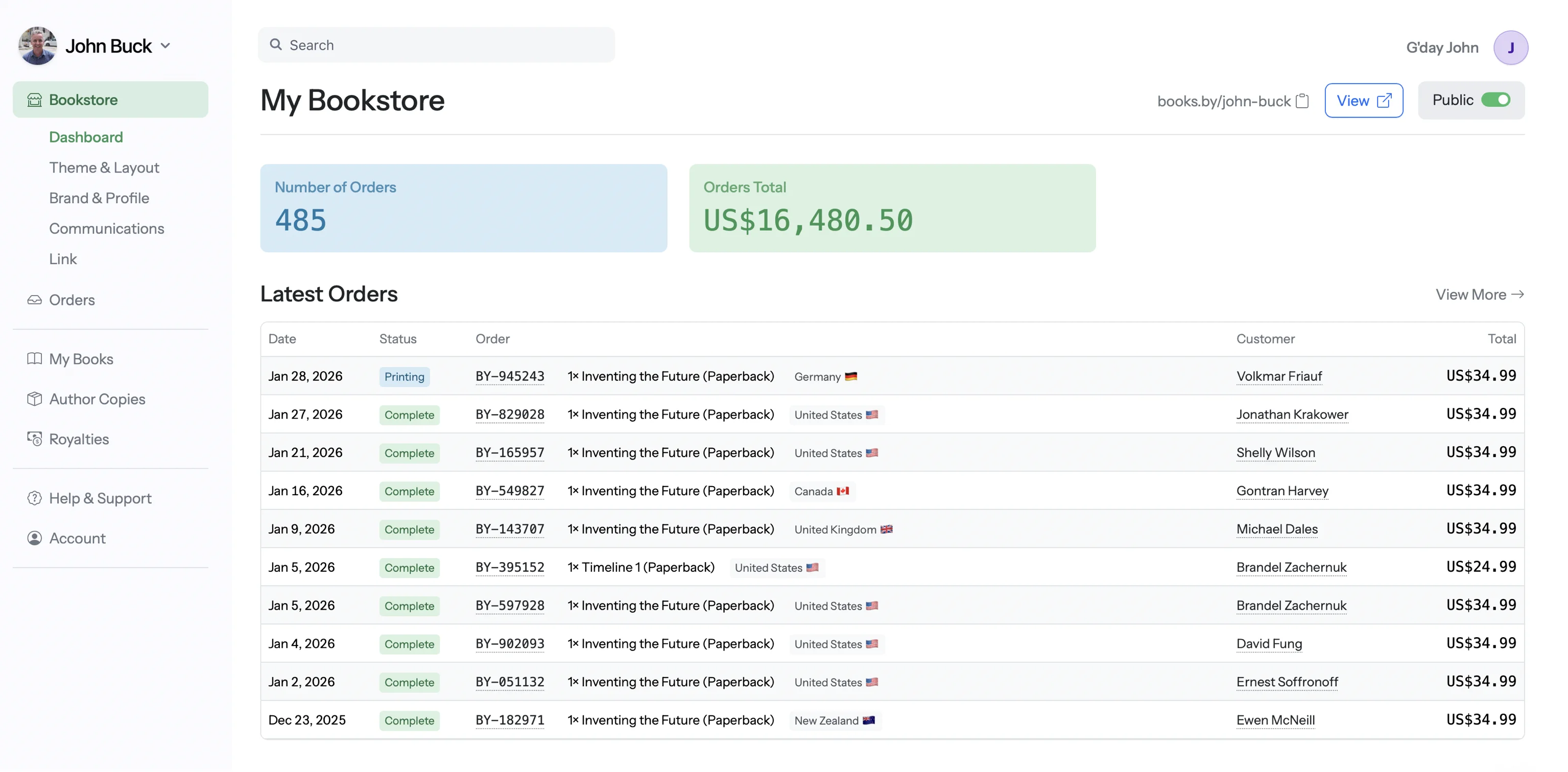
- Professional storefronts: If you want to sell beyond family, your Books.by storefront handles everything — listings, payment processing, shipping — while you keep 100% of royalties.
- Daily payouts: When books sell, you see money within days, not months.
| Memoir Length | Page Count | Print Cost (B&W) | 20 Copies Cost |
|---|---|---|---|
| Short memoir | 150 pages | $3.66 | $73.20 |
| Standard memoir | 250 pages | $5.26 | $105.20 |
| Long memoir | 350 pages | $6.86 | $137.20 |
Calculate Your Royalties
See how much more you could earn selling memoirs directly through Books.by compared to Amazon KDP.
Common Memoir Mistakes
Mistake 1: Starting at the very beginning. "I was born on a sunny day in June 1952..." Nobody cares. Start where the story gets interesting. Your childhood only matters if it directly shapes the story you're telling.
Mistake 2: Including everything. Your life has decades of experiences. Your memoir should have a focused theme or timeframe. More material doesn't make a better book — it makes a bloated one.
Mistake 3: Telling instead of showing. "My mother was a difficult woman" is telling. Showing is the scene where she criticizes your wedding dress, your career, and your husband all in the same conversation. Show the difficulty; let readers draw conclusions.
Mistake 4: Skipping the hard parts. If you sanitize your story, removing all conflict and difficulty, you remove the reason to read it. The hard parts are usually the interesting parts. Include them or reconsider whether you should write this book.
Mistake 5: Waiting for perfect. Your memoir will never feel finished. At some point you have to stop revising and publish. A book in the world does more than a manuscript that's perpetually almost ready.
Frequently Asked Questions
Legally, you can write about real people without permission if you stick to truthful accounts. However, getting consent from living people mentioned significantly reduces legal risk and preserves relationships. Consider changing names and identifying details for anyone who might object.
With Books.by, memoir publishing costs $99/year for platform access plus printing costs ($1.26 base + $0.016/page for B&W). A typical 250-page memoir costs about $5.26 per copy to print. Professional editing ($1,500-$4,000) and cover design ($300-$800) are optional but recommended investments.
Memoir benefits from developmental editing more than any other genre. Structure is everything — finding the narrative arc in a real life is genuinely difficult. A developmental editor helps identify what to include, what to cut, and how to arrange events for maximum impact. Budget $1,500-$4,000 for this crucial investment.
Autobiography covers an entire life chronologically. Memoir focuses on a specific period, theme, or aspect of life — a marriage, an illness, a career, a transformation. Memoir is more intimate and thematic; autobiography is more comprehensive. Most first-time authors write memoir, not autobiography.
You can, but you probably shouldn't. Family photos rarely work as professional book covers — they look amateurish and signal 'vanity project' to readers. Professionally designed covers that evoke your story's themes perform much better, even for personal memoirs intended primarily for family.
Find the universal in the particular. Your story about losing a parent becomes a story about grief. Your immigration story becomes a story about identity. Your career memoir becomes a story about purpose. The specific details are yours; the emotional truth is shared by everyone.
With print-on-demand, start with what you need — maybe 20-50 copies for family and friends. You can always order more. If you're also selling publicly, your Books.by storefront handles orders individually, so you never need to guess demand or maintain inventory.