
I'll be honest: romance authors taught me everything I know about indie publishing. They were building profitable businesses while literary fiction authors were still debating whether Amazon was dignified. Romance authors didn't have time for that — they were too busy writing the next book in their series.
If you want to self-publish romance, you're entering a world that rewards speed, reader obsession, and business savvy. The good news is the playbook is relatively clear. The tricky part is execution.
The Economics of Romance Publishing
Let's start with money, because that's what separates romance from most other genres: there's real money to be made, but only if you understand the math.
Romance readers are voracious. The average romance reader consumes 1-2 books per week. Compare that to literary fiction readers (maybe 1-2 books per month) or non-fiction readers (a few books per year). This reading velocity creates both opportunity and pressure.
The opportunity: a reader who discovers your book and likes it will often buy your entire backlist within days. I've watched Books.by authors go from 1 sale to 40 sales from a single reader in a weekend. That doesn't happen in other genres.
The pressure: if you only have one book, you're leaving money on the table. If you release slowly, readers move on to authors who publish more frequently. Romance isn't a genre for the author who wants to spend three years perfecting a single novel.
KU vs Wide: The Big Decision
Every romance author faces this question: go exclusive with Kindle Unlimited, or sell "wide" across multiple platforms?
The case for KU is visibility. Amazon's algorithm rewards KU enrollment with better placement, and romance readers are heavy KU users — they can't afford to buy every book at their reading pace. In competitive subgenres like contemporary romance, dark romance, and paranormal, KU can generate significant page-read income.
The case for going wide is ownership. When you're exclusive to Amazon, you're one algorithm change away from losing your income. We've seen it happen. Authors who built their entire business on KU page-reads suddenly found their income cut in half when Amazon tweaked the algorithm.
My take: KU is a reasonable place to start, especially if you don't have an existing audience. Use the visibility to build a mailing list, then gradually move your backlist wide as you establish direct reader relationships. The goal is to never be completely dependent on any single retailer.
This is where direct sales become powerful. A reader who buys from your Books.by store is your reader — you have their email, you keep 100% of royalties, and you're not competing with Amazon's recommendation engine pushing them toward other authors.
Cover Design: Where Romance Is Ruthlessly Unforgiving
In no other genre are covers as genre-codified as romance. Get it wrong, and readers won't click. Get it right, and you're signaling exactly what they can expect inside.
The Visual Language of Romance Subgenres
- Contemporary Romance: Illustrated couples or shirtless man. Bright, appealing colors. Often includes a visual setting cue (beach, city, small town).
- Romantic Comedy (RomCom): Bright, bold colors. Illustrated or cartoon-style characters. Playful, chunky fonts. Often includes quirky visual elements (wedding disasters, awkward situations).
- Dark Romance: Moody, desaturated colors. Shadowed male figure, often from behind or with obscured face. Black, gray, dark blue palette. Script fonts with sharp edges.
- Historical Romance: Period-appropriate dress and setting. Ornate, elegant fonts. Softer color palettes. The couple may be in a clinch or the woman alone in an evocative pose.
- Paranormal/Fantasy Romance: Supernatural elements visible (fangs, wings, magic). Dramatic lighting. Often dark backgrounds with a pop of color. The male may show supernatural features.
The key insight: romance readers are scanning at thumbnail size. Your cover must communicate the subgenre in a fraction of a second. They're not studying it — they're pattern-matching against thousands of other covers they've seen.
The biggest mistake I see is authors who want their cover to be "different" or "unique." In romance, unique often means invisible. Readers' eyes slide right past covers that don't match their expectations.
Heat Level Signaling
Your cover also needs to signal the heat level:
- Sweet/Clean: Illustrated couples (not photographic), often clothed and in wholesome settings. Bright, cheerful palette.
- Steamy: Shirtless man, or couple in a clinch. Photo-realistic style. More saturated, sensual colors.
- Dark/Explicit: Moody, often shadowed. Man often alone and from behind. Chains, ropes, or other subtle BDSM signifiers for that niche.
A sweet romance reader who accidentally buys dark romance based on misleading cover will leave a 1-star review. Cover accuracy isn't just about attracting readers — it's about attracting the right readers.
The Series Strategy
If there's one piece of advice that applies to 95% of romance authors, it's this: write in a series.
Romance readers want to fall in love with a world and spend more time there. They want to see the secondary characters from book one get their own love story in book three. They want to revisit the coffee shop, the small town, the pack of werewolves.
The most successful format is interconnected standalones: each book features a different couple and can be read independently, but all books share a world (a town, a friend group, a workplace, a family). This gives readers the satisfaction of a complete romance in each book while creating momentum to read more.
Series Length Strategy
A trilogy is the minimum. Readers who love book one and see books two and three will often buy immediately. But many successful romance authors write 5-12 book series — and some have series that run even longer.
The practical challenge is launch fatigue. Readers who've been with you since book one may be tired by book eight. Fresh readers have a huge backlist to navigate. Some strategies:
- Offer the first book free or at $0.99 to lower the barrier to entry
- Create box sets of books 1-3 for readers who want to binge
- Write spin-off series that connect to your existing world but feel fresh
Release Strategy: Speed Matters
This is where romance diverges dramatically from other genres. In literary fiction, you might release one book every two to three years. In romance, that pace is a death sentence.
The benchmark for KU success is releasing every 6-12 weeks. Wide authors can sustain every 3-4 months. Slower than that, and you're constantly fighting to regain momentum.
This is why many romance authors:
- Write shorter books (50,000-70,000 words versus 80,000-100,000 in other genres)
- Use detailed outlines to write faster without sacrificing plot coherence
- Dictate instead of typing to increase daily word count
- Hire developmental editors who can turn around quickly
The rapid release strategy isn't for everyone. If you write slowly and carefully, romance may not be the genre where you compete on volume. But you can still succeed by focusing on building a fiercely loyal superfan base — which is where direct sales become essential.
Pricing Your Romance Novels
Romance readers are price-sensitive, especially for new-to-them authors. Here's what works:
| Format | Price Range | Notes |
|---|---|---|
| First-in-series ebook | $0.99 or free | Reader magnet to get them hooked |
| Standard ebook | $3.99–$4.99 | Sweet spot for most romance |
| Box set (3+ books) | $5.99–$9.99 | Value pricing for binge readers |
| Paperback | $12.99–$16.99 | Romance readers increasingly collect prints |
| Special edition | $24.99–$39.99 | Sprayed edges, foil, bonus content |
One thing Amazon's pricing tiers punish: books priced between $2.00 and $2.98 earn only 35% royalty instead of 70%. That's a significant penalty. On Books.by, you keep 100% royalties at any price point — no artificial tiers forcing you into Amazon's preferred pricing.
Calculate Your Royalties
See how much more you could earn selling romance novels directly through Books.by compared to Amazon KDP.
Building Your Superfan Base
Here's what separates romance authors earning $5K/year from those earning $50K/year: superfans.
A superfan doesn't just read your books — they preorder every release, buy special editions, recommend you to friends, leave reviews, and join your reader community. Ten superfans are worth more than 1,000 casual readers.
How to Cultivate Superfans
1. Your mailing list is everything. Include a signup call-to-action in the back matter of every book. Offer a free novella, bonus epilogue, or extended scene as incentive. The readers who sign up are self-selecting as your most interested audience.
2. Sell directly. When superfans buy from your own store (rather than Amazon), you get their email address, you keep 100% of royalties, and you can offer them exclusive content. Books.by authors often find that their direct buyers are 3x more likely to buy special editions and bundles.
3. Create exclusive content. Bonus epilogues, character Q&As, signed bookplates, early cover reveals — give your email list things that aren't available anywhere else.
4. Build community. A Facebook reader group, a Discord server, or even a Substack with discussion threads. Romance readers love talking about books, and they love feeling connected to the author.
The Case for Direct Sales in Romance
Most romance authors start on Amazon. It's the biggest market, and KU provides visibility while you build your backlist. But as your career matures, direct sales become increasingly important.
Why? Because romance readers are uniquely loyal. Once they love an author, they'll follow them anywhere — including to a direct sales store.
The math is stark. On a $4.99 ebook:
- Amazon (70% royalty tier): You earn $3.49
- Books.by (100% royalty): You earn $4.69 after payment processing
That's $1.20 more per book. If you're selling 500 books a month from your mailing list, that's an extra $600/month — $7,200/year — from the same sales, just on a different platform.
But here's the bigger win: you get the customer email. When a reader buys from Amazon, you never know who they are. When they buy from your Books.by store, you can add them to your mailing list (with permission), send them exclusive content, and notify them directly when your next book launches.
This is how you stop being dependent on Amazon's algorithm and start building an audience you actually own.
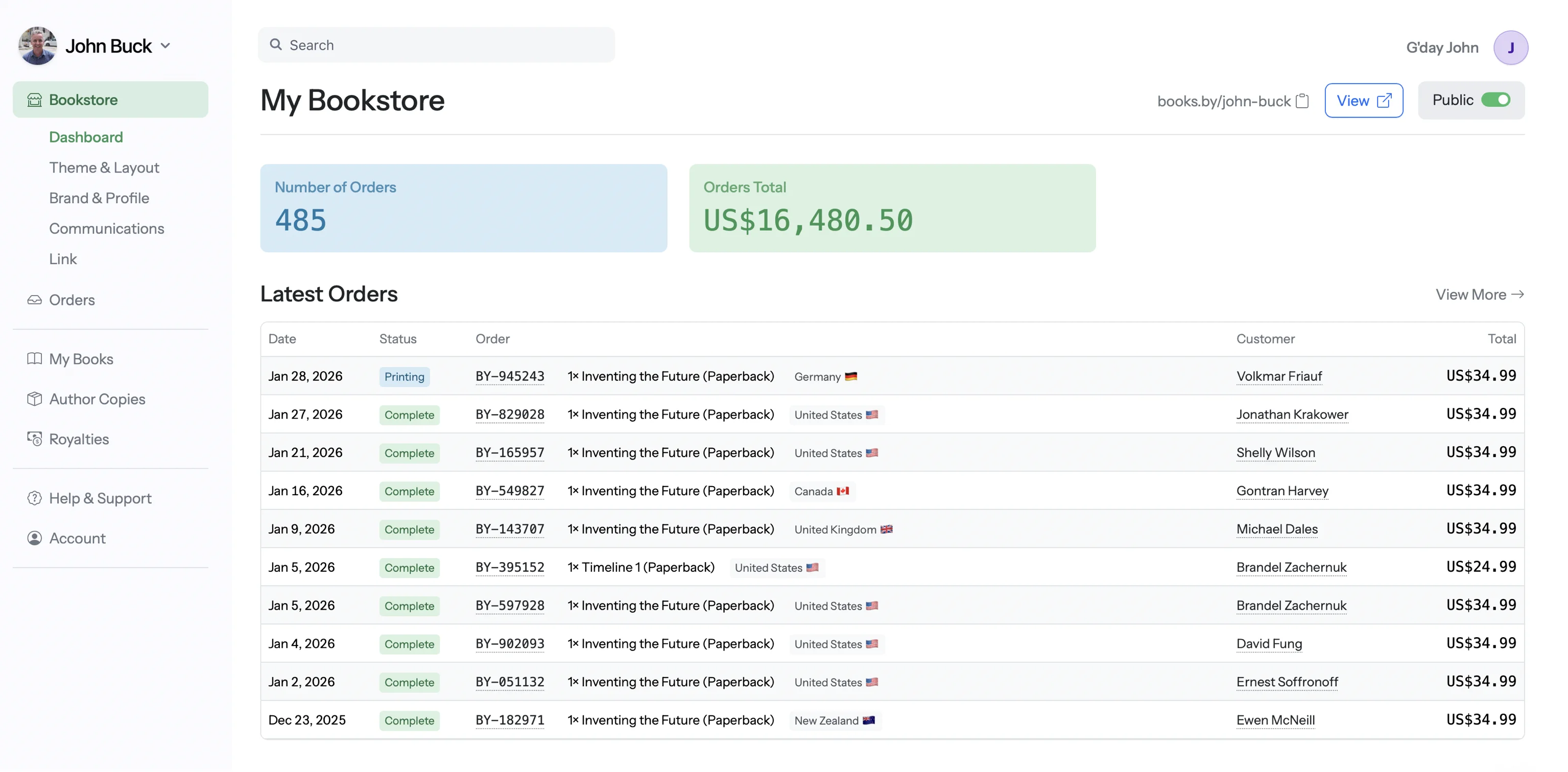
Turn Your Romance Readers Into Superfans
Build your own bookstore, sell directly to readers, and keep 100% of royalties. Get customer emails with every sale. $99/year, unlimited books.
Marketing Channels That Work for Romance
Romance has its own marketing ecosystem. What works in other genres often doesn't apply here.
What Works
BookTok: Romance dominates BookTok. A single viral video can move thousands of copies. The catch is it's nearly impossible to manufacture — you can post consistently and hope something catches, but there's no formula.
Newsletter swaps: Partner with other romance authors in your subgenre to cross-promote to each other's mailing lists. This is one of the most reliable ways to grow your audience.
Promo stacks: Coordinate a price drop ($0.99 or free) with multiple newsletter promotion services (BookBub, Freebooksy, Written Word Media) on the same day. The combined effect can push you onto bestseller lists.
ARC teams: Advanced Reader Copy teams. Build a group of readers who receive early copies in exchange for honest reviews on launch day.
Facebook reader groups: Both your own reader group and larger genre-wide groups. Romance readers are highly active on Facebook.
What Often Doesn't Work
Generic book marketing advice: Most book marketing content is written for non-fiction or literary fiction. Romance has its own rules.
Bookstore events: Unless you're writing small-town romance with local appeal, most romance readers aren't discovering new authors in physical bookstores.
Instagram (alone): Bookstagram is beautiful but lower-converting than BookTok or newsletters. It can be part of your strategy, but it's rarely the driver.
A Note on Writing Quality
I've emphasized business strategy throughout this guide because, frankly, that's what most resources get wrong. But I don't want to leave the impression that the writing doesn't matter.
It matters a lot. Romance readers have high expectations. They want emotional depth, satisfying character arcs, and genuine chemistry. They can smell a lazy book written just to hit a release schedule.
The difference is that romance readers also understand what they're buying. They want tropes executed well — second chance romance, enemies to lovers, grumpy/sunshine. They want the emotional beats they're craving. "Predictable" isn't an insult in romance; it's a feature.
Write books that deliver on their promise. Nail the tropes your readers love. Give them the emotional experience they came for. That's the foundation. All the marketing strategy in the world can't save a book that doesn't satisfy its readers.
Frequently Asked Questions
Romance is one of the highest-earning indie genres. Top romance authors earn $100K-$500K+ annually. Mid-tier authors with 10+ books and consistent releases often earn $30K-$80K. The key variables are release frequency, series length, and whether you're in Kindle Unlimited. However, competition is fierce — most romance authors earn under $5K/year until they have a substantial backlist.
It depends on your subgenre and strategy. KU works well for contemporary romance, dark romance, and paranormal — readers in these subgenres binge-read and prefer subscription access. Historical romance and romantic suspense often perform better wide. If you're starting out, KU's page-read income can help, but you're trading long-term reader ownership for short-term visibility.
Romance covers signal subgenre through specific visual conventions. Contemporary: illustrated couples or shirtless man. RomCom: bright colors, illustrated style. Dark romance: moody, shadowed figures. Historical: period-appropriate dress, ornate fonts. Paranormal: supernatural elements, dramatic lighting. Your cover must clearly communicate the heat level and emotional tone.
The romance market rewards frequency. Successful KU authors typically release every 6-12 weeks. Wide authors can sustain every 3-4 months. Slower than that, and you risk losing algorithmic visibility and reader attention. Many romance authors write shorter books (50K-70K words) to maintain velocity.
For ebooks: $3.99-$4.99 is the sweet spot. First-in-series is often $0.99 or free. Box sets: $5.99-$9.99. For paperbacks: $12.99-$16.99 depending on page count. Romance readers are price-sensitive but voracious — they'll pay full price for authors they love.
Essentially, yes. Series dominate romance because readers fall in love with the world and want more. Interconnected standalones — where each book features a different couple but shares a world — are the most popular format. Standalone romance novels are much harder to market.
Offer a free novella or bonus epilogue in exchange for email signup. Place the offer in the back matter of every book. Use newsletter swaps with other romance authors. Your mailing list is your most valuable asset — it's the only way to guarantee visibility without relying on retailer algorithms.