The One Thing That Matters Most
Before you look at any tool, understand this: your email list is your most valuable marketing asset. Full stop. Social media followers are rented. Ad platforms change their algorithms. But an email list is yours — you can reach your readers directly, for free, anytime you want.
Everything else in this guide — promo sites, social tools, advertising — should feed into one goal: growing your email list and converting subscribers into buyers.
You need an email service provider (ESP) to manage your subscriber list, send newsletters, and automate sequences. Here are the three best options for authors.
MailerLite is the best starting point for most authors. The free tier includes automation, landing pages, and a drag-and-drop email builder — features that Mailchimp gates behind paid plans. The interface is clean and doesn't overwhelm you with options. Deliverability is solid.
It lacks ConvertKit's advanced tagging and some of Mailchimp's integrations, but for 90% of author email needs, MailerLite does the job at a fraction of the cost.
ConvertKit (recently rebranded to Kit) is the tool most full-time authors use. The tagging and segmentation system is excellent — you can tag readers by genre preference, series interest, or engagement level, then send targeted emails to each group. The landing page builder and automation sequences are best-in-class.
The free tier is functional but limited — you can collect subscribers and send broadcasts, but automations require the $29/month plan. Worth it once you have 1,000+ subscribers and want to build sophisticated launch sequences.
Mailchimp is the most recognized name in email marketing. It's fine. The free tier was cut to 500 subscribers in 2023, and many features that used to be free are now paid. The interface is more complex than MailerLite, and pricing scales steeply as your list grows.
If you're already on Mailchimp and it's working, there's no urgent reason to switch. But if you're starting fresh, MailerLite or ConvertKit give you more for less.
Promo sites send emails to large lists of readers who have opted in by genre. They're the fastest way to generate a spike in sales or downloads — especially for discounted books and free ebooks.
The gold standard. A BookBub Featured Deal puts your discounted or free book in front of millions of genre-specific readers. A single feature can generate hundreds to thousands of sales in 24 hours. The catch: acceptance rates are under 20%, and you typically need a strong review count, a professional cover, and a compelling price (free or $0.99).
Apply consistently. Getting rejected is normal — most authors apply 3-5 times before landing a feature. When you get one, it can change your book's trajectory.
Runs several promo sites including Freebooksy (free books), Bargain Booksy (discounted), and Red Feather Romance. Lower reach than BookBub but much easier to book. Good for stacking promotions — run a Written Word Media promo alongside a BookBub application to boost your numbers either way.
Part of Written Word Media's network. Freebooksy promotes free ebooks; Bargain Booksy promotes books under $3.99. Reliable delivery, decent download/sale numbers, and genre targeting. Not as powerful as BookBub, but available when you need them and acceptance is straightforward.
Social media is good for visibility and relationship-building, but poor for direct sales. The best approach: use social to drive people to your email list or direct sales page, not to try to sell books in a feed.
Scheduling tools that let you plan and automate social media posts across platforms. Buffer is simpler; Later is better for Instagram-heavy strategies. Both save time but won't magically grow your audience. The content still has to be good.
Creates book mockups, social media graphics, and ad images. Useful for generating professional-looking promotional images without Photoshop skills. The 3D book mockup tool is particularly popular — turn your cover into a realistic book image for Instagram, Facebook ads, or your website.
Paid advertising works for books, but the margins are tight. A $15 book with a $5 margin needs a cost-per-acquisition under $5 to break even. That's doable — but only if you're tracking everything and testing aggressively.
Amazon Ads put your book in search results and on competitor book pages within Amazon. They work because the buyer is already on Amazon looking for books — high purchase intent. The keyword targeting system rewards specificity: target exact comp titles and narrow genre terms, not broad keywords.
Start with $5–$10/day budget. Monitor ACOS (advertising cost of sales) — aim for under 70% on fiction, under 50% on non-fiction. Kill campaigns that aren't profitable after 2 weeks of data.
Facebook ads can work for books, but the economics are harder than Amazon. You're interrupting someone's feed, not meeting them in a buying mood. The strongest use case is driving traffic to a free reader magnet (lead generation) or to your Books.by storefront where your margin is highest.
Point Facebook ads at your direct sales page — not Amazon. On a $15 direct sale through Books.by, you keep ~$10. On the same sale through Amazon, you keep ~$3. That's the difference between profitable ads and burning money.
Books.by includes built-in Facebook Pixel and Google Analytics support — paste your Pixel ID and GA tag into your storefront settings, and every page view, add-to-cart, and purchase is tracked automatically. That means your Facebook ads can optimise against actual book sales (not just clicks), and you can build retargeting and lookalike audiences from real buyers. Try doing that on Amazon.
Separate from BookBub Featured Deals. BookBub Ads are a self-serve CPM (cost per thousand impressions) platform that targets BookBub's reader base by genre and author preference. Costs are generally lower than Facebook, and the audience is pre-qualified book buyers. Good for testing cover designs and ad copy at low budgets.
The Direct Sales Advantage
Here's what most marketing guides miss: where you send your traffic matters as much as how you generate it.
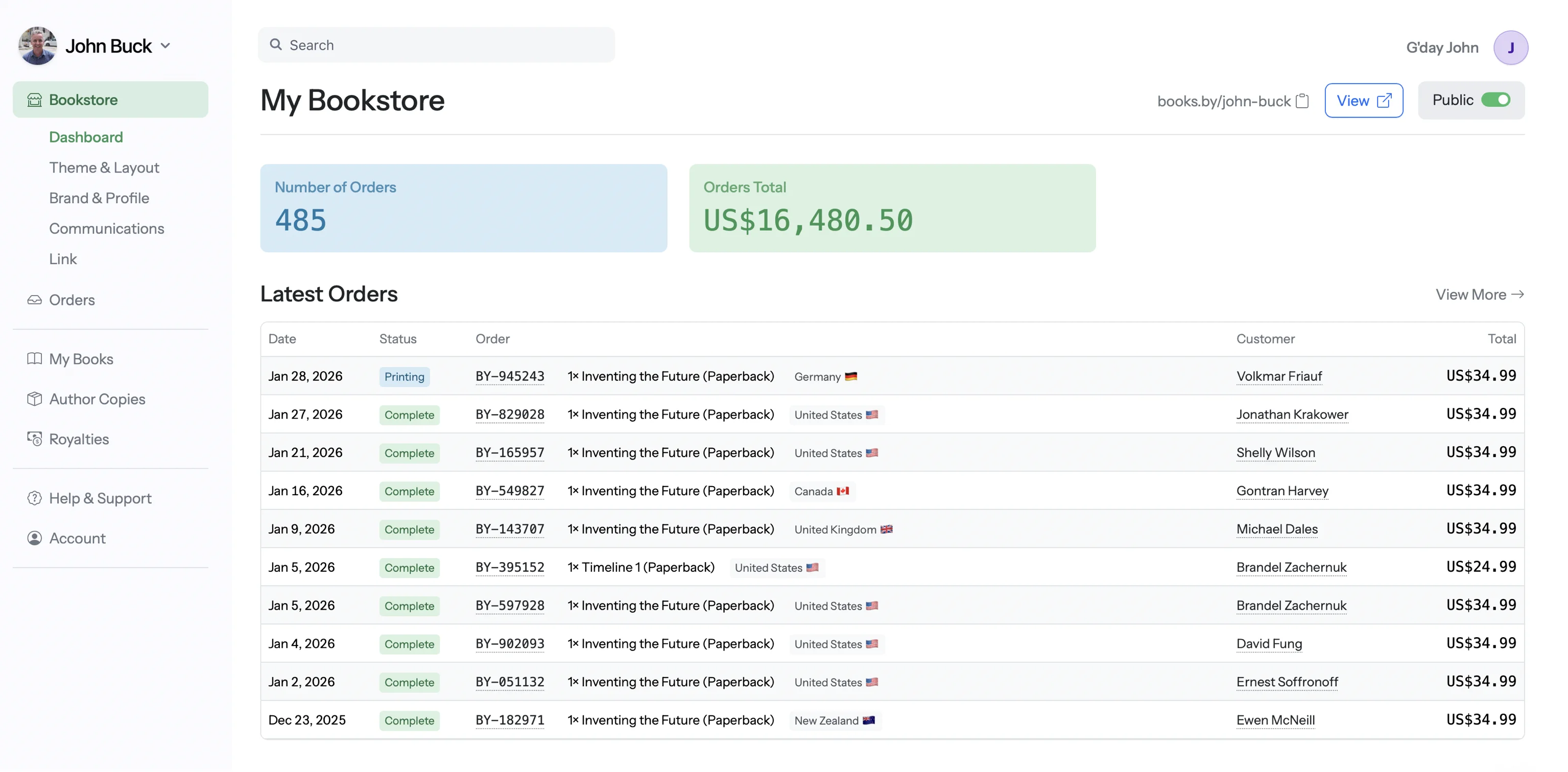
Every Books.by sale captures the buyer's email address. Not just for a newsletter signup — with every actual purchase. That means your marketing compounds. A Facebook ad that drives 50 sales to your Books.by store gives you 50 real customers you can email for your next launch. The same 50 sales on Amazon gives you royalties and nothing else.
Over time, your reader list becomes your most powerful marketing channel. Launch day emails to existing readers routinely outperform any paid promotion. And it costs you nothing to send them.
Build Your Reader List From Day One
Books.by captures reader emails with every sale — no extra tools, no opt-in forms. Start building your audience.
Get Started — Core $99/year →What's Included on Books.by Pro for Authors Who Run Ads
Most marketing tools cost extra: $20/mo for analytics, $30/mo for landing pages, $50/mo for cart abandonment. The Books.by Pro plan ($299/yr) bundles them in.
Core ($99/yr) covers the storefront, print fulfilment, dashboard, and email capture. Pro ($299/yr) adds the marketing stack above.
Frequently Asked Questions
MailerLite for best value (free up to 1,000 subs). ConvertKit for advanced segmentation and automation. Mailchimp if you're already on it. All three work — pick one and start building your list.
A BookBub Featured Deal is the most powerful single promotion in indie publishing. Acceptance rates are under 20%, but keep applying. BookBub Ads (self-serve) are a separate, more accessible option with lower but consistent results.
Start with $50–$200/month. Prioritize email list building first, then test one ad platform. Scale only when you can prove positive ROI. Many authors waste money on ads before building an email list — build the list first.
They can, but point them at your direct sales page (Books.by) where your margin is $10+ per book, not Amazon where your margin is $3. The higher margin makes the ad economics viable.
Your email list. Nothing else comes close. Social algorithms change, ad costs rise, but your email list is an asset you own. Every other tool should feed into list growth.