Most authors spend months (or years) writing their book, then spend approximately zero hours planning their launch. They hit "publish," post on social media, and wonder why nothing happens. This is the single most common mistake we see at Books.by — and it's entirely preventable.
A great book launch is engineering, not luck. The authors who sell 500+ copies in their first week didn't wake up that morning hoping for the best — they spent 3 months building an engine designed to deliver those sales. And the fuel that powers that engine? Your email list.
This guide gives you the complete book launch strategy, from 3 months before launch day to 3 months after. We'll cover the tactics that actually move copies, the reader engagement strategies that create superfans, and the infrastructure that makes it all work — including why owning your reader relationships (not renting them from Amazon) changes everything.
Why Most Book Launches Fail (And What Successful Ones Do Differently)
Before we build your launch plan, let's understand why most launches produce a disappointing trickle of sales instead of the flood authors hope for.
The 4 Launch Killers
What Successful Launches Have in Common
We've analysed launch data from thousands of Books.by authors. The pattern among those who sold 500+ copies in their first month is remarkably consistent:
- They started building their email list at least 3 months early. Most had 500+ subscribers before launch. Some had thousands.
- They had 20–50 ARC readers who posted reviews within 48 hours of launch.
- They activated existing readers — beta readers, street teams, super-fans — as a coordinated launch army.
- They owned their sales channel. A direct-to-reader storefront gave them customer data, 100% royalties, and the ability to remarket to every buyer.
- They treated launch day as the peak of a campaign, not the start of one.
Your Email List: The #1 Most Valuable Asset You'll Ever Build
If you take only one thing from this entire guide, let it be this: your email list is the single most important asset in your author career. Not your social media following. Not your Amazon ranking. Not your book cover. Your email list.
Here's why:
Why Email Beats Every Other Channel
- You own it. No algorithm can throttle your reach. No platform can ban you. No policy change can erase it. Your email list is yours.
- It reaches people. Email open rates for authors average 30–45% (per Kindlepreneur's data). Instagram organic reach is 5–15%. Facebook organic reach is 2–6%. The math is brutal for social media.
- It sells. Email subscribers are 3–10× more likely to buy than social followers. They've given you permission to be in their inbox — that's a fundamentally different level of trust.
- It compounds. Every subscriber you add today will see every launch you do in the future. After 5 books, that list becomes a money-printing machine.
From our team: "Our median Books.by author earns back their $99 subscription within their first 47 days. The ones who earn it back fastest? They all had email lists. Every single one." — Books.by Publishing Team
How to Build Your Email List (Starting From Zero)
You don't need thousands of subscribers to have a successful launch. 200 engaged readers will outsell 5,000 disengaged followers every time. Here's how to build that engaged list:
Step 1: Create Your Reader Magnet
A reader magnet is a free piece of content you offer in exchange for an email signup. The best reader magnets are:
Step 2: Set Up Your Landing Page
You need a place to send people. Options:
- Your Books.by storefront — already has your branding, your books, and collects emails automatically. Use your
books.by/yournameURL everywhere. - A dedicated landing page — services like MailerLite and ConvertKit include free landing page builders. Keep it simple: headline, description of the freebie, email form.
- BookFunnel — specifically designed for author reader magnets. Handles delivery and cross-promotions with other authors.
Step 3: Drive Signups (Where the Subscribers Come From)
- Back matter of your existing books. If you have any books published, add a reader magnet CTA at the end. This is your highest-converting source.
- Social media bios. Your Instagram, TikTok, Twitter/X, and Facebook bio should all link to your signup page (or your Books.by URL).
- Cross-promotions with other authors. Services like StoryOrigin and BookFunnel run group promotions where multiple authors in your genre share each other's reader magnets.
- Guest posts, podcast appearances, and interviews. Every piece of publicity should funnel people to your email list.
- In-person events. Have a QR code at readings, signings, and conferences that goes to your signup page.
Step 4: Segment Your List
Not all subscribers are equal. As your list grows, segment them:
- Super-fans — people who open every email, reply, share your content. These are your ARC readers and street team.
- Buyers — people who've purchased at least one book. They're proven to spend money.
- New subscribers — recently joined, still in the "getting to know you" phase. Nurture them with welcome sequences.
- Genre preferences — if you write across genres, let people self-select what they want to hear about.
Segmentation matters because a one-size-fits-all email blast is far less effective than targeted messages. Your super-fans get the early ARC opportunity. Your buyers get the exclusive launch-day discount. New subscribers get extra context about who you are and why they should care.
📊 Launch Day Sales Calculator
See how your email list size translates to launch day results
Est. Launch Week Sales
50–125
Revenue (100% Royalties)
$749–$1,874
Expected Reviews
5–13
Based on 30–40% open rate, 15–25% click-to-purchase rate. 100% royalties assumes Books.by direct sales.
The Book Launch Timeline: 3 Months to Launch Day
A successful book launch strategy is built in phases. Here's exactly what to do and when — your complete book launch plan broken down week by week.
- Set up your Books.by store and claim your
books.by/yournameURL - Create your reader magnet (prequel, first chapters, or bonus content)
- Set up your email service (MailerLite, ConvertKit, or Mailchimp — all have free tiers)
- Build your landing page and start collecting email signups
- Join author cross-promotion groups in your genre (BookFunnel, StoryOrigin)
- Start sharing behind-the-scenes content on social media (cover design process, editing journey, writing life)
- Identify and shortlist potential ARC readers
- Do your cover reveal — email your list first (exclusive!), then social media
- Set up pre-orders on your Books.by store and Amazon
- Send your welcome email sequence to new subscribers (3–5 emails over 2 weeks)
- Begin recruiting ARC readers — send a signup form to your email list
- Reach out to book bloggers and bookstagrammers in your genre
- Create shareable graphics, quote cards, and promo materials
- Set your launch date and create a countdown in your emails
- Send ARCs to your team (use BookFunnel or direct PDF/EPUB)
- Brief ARC readers: where to post (Amazon, Goodreads, BookBub), and the launch date
- Add your book to Goodreads and start getting "want to read" marks
- Begin your email launch sequence — 1 email per week building anticipation
- Share excerpts, character introductions, world-building details on social media
- Confirm any launch event plans (virtual or physical)
- Order author copies through Books.by print-on-demand for events and signings
- Send "1 week to go" email — build urgency and excitement
- Remind ARC readers to have reviews ready for launch day
- Schedule all launch day social media posts in advance
- Prepare your launch day email (and a follow-up for Day 2)
- Brief your street team with shareable assets and talking points
- Test all links: Books.by store, Amazon, any retailer links
- Prepare a launch-day-only bonus or incentive for early buyers
- Send your launch email at 8–9am in your primary audience's timezone
- Post across all social media platforms — with direct links to your store
- Activate your street team — they share, post, and spread the word
- ARC readers post their reviews on Amazon and Goodreads
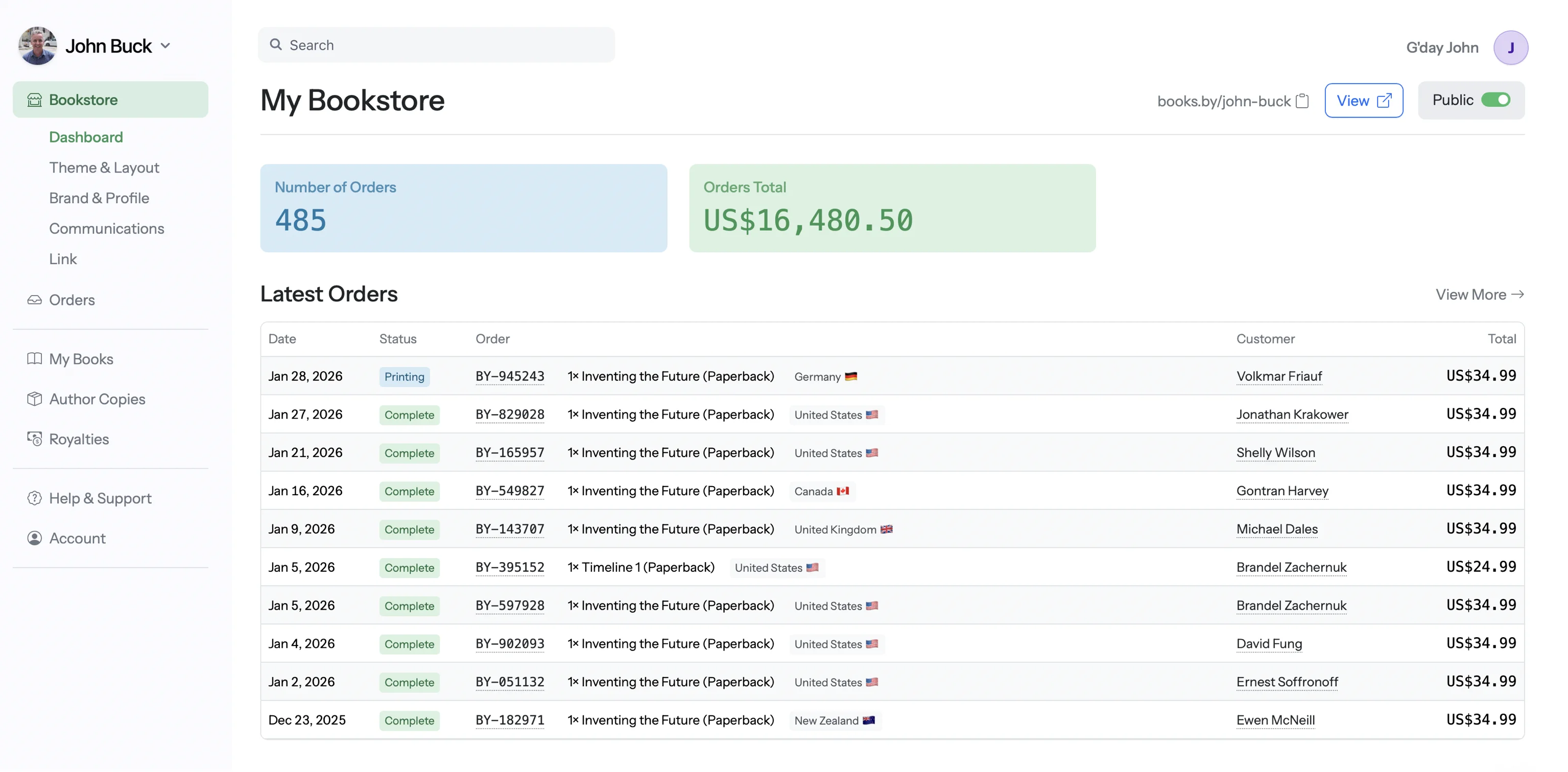
- Monitor sales in real-time on your Books.by dashboard
- Engage with every comment, share, and message — today you're everywhere
- Send an evening follow-up email with early reviews and social proof
- Send a "thank you" email to your list with early results and reader reactions
- Follow up with ARC readers who haven't posted reviews yet
- Start paid advertising (Amazon Ads, Facebook/Meta Ads) with launch revenue
- Run a week-2 promotion or limited-time offer
- Pitch podcasts, blogs, and newsletters in your genre
- Continue engaging readers — respond to reviews, share reader photos
- Start planning your next book (your backlist is your best marketing)
Your ARC Strategy: How to Get 25+ Reviews Before Launch
Reviews are social proof. A book with 25+ reviews looks established, trusted, and worth reading. A book with zero reviews looks risky. Your ARC (Advance Reader Copy) strategy is how you ensure your book launches with credibility, not crickets.
What Is an ARC?
An ARC is a free copy of your book sent to selected readers before launch. In exchange, they agree to leave an honest review on launch day (or within the first week). This isn't paying for reviews — it's giving free copies in exchange for honest opinions, which is perfectly within Amazon's and every retailer's terms of service.
Building Your ARC Team Step-by-Step
Recruit from your email list first
Send an email asking who'd like a free advance copy in exchange for an honest review. Your subscribers are your most engaged potential reviewers — they already care about your work. Aim for 30–60 signups to end up with 20–40 actual reviewers.
Expand to reader communities
Genre-specific Facebook groups, Goodreads groups, r/Fantasy, r/Romance, and BookTok communities all have readers eager for free ARCs. Be genuine: "I'm looking for 20 readers who love [genre] to read my upcoming book early and share honest thoughts."
Use a delivery platform
BookFunnel ($20/yr) and StoryOrigin (free tier) handle ARC distribution seamlessly. They deliver the ebook to any device, track downloads, and even send review reminders. Don't just email PDFs — make it professional.
Send ARCs 4–6 weeks before launch
Give readers enough time to actually read the book. Include a brief note: the launch date, where you'd love them to post reviews (Amazon, Goodreads, BookBub), and a reminder that you want honest opinions — not just 5 stars.
Follow up strategically
Send a reminder 1 week before launch: "Launch day is [date]! Here's a reminder to post your review." Then on launch day, a short email: "Today's the day! Here's the direct link to leave your review." Expect 50–70% follow-through from committed ARC readers.
ARC Numbers That Work
Here's what to expect from your ARC strategy:
Activating Your Existing Readers: Beta Readers, Street Teams & Super-Fans
Too many launch guides focus exclusively on finding new readers. But your most powerful launch asset is the readers you already have — the people who've read your previous books, followed your journey, or engaged with your content. These aren't just readers. They're potential advocates.
Your Reader Ecosystem
Think of your existing audience in concentric circles, each with a different role in your launch:
How to Activate Each Group
Super-Fans: Make Them Feel Special
- Give them the very first look at your cover, blurb, and opening chapter
- Ask for their input on marketing copy or back cover text
- Offer signed copies, custom bookmarks, or a personal thank-you note
- Name a character after them (if appropriate) or include them in your acknowledgements
- Give them a direct line to you — a private Discord channel, a WhatsApp group, or just your personal email
Street Team: Make It Easy to Help
Your street team wants to help but won't if it's complicated. Give them a Street Team Kit:
- Pre-written social media posts they can copy and paste
- Professional graphics in multiple sizes (Instagram square, story, Twitter header)
- A direct link to your Books.by store (so you get the customer data + 100% royalties)
- Clear instructions: "Post on launch day, tag me, use #[hashtag]"
- A "shareworthy" exclusive — a character quiz, a reading order guide, or behind-the-scenes content they can share with their own followers
books.by/yourname link (instead of an Amazon link), every sale through that link gives you the customer's email address and 100% royalties. You're building your list and your revenue simultaneously, with every share. If they share your Amazon link, Amazon gets the customer data and takes 30–65% of the sale.
Turning Readers Into Long-Term Advocates
The launch is just one event. The real goal is building a community of readers who support every launch you do for the rest of your career. Here's how:
- Thank publicly and personally. After launch, send a personal thank-you to everyone who helped. Name-check people in your newsletter.
- Share results. Tell your community how the launch went. "We sold 500 copies in the first week — and that's because of YOU." People love being part of a success story.
- Keep engaging between launches. Don't go silent for 6 months and then pop up asking for help. Share writing updates, ask for opinions, run polls, recommend other books.
- Reward loyalty. Early access to every new book. Exclusive content. First dibs on signed copies. Make being your reader feel like being in a club.
Launch Events: Virtual, Physical & Everything In Between
A launch event creates a focal point — a moment where your launch stops being "a book for sale" and becomes "an experience." Events generate urgency, social proof, and content all at once. And they don't have to be expensive or complicated.
Virtual Launch Events
Virtual events have the widest reach and lowest cost. Your readers can attend from anywhere in the world, and you don't need to rent a venue or buy wine.
Physical Launch Events
Physical events are powerful because they create real-world connections and shareable moments. They also sell a lot of books — readers who attend a signing almost always buy.
Book Signings
- Local bookstores: Approach independent bookstores 2–3 months before launch. Bring a professional cover proof, your one-paragraph pitch, and an offer to promote the event to your email list. Most indie stores love supporting local authors.
- Libraries: Many libraries host author events. Contact your local library's programming coordinator.
- Cafés and venues: If bookstores say no, approach literary cafés, wine bars, or community spaces. You bring the audience — they provide the venue.
Reading Events
Host a reading at a bookstore, library, or community space. Read a compelling excerpt (practice it — a good reading is a performance), then do a Q&A. These work exceptionally well for literary fiction, memoir, and narrative non-fiction.
Event Follow-Up (Critical!)
Every in-person event is an email list opportunity. Have a QR code displayed prominently that links to your Books.by store or reader magnet signup. Every person who scans it becomes a permanent contact for your future launches. "Scan for a free bonus chapter" is irresistible at a signing table.
Launch your book where you own the reader relationship
Books.by gives you a branded storefront, customer emails for every sale, 100% royalties, and daily payouts.
$99/year flat. No per-sale commissions eating your launch revenue.
Start Your Books.by Store →Launch Day Tactics: Your Hour-by-Hour Playbook
Launch day is the crescendo of your 3-month campaign. Everything you've built — your email list, your ARC team, your street team, your events — converges on this one day. Here's how to make the most of it.
The Launch Day Email Sequence
Your email list is your #1 launch day weapon. Here's the exact sequence that works:
8:00 AM — The Launch Email
Subject: "It's here 🎉 [Book Title] is live!" Keep it warm, personal, and excited. Include your cover image, a 2-sentence pitch, and a single clear CTA button linking to your Books.by store. Don't give people 5 different links — one link, one action: buy the book.
12:00 PM — The Social Proof Email
Only send this to people who opened but didn't click the morning email. Subject: "Readers are already raving about [Book Title]." Include 2–3 early reviews from your ARC team, a quote from a beta reader, and the buy link again. Social proof converts fence-sitters.
Day 2 — The "In Case You Missed It" Email
Subject: "500 readers can't be wrong..." or "The reviews are in 🌟" Share your first-day results, reader reactions, and any early milestones. This catches people who missed Day 1 entirely. Include a personal note about what the launch means to you.
Social Media Launch Strategy
Social media works best when it creates a feeling of momentum — not when it's a single "my book is out" post that disappears into the algorithm.
- Morning: "It's official!" announcement with cover image and buy link. Pin it to your profile.
- Mid-morning: Behind-the-scenes — a photo of you holding the printed book, a screenshot of your Books.by dashboard showing the first sale, or a video of your reaction.
- Afternoon: Share a reader review or reaction. "I'm already getting messages like this..." Reader praise is more persuasive than anything you can say about your own book.
- Evening: Thank-you post. Share a milestone: "100 copies sold on day one. I'm speechless." Gratitude is engaging and authentic.
- Stories/Reels all day: Keep a running commentary. Unbox your author copies. React to reviews in real-time. Show your sales dashboard. Take people along for the ride.
Pricing Strategy for Launch
Post-Launch: Keeping Momentum Alive
The biggest mistake authors make after a successful launch? Going silent. Your launch week creates a wave of attention, reader engagement, and momentum — and if you let it die, you're starting from scratch for your next book. The authors who build real careers keep that engine running.
Week 2–4: Capitalize on Launch Energy
- Follow up on reviews. Gently remind ARC readers who haven't posted yet. Share a direct link to make it one-click easy.
- Start paid advertising. Use your launch revenue to fund Amazon Ads and Facebook/Meta Ads. You now have social proof (reviews), which makes ads far more effective. Start at $5–10/day. (See our complete marketing guide for ad strategies.)
- Run a "week 2" promotion. A different angle — "Reader reactions are in" email with a limited-time deal. Or a bundle offer with your backlist.
- Pitch media. Local newspapers, podcasts in your genre, book blogs, and newsletter features. You have a news hook — a new book just launched with strong reviews.
Month 2–3: Build Long-Term Reader Engagement
- Send regular newsletters. Bi-weekly or monthly. Not just "buy my book" — share what you're reading, your writing process, behind-the-scenes of your next project. Value-first, sales-second.
- Engage on social media. Respond to every review mention, every reader photo, every tag. Make your readers feel seen and appreciated.
- Run a Goodreads giveaway. Generates awareness, "want to read" marks, and reviews. Books.by's print-on-demand makes it easy to send winners their copies.
- Plan newsletter swaps. Partner with other authors in your genre to cross-promote to each other's email lists. Services like BookFunnel and StoryOrigin facilitate this.
The Long Game: Every Reader Is a Future Launch Asset
Every reader who buys your book, joins your email list, or follows you on social media is an asset for your next launch. This is the compounding power of a direct-to-reader strategy:
This is why owning your reader data matters so much. When you sell through Books.by, every buyer's email goes into your list. After 5 books and 5 launches, you might have 5,000–10,000 customer emails — all people who've proven they'll spend money on your books. That's a launch army that guarantees a successful debut for every future title.
When you sell exclusively through Amazon, you have zero customer emails after 5 books. You're starting every launch from scratch, dependent on an algorithm you don't control.
📋 Your Book Launch Checklist
Use this interactive checklist to track your progress. Check off each item as you complete it — your progress bar will update automatically.
Book Launch Readiness Tracker
10 Book Launch Mistakes That Kill Sales
We've watched hundreds of launches. These are the mistakes that show up again and again — and the fixes that turn them around.
books.by/yourname link on Books.by. One clean, memorable URL for your social bios, business cards, event materials, and email signatures. No ugly affiliate links or multi-step purchase journeys.Ready to launch? Own every reader relationship from Day 1.
Books.by gives you a branded storefront at books.by/yourname, customer emails for every sale, 100% royalties, daily payouts, and print-on-demand for events. Everything in this guide works better when you own your sales channel.
Launch on Books.by — $99/yr →100-day money-back guarantee · Cancel anytime · No per-sale commissions
Frequently Asked Questions
Start planning at least 3 months before your launch date. The most critical pre-launch activity is building your email list, which takes time. Your ARC team needs 4–6 weeks with the book, and you'll want at least a month for cover reveals, pre-orders, and building anticipation.
It depends on your email list size. A well-nurtured list of 500 subscribers might generate 50–100 launch day sales. A list of 2,000+ engaged readers could produce 200–500+ sales. First-time authors without a list typically see 5–20 sales from social media alone.
Technically no, but practically yes. Your email list is the single most reliable way to drive launch sales and reviews. Social media algorithms are unpredictable — your post might reach 5% of followers. Email reaches 95%+ of subscribers. Start building yours today.
An ARC (Advance Reader Copy) team is a group of readers who receive your book free before launch in exchange for honest reviews. Recruit from your email list, social media, and reader groups. Start with 30–50 signups to end up with 20–30 reviews. Use BookFunnel or StoryOrigin to distribute copies professionally.
Pre-orders work best when you already have an audience — they let you accumulate sales that count on launch day. For debut authors with a small list, launching immediately creates more urgency. Many authors do both: set up pre-orders 2–4 weeks early to build momentum, then push hard on launch day.
The ARC strategy is the most effective: send 30–50 free advance copies 4–6 weeks before launch, and coordinate reviews for launch day. Also ask email subscribers to leave reviews after buying, run Goodreads giveaways, and approach book bloggers in your genre. Aim for 25+ reviews in your first week.