
Fantasy is a genre built on patience. Readers are patient — they'll commit to a 12-book series. And the business rewards patience too — your first book might sell modestly, but a completed series with strong read-through creates compounding income that most other genres can't match.
The flip side: fantasy is expensive to produce (longer books, maps, illustrations), slow to write (worldbuilding takes time), and brutally competitive in the top subgenres. Here's how to approach it strategically.
Epic Fantasy vs Urban Fantasy: Two Different Businesses
These subgenres look similar on a bookshelf but require completely different business strategies.
Epic Fantasy
Books run 100,000-150,000 words. Readers expect rich worldbuilding, multiple POVs, intricate magic systems, and political intrigue. Production takes longer — you're looking at 6-12 months per book for most authors.
The economics favor long-term thinking. Your first book might only sell 200 copies. But when your trilogy is complete, readers who've been waiting will buy all three. A completed epic fantasy series is an asset that generates income for years.
The hard truth: don't start publishing an epic fantasy series until you have at least two books finished. Fantasy readers have been burned too many times by series that never got completed. An unfinished series from an unknown author is commercial poison.
Urban Fantasy
Shorter books (70,000-90,000 words), faster pace, contemporary settings with supernatural elements. Think Jim Butcher's Dresden Files or Ilona Andrews' Kate Daniels. The protagonist is usually a single POV character who carries across the series.
Urban fantasy allows faster releases — every 3-4 months is achievable. The series can run longer (10+ books) because each book is a self-contained mystery or mission within a larger arc. This makes urban fantasy one of the most financially reliable subgenres for indie authors.
The Growing Subgenres
LitRPG and Progression Fantasy are the fastest-growing corners of fantasy right now. Readers are voracious, KU page-reads are enormous, and the community is highly engaged. Books are typically 80,000-120,000 words with game-like mechanics (leveling, skill systems, stat blocks). If this is your thing, the market is hungry.
Romantasy (romantic fantasy) has exploded thanks to authors like Sarah J. Maas and Rebecca Yarros. It blends epic worldbuilding with romance-level emotional intensity and relationship focus. Covers trend toward illustrated characters, often in embrace. This subgenre commands premium paperback prices ($16.99-$19.99) and special editions sell exceptionally well.
Series Economics: Why Fantasy Authors Need Math
Fantasy is a series genre. The math of how readers flow through your series — called "read-through" — determines your income more than any other factor.
Here's a realistic read-through for a well-written fantasy trilogy:
- Book 1 → Book 2: 60-70% of readers continue
- Book 2 → Book 3: 75-85% of those readers continue
So if 1,000 readers buy Book 1, roughly 650 buy Book 2, and 520 buy Book 3. That's 2,170 total book sales from 1,000 readers.
Now the money. If each book is priced at $4.99 (ebook) and you're selling direct through Books.by at 100% royalty (minus payment processing):
- Book 1: 1,000 × $4.69 = $4,690
- Book 2: 650 × $4.69 = $3,049
- Book 3: 520 × $4.69 = $2,439
- Total from 1,000 initial readers: $10,178
The same 1,000 readers on Amazon at 70% royalty ($3.49 per book) would generate $7,577. That's $2,601 less — from the same readers buying the same books. Run your own numbers with our royalty calculator.
This is why series completion matters so much. Every unwritten book in your series is money left on the table. And every reader you can move from Amazon to direct sales increases the value of each book in the series.
Worldbuilding as a Selling Point
In most genres, worldbuilding is background. In fantasy, it's a feature. Readers actively seek out books with interesting magic systems, unique political structures, and vivid settings. Brandon Sanderson built a career on magic system design. This is your advantage.
But worldbuilding is also the most common trap. Authors spend years building their world and forget to write a compelling story in it. The world serves the story, not the other way around.
A practical rule: build 3x more world than appears in the book, but only reveal what the plot demands. The rest creates consistency and depth that readers sense even when they can't articulate why.
Maps and Interior Illustrations
Maps are nearly mandatory for epic fantasy. If your characters travel between named locations, readers will want a map. Some will refer to it on every chapter.
| Art Type | Cost Range | When to Include |
|---|---|---|
| Basic map (black & white) | $200–$400 | Any epic fantasy with travel |
| Detailed map (color) | $400–$800 | Series with complex geography |
| Chapter header illustrations | $50–$150 each | Premium editions, special releases |
| Character art | $150–$500 per character | Marketing, special editions, fan engagement |
For your first book, a clean black-and-white map is enough. Save the color map and character art for when the series is complete and you're releasing special editions. Use our page count calculator to see how interior art affects your page count and printing costs.
One thing authors overlook: maps need to work at ebook size. A beautifully detailed map that's illegible on a Kindle defeats the purpose. Design for the smallest screen first, then add detail for print.
Cover Design for Fantasy
Fantasy cover conventions vary sharply by subgenre, and getting this wrong is expensive.
- Epic Fantasy: Sweeping landscapes, castles, dramatic skies. Often features a cloaked or armored figure from behind, walking toward something vast. Illustrated style dominates. Color palette: deep blues, purples, golds, rich greens.
- Urban Fantasy: Character-focused. Figure in modern clothing (leather jacket, weapons) against a cityscape with magical elements (glowing runes, supernatural creatures in shadow). Can be illustrated or photo-composite.
- LitRPG/Progression: Bright, dynamic, game-influenced art. Often features a character in action with visible magical effects. Anime-influenced illustration style is common and expected.
- Romantasy: Illustrated couple or single character in fantasy attire. Rich, lush color palettes. Often features foliage, flowers, or magical elements framing the characters. Highly detail-oriented.
Budget $400-$800 for a custom fantasy cover. This is more than most genres, but fantasy readers judge covers harshly and the thumbnail needs to pop among dozens of competing titles.
Series covers must be visually cohesive. Same illustrator, same layout template, same font treatment. When a reader sees your book 3 cover, they should instantly recognize it as part of the same series. Hire one artist for the whole series — switching artists mid-series looks amateur.
Pricing Fantasy Books
Fantasy books are longer, so they can command slightly higher prices than other genres:
| Format | Price Range | Notes |
|---|---|---|
| Ebook (first in series) | $0.99–$2.99 | Loss leader to drive read-through |
| Ebook (standard) | $4.99–$6.99 | Fantasy readers accept higher prices for longer books |
| Paperback | $14.99–$19.99 | Page count drives this — a 400-page book costs more to print |
| Hardcover | $24.99–$34.99 | Fantasy readers buy hardcovers more than any other genre |
| Special edition | $39.99–$79.99 | Sprayed edges, foil stamps, interior art — fantasy fans collect these |
Fantasy is one of the few genres where hardcovers and special editions are a meaningful revenue stream for indie authors. A limited-run special edition of a beloved series finale can sell hundreds of copies at $49.99+. This is direct-sales territory — Amazon doesn't support custom special editions, but your Books.by store does.
Your Books.by storefront also includes customisable themes so the look matches your series brand — dark academia, grimdark, high-fantasy gold-on-black, whatever fits the world. And coupon codes are built in: hand out a CON25 code at conventions, run a launch-week 20% off promo for your newsletter, or give beta readers a 100% off code for the next book in the series.
The Series Economics: One Reader Across Five Books
Fantasy is a series business. The interesting math isn't "royalty on one book" — it's "what happens across an entire series when one reader binges from book 1 to book 5." That's where the platform choice stops being a small detail and starts shaping your career.
Let's follow a single reader through a five-book epic fantasy series. Paperbacks at $17.99, around 350 pages each. They love book 1 and read all the way through to book 5 — the holy grail of indie fantasy.
≈ 30% of cover price kept
≈ 63% of cover price kept
The same reader is worth $29.80 more on Books.by — for the exact same five books.
Now scale that up. A successful indie fantasy series typically reaches 1,000–3,000 dedicated readers who finish the whole arc. Run that math and the gap stops being academic:
Of course, KDP brings the discovery — readers find book 1 in Amazon's algorithm. Most fantasy authors run both: KDP for cold-traffic discovery on book 1, Books.by for everything readers already came looking for (book 2, the special edition box set, the signed hardcover of the finale). The minute a reader has joined your newsletter or your Discord, sending them to your store instead of Amazon is essentially free money.
Run your own series read-through scenarios with the royalty calculator.
Build Your Fantasy Empire
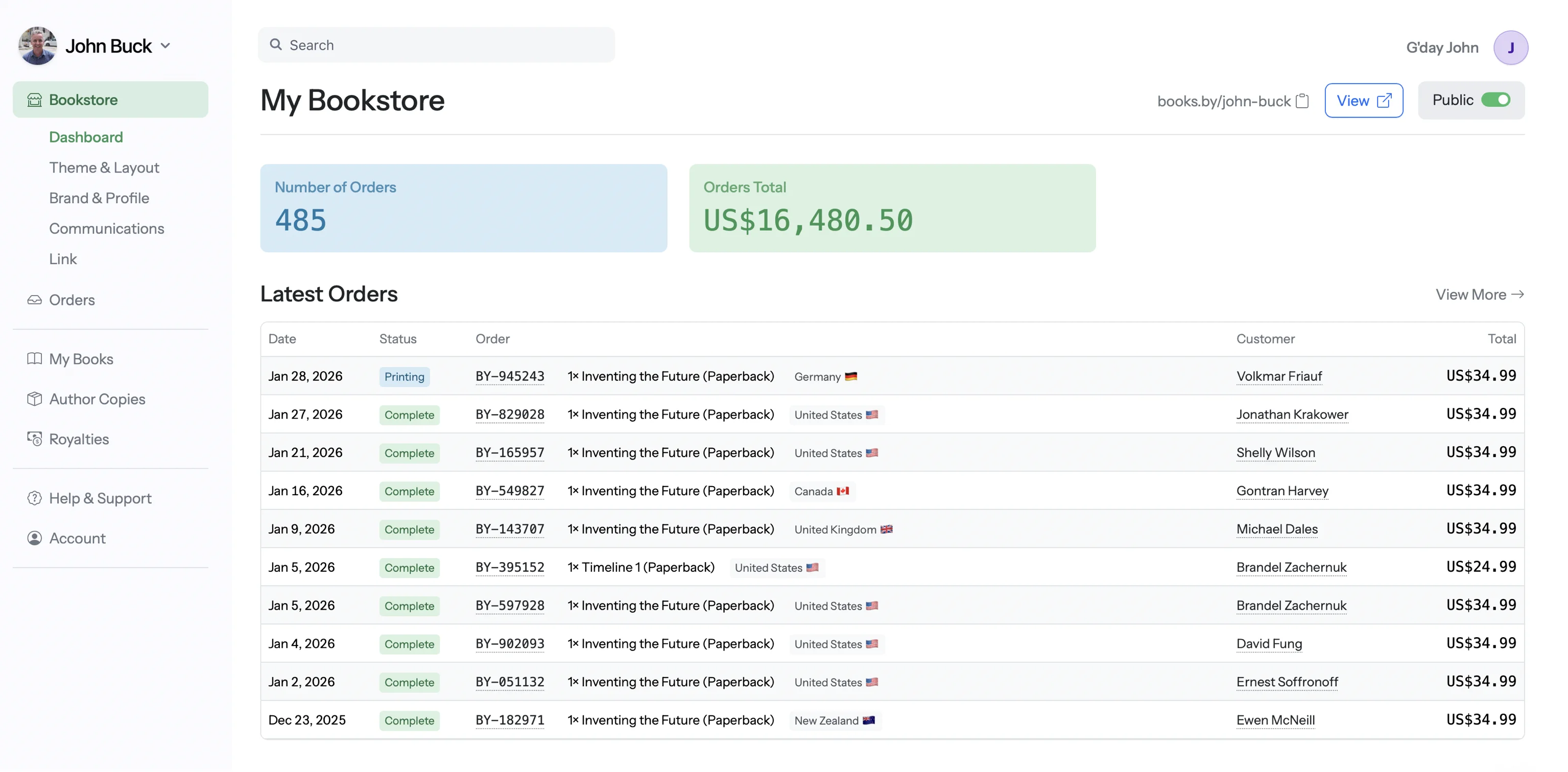
Sell hardcovers, special editions, and ebooks from your own store. Keep 100% of royalties. Get customer emails with every sale. $99/year for print, $299/year with ebooks.
Marketing Fantasy Books
Fantasy has some of the strongest reader communities in all of fiction. Your marketing strategy should be community-first.
Reddit is your friend. Subreddits like r/Fantasy, r/ProgressionFantasy, and r/LitRPG are active, engaged, and genuinely supportive of indie authors — if you participate authentically. Don't spam your book link. Contribute to discussions, do AMAs when your book launches, and let your participation build credibility.
BookTok matters less here than in romance, but it's growing. Romantasy does well on TikTok. Epic fantasy is harder to convey in a 60-second video, but aesthetic content (maps, magic systems, worldbuilding details) can gain traction.
Newsletter swaps work, but the fantasy newsletter ecosystem is smaller than romance. Services like StoryOrigin and BookFunnel can help you find swap partners.
Convention appearances are surprisingly effective for fantasy. Events like DragonCon, local comic cons, and fantasy-specific conventions let you sell signed copies directly. Bring your print books, offer to sign them, and collect email addresses.
Frequently Asked Questions
Epic fantasy: 90,000-150,000 words. Urban fantasy: 70,000-90,000 words. YA fantasy: 70,000-100,000 words. Going under 70K for epic fantasy disappoints readers. Going over 150K as a debut increases printing costs and risk.
If your story involves travel between named locations, yes. Maps are expected in epic fantasy. A professional map costs $200-$800. For urban fantasy or portal fantasy, maps are optional. Make sure it's legible at ebook size.
Yes, especially for series writers. A completed trilogy with strong covers and reviews can generate $2,000-$10,000/month. The key is series completion. LitRPG and progression fantasy are currently the fastest-growing subgenres for indie authors.
Urban fantasy has a faster path to income (shorter books, faster releases). Epic fantasy has a higher long-term ceiling with deeply loyal readers who buy hardcovers and special editions. Write what excites you — forced writing in either subgenre won't fool the readers.
Series are the default in fantasy. Over 80% of bestselling indie fantasy is part of a series. Standalones are significantly harder to market. Trilogies are the minimum; many successful authors write 5-9 book series. Read-through economics make each additional book more profitable.
Epic: sweeping landscapes or cloaked figures, illustrated style, deep blues/purples/golds. Urban: character-focused with city backdrop and magical elements. LitRPG: bright, dynamic, game-influenced art. Romantasy: illustrated characters in fantasy attire with lush color palettes. Hire one artist for your whole series.