
A nutritionist I worked with in Brisbane spent eighteen months writing a meal-planning guide for women with PCOS. She'd been running her practice for ten years, had a 4,000-person email list, and a small but loyal Instagram following. The book wasn't going to be a bestseller — she knew that, I knew that, her publisher would have known that if she'd had one. She self-published it instead.
Eight months later her client roster was full, her speaking fees had doubled, and she was charging $400 for a 90-minute consult that used to be $180. The book hadn't sold like a Colleen Hoover novel. It had done something more useful: it had repositioned her as the practitioner-who-wrote-the-book on her specific niche, and that did the rest.
This is the playbook that almost every successful self-published health and wellness author follows. The book itself is rarely the main revenue stream. The book is the front door — it makes you an author, and in this industry "author" translates directly to "authority," and authority translates directly to fees you couldn't charge before. If you're a clinician, coach, trainer, or therapist sitting on a methodology that works, the book is the cheapest credibility instrument you'll ever buy.
How Health and Wellness Authors Use Books as a Business Tool
Before we talk about writing, covers, or formatting, the strategic question: what is this book supposed to DO for your business?
For most health professionals, the answer is some combination of:
- Establish authority — "I wrote the book on this" is a literal statement you can make
- Generate leads — every reader is a potential client, and every purchase gives you their email
- Anchor your speaking — event organizers book authors, not practitioners with good Instagram accounts
- Scale your methodology — your book can reach 10,000 people while you see 30 clients a week
- Create a premium offer — "the author of [book]" charges more per session than the person without one
This means the ROI of your book isn't measured in royalties alone. It's measured in clients gained, speaking fees increased, and consulting rates raised. A book that sells 500 copies but brings you 20 new coaching clients at $200/month has generated $48,000 in annual revenue — far more than the book royalties.
Email Capture: Why Direct Sales Matter More Here
When someone buys your health book on Amazon, you get a royalty payment and nothing else. You don't know who they are. You can't follow up. You can't offer them your program, your course, or your coaching.
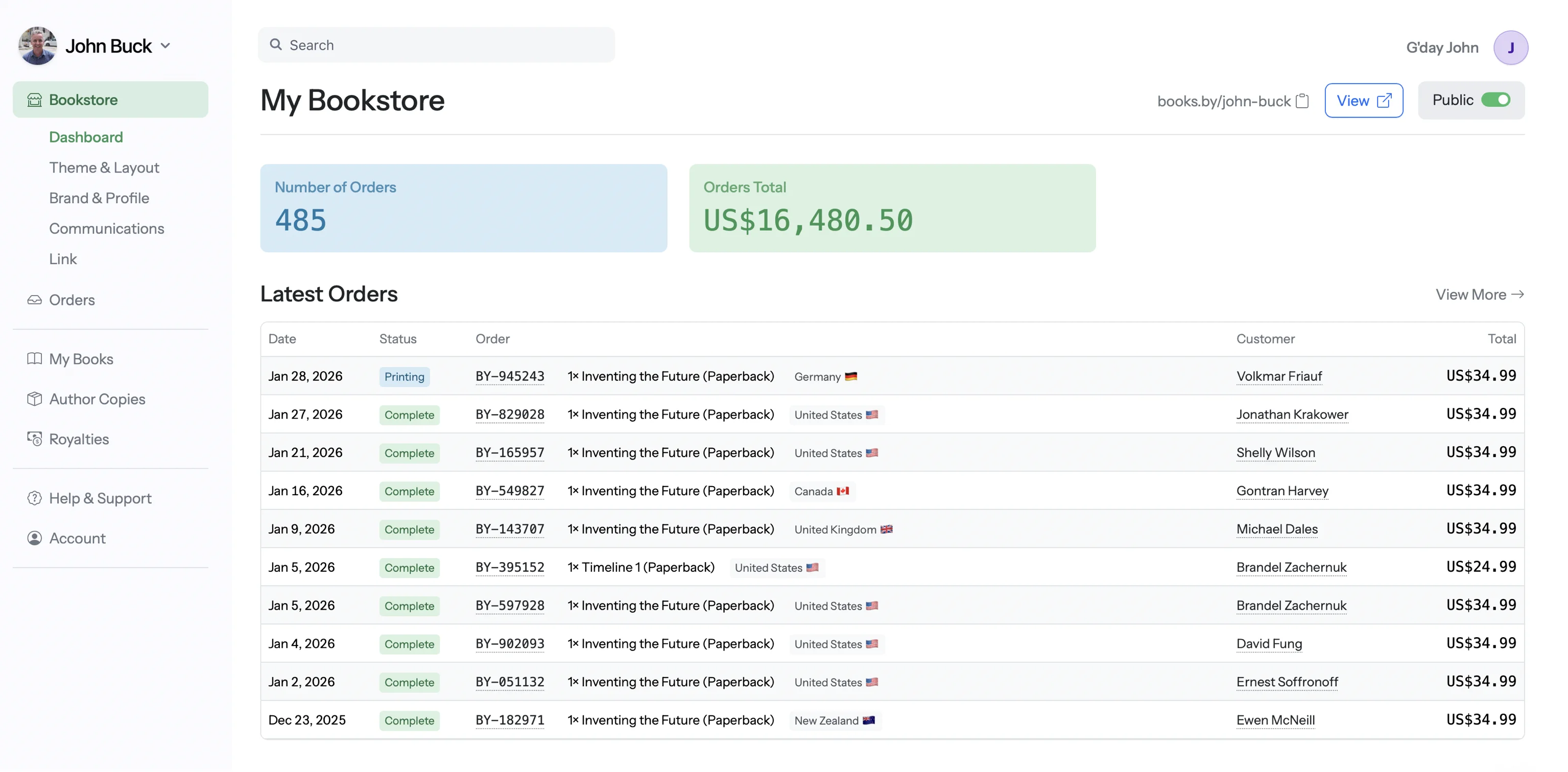
When someone buys through your Books.by store, you get their email address with every purchase. That's the difference between a one-time transaction and the beginning of a client relationship.
If you run Facebook ads to your book — and most health and wellness authors do, because the targeting on health interests is excellent — your Books.by storefront includes built-in Facebook Pixel and Google Analytics support. Paste your Pixel ID and GA tag into your storefront settings and every page view, add-to-cart, and purchase is tracked automatically. Your ads optimise against actual sales, you can build retargeting audiences from real buyers, and you can see exactly which traffic sources convert.
You can also sell an ebook edition directly from the same storefront — readers get an instant download, you keep ~97% of the price, and the ebook becomes a low-friction lead magnet for your coaching or program funnel. Price the ebook at $4.99 to attract leads, then upsell into the print edition, your course, or a consultation from inside the book.
Beyond the purchase email, build additional touchpoints into the book itself:
- Offer a downloadable meal plan, workout template, or assessment tool at the end of key chapters
- Link to a companion video series that requires registration
- Include a "book resources" page on your website where readers sign up to access bonus content
- Offer a free initial consultation exclusively for book readers
Place these calls-to-action at natural break points — end of chapters, after case studies, after particularly actionable sections. Don't interrupt the reading experience, but don't miss the opportunity either.
Credentials and Credibility
Legally, anyone can publish a health book. You don't need a medical degree, certification, or license. The First Amendment protects your right to publish.
Practically, credentials change everything about how your book is received.
| Your Background | Credibility Strategy |
|---|---|
| Licensed physician/practitioner | Lead with credentials on cover and marketing. Your degree does the heavy lifting |
| Certified health professional (RD, CPT, etc.) | Use your certification prominently. Get a foreword from an MD if possible |
| Health coach or wellness practitioner | Partner with a credentialed reviewer. Lead with client results, not authority claims |
| Personal experience only | Frame as memoir/personal journey, not clinical guidance. "My story" not "your protocol" |
Regardless of your credentials, get your manuscript reviewed by someone with relevant clinical credentials. Even if it costs $500-$1,500, a technical review catches claims that could get you into regulatory trouble and adds a layer of credibility you can reference.
FDA/FTC Compliance: The Non-Negotiable Part
This section isn't optional. Health books face regulatory scrutiny that fiction and most other nonfiction categories don't.
FDA requirements: If you discuss supplements, treatments, or health products, you cannot make claims that they cure, treat, or prevent diseases unless those claims are FDA-approved. "Turmeric cures inflammation" is a drug claim that requires FDA approval. "Research suggests turmeric may have anti-inflammatory properties" is an informational statement.
FTC requirements: Any health claims must be substantiated by competent and reliable scientific evidence. If you recommend products and have an affiliate relationship, you must disclose it. Testimonials and before/after results must be representative, not exceptional cases presented as typical.
Your disclaimer needs to include:
- "This book is for informational purposes only and is not intended as medical advice"
- "Consult your healthcare provider before beginning any health program"
- Your specific credentials (or lack thereof) clearly stated
- Any affiliate relationships disclosed
Place the disclaimer on the copyright page. Have a healthcare attorney review your specific language — a generic template may not cover your specific claims. Budget $200-$500 for legal review. This is cheap insurance.
Content Strategy: Shorter Is Better
Health readers want actionable, not exhaustive. The most successful health books are 30,000-50,000 words — roughly 120-200 pages in a standard format. That's a book someone can read in a weekend and start implementing Monday.
A common mistake: writing a 400-page encyclopedia of everything you know. Nobody finishes those. A focused book on one specific topic — gut health, sleep optimization, postpartum recovery, managing Type 2 diabetes through diet — outperforms a comprehensive "wellness bible" every time.
Structure matters more here than in any other nonfiction category. Readers want:
- Clear chapter organization that builds sequentially
- Actionable takeaways at the end of each chapter
- Case studies or examples that demonstrate the protocol
- Checklists, meal plans, or templates they can immediately use
- A clear "what to do now" ending, not just theory
What an Amazon Sale Actually Costs You
Most royalty comparisons stop at the per-book number. For a health and wellness author, that's the wrong number to optimise. Your book is the front of a funnel — the real revenue is downstream, in the clients who hire you because they read it.
Each direct sale on your own store does two things at once: it returns the book royalty, and it adds a qualified subscriber to your email list. Each Amazon sale does the first thing only. The subscriber is the part that compounds.
- Royalty payment
- No email
- No name
- No follow-up channel
- No path to coaching/program upsell
- Royalty payment
- Email captured automatically
- Full name + address
- Permission to follow up
- Direct line for program / consult upsell
The Lifetime-Value Math
Marketers have spent twenty years measuring what an email subscriber in the health and wellness space is worth. The honest range is between $1 and $5 per subscriber per month, depending on niche, list quality, and what you sell behind it.
So a Books.by sale isn't really worth $11.40. It's worth $11.40 plus the lifetime value of that subscriber. Even at the conservative end of the range:
Add a single coaching client conversion — a $200/month coaching program retained for six months is $1,200 of revenue from one reader — and the gap stops being a multiplier and starts being a different business model.
The takeaway isn't "don't sell on Amazon." Amazon brings discovery, and discovery you can't ignore. The takeaway is: every reader you actively send to a buy link — from your podcast, your speaking events, your client emails, your bio link — should be sent to your store, not to Amazon's. Those are leads you're paying to convert. Don't give them to a marketplace.
The royalty calculator handles the per-book half of this. The lead-value half depends on what you charge for what you do next.
Your Health Book, Your Client List
Every sale captures the buyer's email. Sell paperbacks and ebooks from your own branded store. Keep 100% of royalties. From $99/year.
Pricing Health Books
Health books occupy a middle ground — not as cheap as genre fiction, not as expensive as textbooks.
| Format | Price Range | Notes |
|---|---|---|
| Ebook | $7.99–$14.99 | Higher than fiction. Readers pay more for specialized knowledge |
| Paperback | $14.99–$19.99 | Standard range. $16.99 is the sweet spot for most titles |
| Hardcover | $24.99–$29.99 | Worth offering for gift market and waiting room copies |
If you're using the book as a lead generation tool, you can even sell it at cost or give away ebooks for free to maximize distribution. The client revenue downstream dwarfs the royalties you'd earn on $14.99.
Marketing for Health Authors
Podcasts are your #1 channel. Health and wellness podcast guests sell books. Every appearance positions you as an expert and drives listeners to your store. Pitch yourself to 20-30 podcasts in your niche. Even small shows with 500 listeners convert well because the audience self-selected for your topic.
Author copies as business cards. Order author copies through Books.by at print cost. Hand them to potential clients, referral partners, speaking organizers. A $5 book that lands you a $5,000 speaking engagement is the best ROI in marketing.
Your existing audience. If you already have a practice, a following, or an email list, your book launch is warm traffic. Tell your current clients, post to your social channels, email your list. Don't overthink the launch — your people already trust you.
Frequently Asked Questions
Legally, no. Practically, credentials matter for credibility. If you're not licensed, partner with a credentialed reviewer for a foreword or technical review. Frame personal experience as memoir, not clinical guidance. Always include an FDA/FTC disclaimer.
A disclaimer that content is informational only and not medical advice. No unsubstantiated cure/treatment claims. Disclose affiliate relationships with recommended products. Budget $200-$500 for a healthcare attorney to review your specific language.
Sell direct to capture buyer emails automatically. Include downloadable resources (meal plans, templates) that require email signup. Link to companion content. Offer book-reader-only consultation rates. Every reader is a potential client.
Self-publish if the book is a business tool (lead gen, authority, speaking). You keep control, move faster, and capture reader data. Traditional publishing only makes sense if you need a major publisher name for institutional credibility.
30,000-50,000 words (120-200 pages). Shorter and more focused beats longer and comprehensive. Readers want to finish your book in a weekend and start implementing Monday. Cookbooks can be shorter at 15,000-25,000 words plus photography.
$3,000-$8,000 total. Editing ($1,500-$3,000), cover ($400-$800), interior design ($500-$1,200), legal review ($200-$500), and medical/technical review ($500-$1,500 if not credentialed). Plus Books.by from $99/year.
Yes, but carefully. FTC requires health claims to be substantiated by scientific evidence. No cure or treatment claims without FDA approval. Disclose affiliate relationships. Use "research suggests" and "may support" language. Have an attorney review your manuscript.