Every consultant knows the pain: you're excellent at what you do, but proving it to strangers is exhausting. Cold outreach gets ignored. LinkedIn posts disappear in hours. Networking events yield business cards that go nowhere.
Then you meet the consultant who just hands people a book. "Here's my thinking on the topic." The conversation shifts immediately. They're not selling — they're educating. And somehow, they always seem to be booked solid.
That's not a coincidence. A book is the ultimate credibility asset. It positions you as the expert, generates inbound leads while you sleep, opens speaking opportunities, and provides content for years of marketing. No other marketing investment comes close to the ROI.
The Business Case for Writing a Book
Let's cut the motivational fluff. Here's the actual business logic:
Lead Generation That Compounds
Every blog post you write has a half-life of about 48 hours. Social posts? Hours. A book keeps generating leads for 5-10 years. People find it on Amazon, hear about it from colleagues, see it on your shelf during Zoom calls. It's a lead magnet that never expires.
One management consultant I know tracks all his inbound leads. 60% of them mention his book somewhere in the first conversation — either they read it, or someone recommended it to them. That's six years after publication.
Premium Pricing Justification
When prospects compare you to competitors, the book is the differentiator. You're not just another consultant — you literally wrote the book on this topic. That perception gap justifies premium fees.
A strategy consultant raised her rates 40% after her book came out. She didn't change her services. But now when clients questioned her fees, she could point to the book: "This is the methodology. This is the depth. That's why the investment."
Speaking Opportunities
Conference organizers need speakers with credibility signals. A book is the ultimate shortcut. It gives you a topic, a framework, and proof you can deliver coherent thinking for an hour.
Many speaking bureaus won't even consider you without a published book. And conferences often buy bulk copies for attendees — which can effectively subsidize (or exceed) your speaking fee.
Content Engine
One book generates years of content. Each chapter becomes 3-5 LinkedIn posts. Key concepts become podcast talking points. Frameworks become webinar topics. You're not creating content from scratch anymore — you're repurposing a complete body of work.
Self-Publishing vs. Traditional: The Consultant's Calculation
Traditional publishing sounds prestigious. A "real" publisher, bookstore distribution, maybe an advance. But for consultants, the math rarely works:
| Factor | Traditional Publishing | Self-Publishing (Books.by) |
|---|---|---|
| Timeline | 18-24 months from deal to shelf | 2-3 months from manuscript to published |
| Royalties | 10-15% of retail | 100% (minus print + processing) |
| Control | Publisher controls pricing, cover, title | You control everything |
| Bulk pricing | Must buy at wholesale ($8-12/book) | Author copies at print cost (~$4) |
| Updates | New edition requires publisher approval | Update anytime, instantly |
| Customer data | Publisher owns all buyer information | You get every buyer's email |
The 18-24 month timeline is the killer. How many clients could you land in that time? How much revenue would that book generate if it existed now instead of two years from now?
Traditional publishing made sense when bookstore distribution mattered. For consultants — whose books are marketing tools, not revenue centers — self-publishing is almost always the smarter path.
Calculate Your Royalties
See how much more you could earn selling consultant books directly through Books.by compared to Amazon KDP.
What Your Book Should Actually Cover
The worst consulting books are thinly-veiled sales pitches. The best ones provide genuine value that makes readers want to hire the author.
Structure That Works
Start with the problem. Articulate the pain your target clients face better than they can articulate it themselves. When readers think "that's exactly my situation," you've hooked them.
Introduce your framework. Every good consulting book has a proprietary model — a structured approach to solving the problem. This becomes your brand differentiator. The "7 Habits," the "Blue Ocean Strategy," the "Lean Startup." Your version.
Prove it with cases. Theory without evidence is unpersuasive. Include case studies (anonymized if needed) showing your approach in action. Real numbers. Real outcomes. Real companies.
Make it actionable. Give readers things they can do immediately. Self-assessments, worksheets, checklists. The more value they get from the book, the more they'll trust you with the bigger work.
End with the bigger opportunity. You've given them tools to improve. Now acknowledge that going further requires partnership. "This is what you can do yourself. Here's when you need help."
Length Matters (Shorter Is Often Better)
Business books average 50,000-70,000 words. But executives are busy. A 120-page book (25,000-30,000 words) that gets read and recommended beats a 300-page book that sits on a shelf.
Don't pad. Say what you need to say, provide the value, and stop. Your consulting work is where the depth happens — the book is the door.
The Writing Process for Busy Consultants
You don't have three months to disappear into a writing cave. Here's the pragmatic approach:
Option 1: Talk, Don't Type
You explain your methodology to clients constantly. Do the same thing into a recorder.
- Block 10 sessions of 1 hour each
- Record yourself explaining each chapter as if to a new client
- Transcribe with Otter.ai, Rev, or similar
- Edit the transcript into prose
Many consultants find they can dictate a full manuscript in 15-20 hours of recorded speaking. That's 10 hours less than writing from scratch.
Option 2: Repurpose What Exists
Look at what you've already created:
- Client presentations
- Workshop materials
- Email explanations to prospects
- Blog posts and articles
- Webinar transcripts
- Podcast interviews
Compile, organize, edit, and fill gaps. You may already have 60% of a book scattered across existing materials.
Option 3: Hire a Ghostwriter
A good business ghostwriter costs $15,000-40,000. For consultants billing $300+/hour, this can make economic sense. You provide the ideas, methodology, and case studies. They do the heavy writing.
Make sure you own the copyright outright. Have them sign work-for-hire agreements.
Your Book as Lead Magnet
A consulting book isn't primarily a revenue source — it's a lead generation tool. Here's how to maximize that:
Direct Sales on Your Website
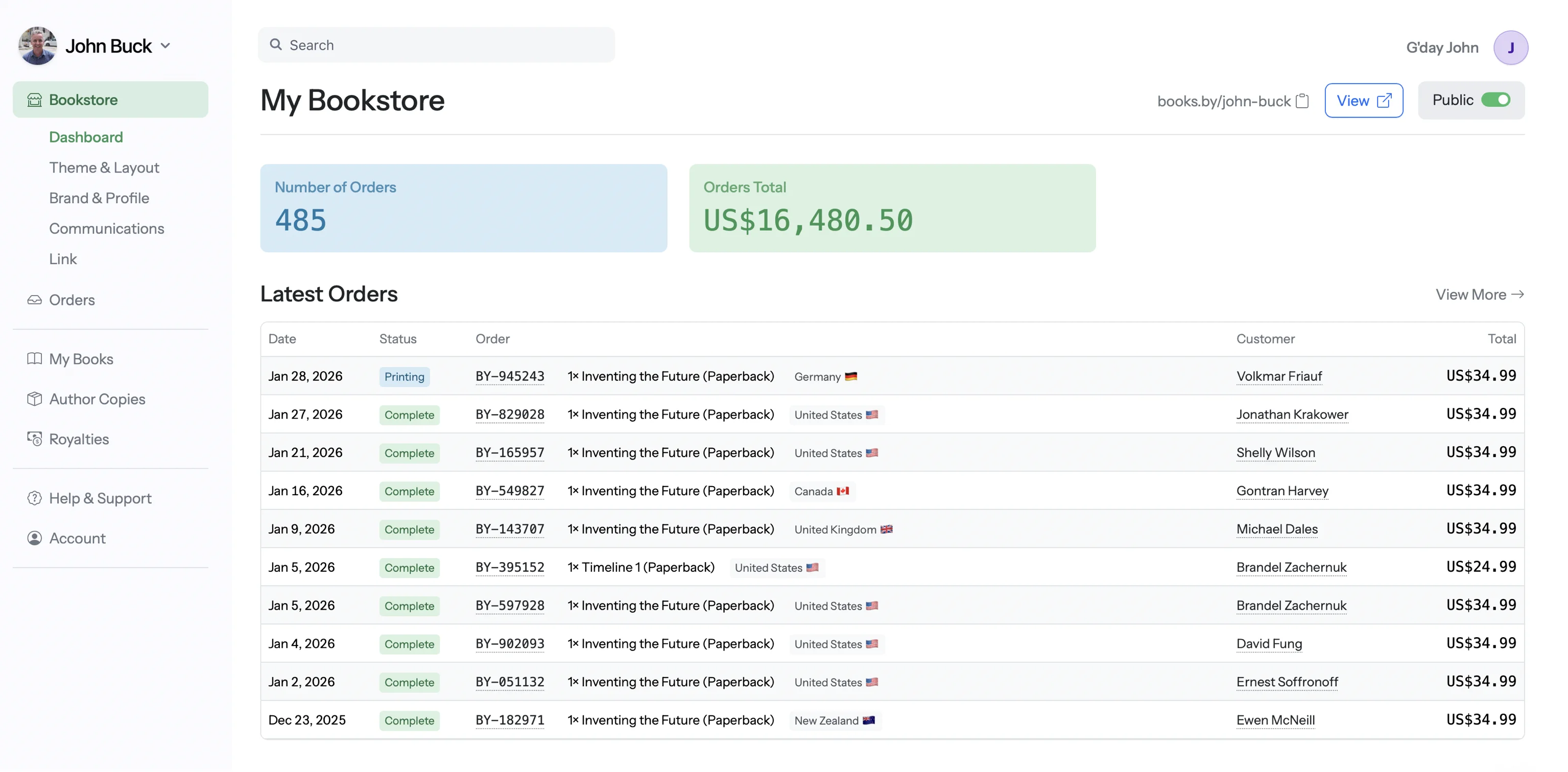
With Books.by, you get a branded storefront at books.by/yourname. Every buyer gives you their email address. That's data Amazon doesn't share.
Add your book to your consulting website, email signature, and LinkedIn profile. When prospects buy, you know who's interested enough to invest.
Free PDF Download (With Email Capture)
Offer the ebook free in exchange for an email address. Books.by supports this through the lead magnet feature — you get the download and the contact info for followup.
Yes, this means some people get the book free. But those emails are warm leads, and most serious prospects will still buy the print version.
Client Welcome Packages
Every new client gets a signed copy of your book. It sets expectations, establishes your methodology, and immediately elevates the engagement's perceived value.
At Books.by's author copy pricing, a 200-page book costs about $4.46. Include one in every $50,000 engagement — the ROI is obvious.
Speaking Giveaways
Negotiate with event organizers to buy copies for all attendees. You get distribution, they get added value for participants, and every book has your contact info.
Distribution Strategy for Consultants
Unlike fiction authors chasing Amazon rankings, consultants have different distribution priorities:
Priority 1: Your Own Channels
Your website. Your email list. Your social profiles. Direct sales through Books.by where you keep 100% royalties and get customer data.
Priority 2: Amazon (For Discovery)
Yes, list on Amazon — but for visibility, not margin. When prospects Google your name or your topic, they should find your book. Amazon reviews build social proof.
You can publish on Amazon KDP alongside Books.by. Just know that Amazon sales give you ~$4-6 per book instead of $12-15 on direct sales.
Priority 3: Bulk Sales
Corporate bulk orders can move hundreds of copies. Training programs, conference giveaways, client gifts. With Books.by, you order author copies at cost and resell at whatever margin you negotiate.
Updating Your Book
Business content gets dated. Methodologies evolve. Case studies multiply. With print-on-demand, updating is trivial:
- Upload new interior file to Books.by
- New copies print with updated content
- No pulping old inventory
- No negotiating with publishers
Consider annual updates for time-sensitive content, or new editions every 3-5 years with major methodology evolution.
Frequently Asked Questions
A book is the highest-leverage marketing asset for consultants. It generates inbound leads, commands speaking invitations, differentiates from competitors, justifies premium pricing, and creates a permanent credibility asset. One book can drive business for 5-10 years.
Books generate leads through multiple channels: speaking engagements where you sell or give away copies, your website where visitors can purchase or download, social media content derived from book chapters, podcast interviews discussing your book's thesis, and referrals from readers who share with colleagues.
Both strategies work. Free books maximize distribution and lead volume. Paid books ($20-40) generate revenue and attract more serious readers. Many consultants do both: sell the print book for credibility, offer a free PDF download to capture emails. With Books.by, you get buyer email addresses on every sale.
Business books typically run 30,000-50,000 words (150-250 pages). Shorter is often better for consultants — busy executives prefer concise, actionable content. A 120-page book that gets read beats a 400-page book that sits on a shelf.
For consultants, self-publishing usually makes more sense. Traditional publishers take 18-24 months (you could land 50+ clients in that time), pay 10-15% royalties, and control pricing and distribution. Self-publishing gives you speed (2-3 months), 100% royalties with Books.by, and complete control over how you use the book in your business.
Absolutely. Sending new clients your book sets expectations, establishes your methodology, and reduces repetitive explanations. Order author copies at cost ($3-5 each) and include in every welcome package. It immediately elevates the perceived value of your engagement.
Event organizers prefer speakers who are published authors — it's a credibility shortcut. A book also gives you a topic, a framework, and content that differentiates your talk. Many conferences will purchase bulk copies for attendees, effectively subsidizing your fee.