
Here's the honest truth about self-publishing literary fiction: you're not going to sell 10,000 copies a month. That's not the game. The game is 500-2,000 copies a year at higher margins, with a readership that talks about your book at dinner parties, recommends it to friends individually, and keeps it on their shelf for a decade.
That's a viable business if you structure it right. It's just a different business than what the "six-figure indie author" crowd talks about.
Why Literary Fiction Is Different
Genre fiction sells on premise and trope satisfaction. Literary fiction sells on voice, craft, and cultural conversation. This distinction matters because it changes everything about how you market, price, and produce your book.
Literary readers don't browse by category the way romance or thriller readers do. They find books through reviews, word-of-mouth, bookstore browsing, literary festivals, and recommendations from people they trust. This makes discovery slower but also stickier — a literary reader who loves your book will hand-sell it to twenty people over five years.
The economics work differently too. Literary fiction readers buy fewer books but pay more per title. They value hardcovers. They care about paper quality, typography, and cover design in ways that genre readers generally don't. A literary novel that looks and feels cheap is dead on arrival with this audience.
Print Quality Is Your Credibility
In genre fiction, readers barely notice the paper stock. In literary fiction, they notice everything.
The physical object is part of the experience. A literary reader holds the book, feels the paper, notices the font choice. If your book looks and feels like a cheap print-on-demand product, you've lost them before they read a word.
What to get right:
- Paper: Use cream/off-white paper, not bright white. Cream signals literary intent and is easier on the eyes for long reading sessions. Every traditionally published literary novel uses cream stock
- Typography: Choose a classic serif font. Garamond, Caslon, Baskerville, or Bembo. Avoid anything modern or sans-serif for body text. Line spacing matters — literary prose needs room to breathe
- Margins: Generous. Literary fiction shouldn't feel cramped on the page. Don't try to save pages by shrinking margins — that's a genre fiction trick that looks cheap here
- Trim size: 5.5" × 8.5" or 5.25" × 8" are the standard literary sizes. 6" × 9" works but reads slightly more commercial. See our trim size guide for comparisons
Use our page count calculator to see how your word count translates to pages at different trim sizes.
Cover Design: Signal, Don't Sell
Literary fiction covers operate on a completely different principle than genre covers. A genre cover sells: it tells you exactly what kind of book this is and promises a specific experience. A literary cover signals: it communicates taste, seriousness, and literary merit through design restraint.
What works:
- Clean, minimalist compositions with plenty of negative space
- Muted, sophisticated color palettes — think dusty blues, olive greens, warm grays, cream
- Conceptual or abstract imagery rather than literal illustration
- Strong, elegant typography — often the title treatment IS the cover design
- No people's faces. Literary covers almost never show characters directly
Budget $500-$1,000 for a literary fiction cover. Find a designer who has worked on literary titles specifically — a designer who's great at romance or thriller covers will almost certainly get this wrong. Look at what independent bookstores display in their front windows. That's your reference.
How to Get Reviews for a Self-Published Literary Novel
Reviews matter more in literary fiction than in any other category. In romance, reviews confirm what the cover and blurb already promised. In literary fiction, reviews are the primary discovery mechanism.
Where to invest:
| Review Source | Cost | Impact |
|---|---|---|
| Kirkus Indie | ~$425 | High — widely respected, appears in Kirkus magazine |
| BlueInk Review | ~$395 | Moderate — respected in indie publishing circles |
| Foreword Clarion | ~$499 | Moderate — access to Foreword Reviews magazine |
| BookLife (PW) | Free | Variable — selected reviews appear in Publishers Weekly |
| NetGalley | $449+/title | Generates reader and librarian reviews pre-publication |
| Literary blogs/BookTubers | Free (send ARC) | Cumulative — builds buzz among literary readers |
Start with BookLife (free) and Kirkus Indie ($425). A starred Kirkus review is the single most valuable marketing asset for a literary novel. If you can only afford one investment beyond your cover and editing, make it Kirkus.
Are Literary Fiction Awards Worth Submitting To?
Award stickers move books in literary fiction more than in any other genre. A "Winner" or "Finalist" badge gives your book institutional credibility that compensates for the lack of a traditional publisher's name on the spine.
Awards that accept self-published literary fiction:
- Independent Publisher Book Awards (IPPYs) — broad categories, good recognition, ~$95 entry
- Foreword INDIES — respected in indie publishing, ~$99 entry
- American Book Fest awards — multiple categories, ~$79 entry
- State and regional literary awards — less competitive, meaningful locally
- PEN/Hemingway (debut) — no publisher requirement, extremely prestigious if you win
Budget $300-$500 per year for award submissions. Enter 3-5 that make sense for your book. The math works out: one win pays for itself many times over in additional sales and credibility.
How to Price Self-Published Literary Fiction
Literary fiction commands premium pricing. Your readers buy 10-20 books a year, not 100. They expect to pay more for each one and they don't flinch at literary pricing.
| Format | Price Range | Notes |
|---|---|---|
| Ebook | $7.99–$12.99 | Literary readers accept higher ebook prices. Don't race to $2.99 |
| Paperback | $16.99–$19.99 | Standard literary pricing. Quality production justifies it |
| Hardcover | $26.99–$32.99 | Literary readers buy hardcovers. Offer this format |
Do not discount your literary fiction to $0.99 or $2.99. That signals "genre fiction" or "this isn't very good" to literary readers. Your pricing is part of your positioning.
The Economics of Literary Fiction (Without the Spreadsheet)
Literary readers don't shop with comparison tables. Neither, frankly, do most literary writers. So instead of another five-row platform breakdown, here's the situation in plain prose.
A literary novel priced at $18.99 in paperback — cream paper, 300 pages, the kind of book that earns its shelf space — returns roughly $5.49 per copy on Amazon KDP after the 40% expanded-distribution cut and print cost. The same book, sold direct through Books.by, returns roughly $11.92 once printing and payment processing are settled. Slightly more than double, on a book that didn't change.
That ratio is the real number to hold in mind. At literary-fiction volume — the realistic 500–2,000 copies a year that a well-produced indie novel reaches — the per-unit gap is the entire game. A thousand copies on KDP is roughly $5,500. A thousand copies direct is roughly $11,900. The difference, $6,400, is approximately the cost of professional editing and a serious cover for your next book. The platform you choose to sell from doesn't change your reader; it changes whether the next book happens.
None of this is an argument against Amazon. Discoverability is real, and there are literary readers who will only ever buy through Amazon, the same way some readers will only buy from independent bookstores. The argument is for the second store — the one tied to your name rather than to a marketplace, the one that treats a long-tail $18.99 hardcover the same way it treats a $4.99 ebook: as your sale, your customer, your margin.
If you do want to see the spreadsheet version, the royalty calculator handles cream paper, hardcovers, and any trim size you care to model.
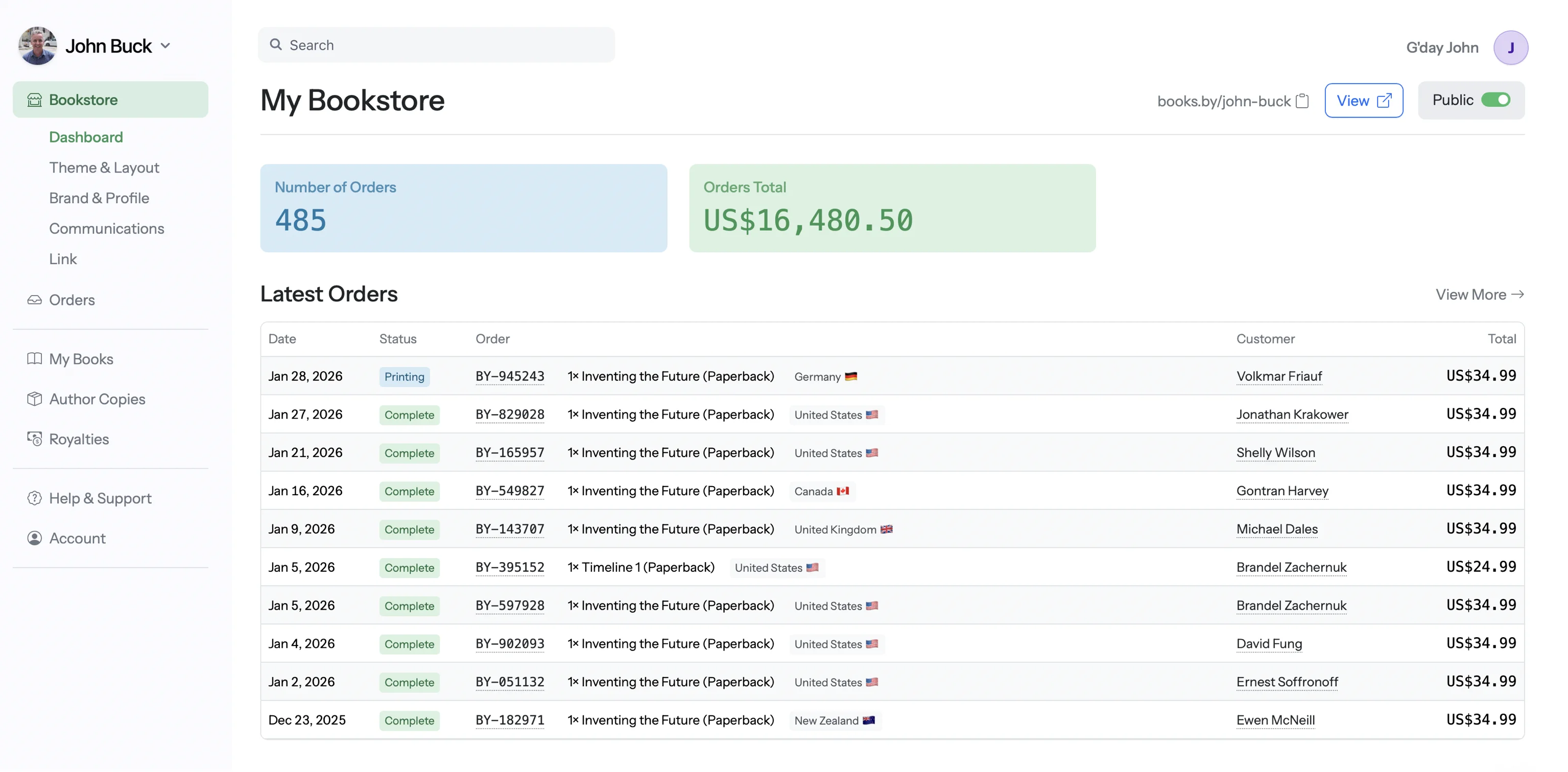
A Bookstore Worthy of Your Fiction
Sell hardcovers, paperbacks, and ebooks from your own beautifully branded store. Keep 100% of royalties. Get reader emails with every sale. From $99/year.
Marketing Literary Fiction
Forget the playbook that works for genre fiction. AMS ads, Facebook targeting, and newsletter swaps — those are built for high-volume, high-velocity genres. Literary fiction requires a different approach.
Book clubs are your best channel. Literary fiction is the most-selected genre for book clubs. Getting into book club recommendation lists, partnering with local book clubs, and offering reading group guides drives steady, sustained sales.
Independent bookstores matter. Approach local indie bookstores about consignment or events. Many indie bookstores actively support local and self-published authors, especially when the production quality meets their standards. Bring a physical copy — let the object speak for itself.
Literary events and readings. Open mic nights, literary festivals, bookstore readings, writing conference panels. Literary fiction sells through personal connection more than any other genre. Readers want to meet the author, hear the prose read aloud, understand the person behind the sentences.
Instagram over TikTok. Literary fiction does better on Instagram than BookTok. Bookstagram's aesthetic-focused culture aligns with the visual sophistication literary readers expect. Beautiful flat-lays, atmospheric reading scenes, and thoughtful captions work here.
Does Self-Publishing Carry a Stigma in Literary Fiction?
Yes, some. The fix isn't an argument — it's a book that's indistinguishable from a traditionally published one. Professional editing, a cover that could sit in a Knopf catalog, cream paper, decent typography. If the object is excellent, the source becomes irrelevant.
Frequently Asked Questions
Yes, but the model is different. Lower volume, higher margins, premium pricing. You're targeting 500-2,000 copies a year with $10+ royalty per copy selling direct, not 10,000 copies at $2 royalty. Creative control over production quality is actually an advantage in this genre.
Critical. Reviews are the primary discovery mechanism for literary fiction. Invest in a Kirkus Indie review (~$425) and submit to BookLife (free). A starred Kirkus review is the single most valuable marketing asset for a literary novel.
Minimalist and sophisticated. Clean typography, restrained colors, conceptual imagery. No character illustrations, no dramatic scenes. Think indie bookstore window display. Budget $500-$1,000 and hire a designer with literary title experience specifically.
Yes. Paperback: $16.99-$19.99. Hardcover: $26.99-$32.99. Ebook: $7.99-$12.99. Never discount to $0.99 — that signals genre fiction and undermines your positioning with literary readers.
Some awards accept indie submissions — IPPYs, Foreword INDIES, PEN/Hemingway (debut), and many state-level awards. Budget $300-$500/year for submissions. One win pays for itself in sales and credibility many times over.
More than any other genre. Use cream paper, a classic serif font, generous margins, and professional interior design. Literary readers notice and judge the physical object. A cheap-feeling book destroys credibility before they read the first sentence.