Everyone hands out business cards. Some agents send postcards. A few run Facebook ads. But when you walk into a listing presentation and leave behind a book you wrote — "The Complete Guide to Selling in [Your Neighborhood]" — you're playing a different game entirely.
A book is the nuclear option for authority positioning. It says: this person knows enough to write a book about it. It sits on coffee tables, gets passed to friends, and keeps your name in the conversation for months. Unlike a flyer that goes straight to recycling, a book gets kept.
This isn't about writing the great American novel. It's about creating a tangible marketing asset that works harder than any digital ad.
Why Books Work for Real Estate
Real estate is a local expertise business. Clients aren't choosing you for your national brand — they're choosing you because you know their neighborhood, their market, their streets.
Books let you demonstrate that expertise in a format that commands respect. Consider the difference:
- Business card: Gets thrown away or lost in a drawer
- Brochure: Skimmed for 10 seconds, recycled
- Email newsletter: 15% open rate if you're lucky
- Book: Kept, displayed, referenced, shared
A book has weight — literal and psychological. It's the only marketing asset that people will actually thank you for giving them.
The Five Book Types That Work
1. Hyper-Local Neighborhood Guides
This is the most powerful format for farm area dominance. "The Insider's Guide to Westwood Heights" or "Everything You Need to Know About Moving to Capitol Hill."
Include:
- Neighborhood history and character
- School districts and ratings
- Restaurants, coffee shops, local favorites
- Parks, recreation, walking trails
- Commute times and transit options
- Price ranges and market trends
- Hidden gems and local secrets
- Photos of the area (color printing matters)
This book becomes the definitive resource for anyone considering your neighborhood. When prospects Google "[Your Neighborhood] real estate guide," you own that search.
2. First-Time Homebuyer Guides
First-timers are anxious and information-hungry. A book that walks them through the process — pre-approval, house hunting, offers, inspections, closing — positions you as the expert guide they need.
Make it local. Don't just explain how mortgages work in general — explain the specific loan programs available in your state, the quirks of your market, the timeline for your area.
Distribution: Give these to buyers at first meetings. Offer free copies on your website in exchange for contact information. Leave stacks at mortgage broker offices, banks, and apartment complexes.
3. Annual Market Reports
This one requires regular updates, but it's phenomenal for positioning. "The 2026 [Your City] Real Estate Market Report" establishes you as the data-driven expert.
Include:
- Year-over-year price changes by neighborhood
- Days on market trends
- Inventory levels and what they mean
- Interest rate impact analysis
- Predictions for the coming year
- Charts, graphs, visual data
Send to your past clients, expired listings, and FSBOs. Use for listing presentations with data-obsessed sellers. Update quarterly or annually.
4. Home Seller Preparation Guides
"Get Your Home Ready to Sell: The Complete Preparation Checklist for [Your City] Homeowners"
Sellers have a million questions: What repairs are worth it? How much should I declutter? Do I need to stage? What will buyers notice?
This book answers everything before they even ask. It also subtly positions you as the agent who knows how to maximize sale price — which is exactly what sellers want to hear.
5. Relocation Guides
If your area attracts relocating employees — corporate headquarters, tech hubs, military bases, universities — a relocation guide is gold.
"Moving to Austin: The Complete Relocation Guide" covers everything a newcomer needs: neighborhoods, schools, cost of living, culture, job markets, and housing options.
Partner with relocation companies, HR departments, and employee resource groups to distribute.
The Economics of Real Estate Books
Let's talk numbers. Here's what a neighborhood guide costs with Books.by:
| Specification | Cost |
|---|---|
| Format | 6"×9" paperback, color interior |
| Page count | 100 pages |
| Print cost per copy | $1.379 + (100 × $0.036) = $4.98 |
| Order 50 copies | $249 |
| Order 100 copies | $498 |
At $5 per book, you could hand out 100 copies for about what you'd spend on a couple Facebook ad campaigns. But unlike digital ads that disappear, books sit on desks for months.
And if you want to sell copies online? Price at $14.99 and you'll net about $9.50 per sale after printing and payment processing. A few sales each month covers your Books.by subscription and then some.
Calculate Your Royalties
See how much more you could earn selling real estate books directly through Books.by compared to Amazon KDP.
Fast Publishing for Real Estate
One major advantage for agents: print-on-demand is fast. Unlike traditional publishing's 12-18 month timeline, you can go from idea to printed books in 2-4 weeks.
This matters because:
- Market data gets stale: A market report with 6-month-old data is useless. POD lets you publish quarterly updates.
- Neighborhoods change: New restaurants open, schools get rezoned. Update and republish anytime.
- Listings come fast: Need books for an open house next weekend? Order now, have them in days.
Traditional publishers can't serve real estate agents. POD was made for this use case.
Creating Your Book: The Realistic Timeline
You're busy selling houses. You're not going to take six months off to write a book. Here's the practical approach:
Week 1-2: Outline and Research
Block four hours total. Dump everything you know about your topic into a document. Organize by chapter. Identify gaps that need research.
Week 2-4: Writing (or Dictating)
Most agents find dictation easier than typing. Use your phone's voice recorder in the car, then transcribe with Otter.ai or similar. You talk to clients all day — you already know this material.
Target 10,000-15,000 words (about 50-75 pages of content). That's 3-4 hours of talking, edited down.
Week 4-5: Editing and Design
Hire a copyeditor on Upwork ($100-200) to clean up your prose. Use Canva or hire a designer ($200-500) for interior layout if you want photos and graphics.
Week 5-6: Upload and Order
Upload to Books.by. Order your first batch of author copies. Books arrive in 5-7 business days.
Total investment: ~$400-800 and perhaps 20 hours of your time. Compare that to any other marketing with this shelf life.
Distribution Strategies That Work
Open House Strategy
Stack copies by the sign-in sheet. "Free copy of my neighborhood guide — sign in and take one home." You get their contact info, they get a valuable resource. Better than a magnet.
Listing Presentation Leave-Behind
After your CMA and marketing plan, leave your market report book. While other agents leave folders, you leave something substantial that stays on the counter for weeks.
Expired Listing Outreach
Mail your book to expired listings with a brief note: "Your home deserves an agent who understands this market. Here's the data to prove I do." Physical books get opened. Postcards don't.
First Meeting Gift
When you meet a new buyer or seller, give them your book. It reframes the relationship immediately — they're working with an expert, not just another agent.
Past Client Maintenance
Send annual market reports to your sphere. It's a touchpoint that provides value, keeps you top of mind, and triggers referral conversations.
The Online Storefront Advantage
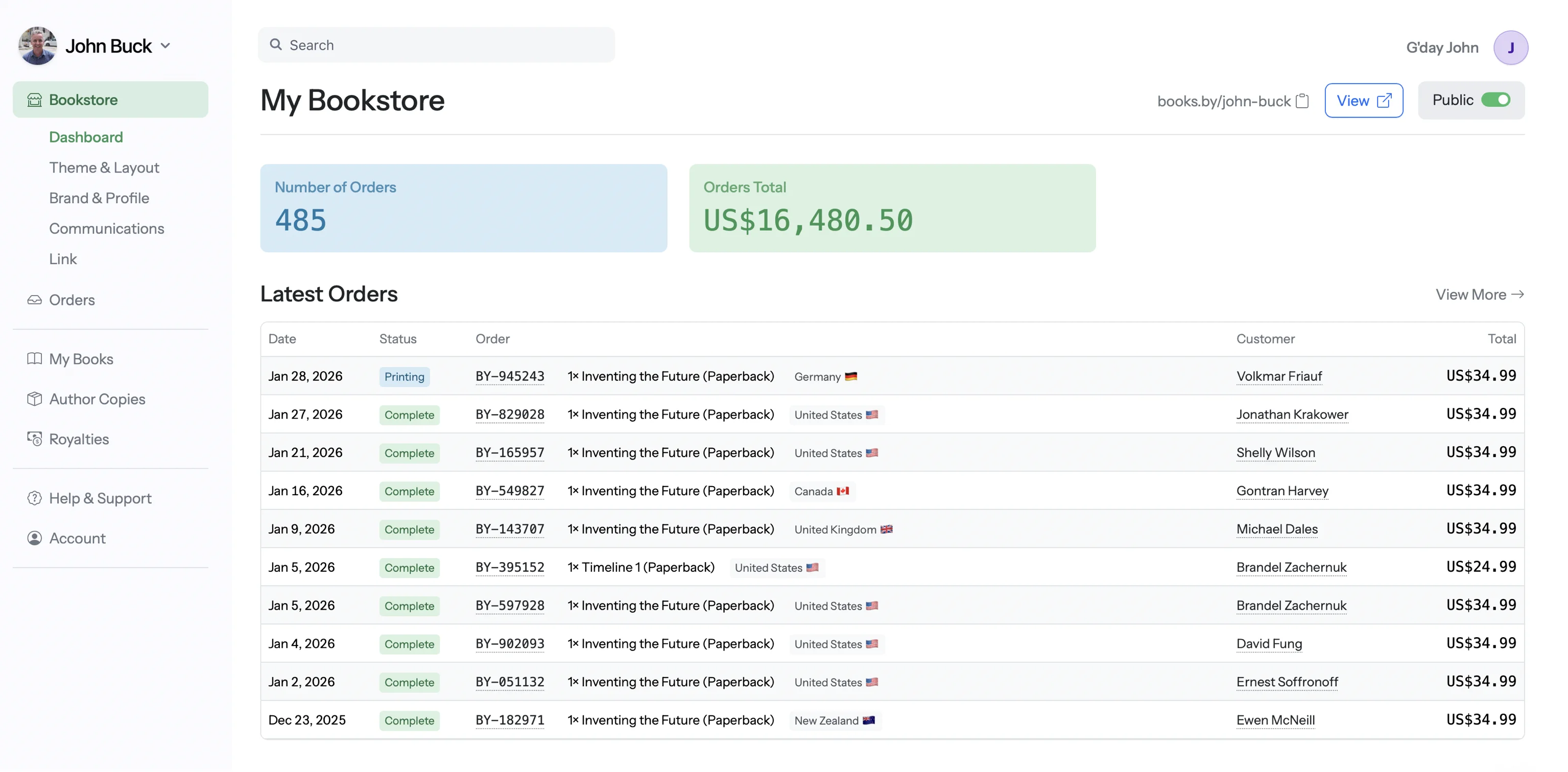
With Books.by, you don't just print books — you get a branded online storefront at books.by/youragentname.
Why this matters:
- Lead capture: Every sale gives you the buyer's email address
- 24/7 availability: Prospects can buy your book at 2am
- Website integration: Add to your real estate site, email signature, social profiles
- Revenue stream: Book sales offset marketing costs
Sell your neighborhood guide for $12.99. Some buyers will purchase instead of requesting a free copy — and they're more qualified leads because they self-selected.
Content That Converts
A few tactical notes on what to include (and avoid) in your real estate book:
Include your contact information prominently. In the introduction. In the conclusion. On the back cover. Make it easy for readers to reach you when they're ready.
Add QR codes. Link to your website, YouTube channel, or current listings. Readers with smartphones can jump directly to more information.
Avoid outdated specifics. "Interest rates are at 7%" will date your book in months. Write about how to evaluate rates rather than specific numbers. Or update frequently.
Make it genuinely useful. Don't write a 100-page sales pitch. Provide real value, and the sales will follow. If someone could Google everything in your book, you're not adding enough local expertise.
Frequently Asked Questions
Real estate agents use books as authority-building tools: neighborhood guides left at open houses, first-time buyer handbooks given to new leads, market reports for expired listing presentations, and local area books that establish expertise. A book is the highest-credibility marketing asset an agent can have.
The most effective real estate books include: hyper-local neighborhood guides (your farm area), first-time homebuyer guides, relocation guides for your city, annual market reports, home preparation guides for sellers, and investment property primers. Focus on useful content that solves problems for your target client.
With print-on-demand, you can have a book ready in 2-4 weeks. Market reports can be published quarterly with fresh data. Unlike traditional publishing, there's no 12-month lead time — you can have books in hand for your next open house.
Start with 25-50 copies. At Books.by's author copy pricing, a 100-page color neighborhood guide costs about $4.98 to print. Order what you'll use in 30 days and reorder as needed — print-on-demand means you're never stuck with outdated inventory.
Both strategies work. Giving books away at open houses or listing presentations creates goodwill and lead flow. Selling on your website (even at $9.99) qualifies leads and generates revenue. Many agents do both — free copies for active marketing, paid copies online.
Yes, easily. With print-on-demand, you can upload a new version anytime. Create quarterly market reports with fresh data, update neighborhood guides when new amenities open, or revise pricing content as the market shifts. No need to pulp outdated copies.
Include a clear call-to-action (your phone, website, QR code), provide genuinely useful local information, and make it specific to your market — not generic advice anyone could Google. Your book should answer the question: "Why should I work with this agent?"