
The consultant charges $50,000 for a strategy engagement. The keynote speaker commands $25,000 per appearance. The CEO advisor lands board seats at companies she's never met. What do they have in common? Often, a book. Not always a bestseller — sometimes a modestly-selling book that happened to reach exactly the right people.
This is what separates business book thinking from fiction or general nonfiction. For a novelist, book sales are the business model. For a business author, book sales are often a rounding error compared to what the book enables: consulting contracts, speaking engagements, corporate advisory roles, premium program enrollments.
The book becomes your most powerful business card. It sits on an executive's desk weeks before your meeting, establishing authority before you walk in the room. It gets you invited to podcasts where your ideal clients are listening. It gets you on conference stages where your audience gathers. It compresses years of relationship-building into the time it takes to read 200 pages.
This guide covers business book strategy specifically: how to position your book for maximum leverage, why production quality matters more here than in any other genre, how to use bulk orders and direct sales for client acquisition, and how to think about ROI beyond royalties.
Why Writing a Business Book Pays Off: Lead Generation and Authority
Before we talk about how to publish, let's be precise about why. A business book serves multiple functions simultaneously:
Credibility Acceleration
"Author" carries weight that "consultant" alone doesn't. When your bio says "author of [Title]," you've demonstrated something: the ability to organize complex ideas, the commitment to see a major project through, the confidence that your thinking is worth publishing. This isn't fair or logical, but it's real.
For consultants, coaches, and advisors, this credibility matters in competitive pitches. When a prospect is choosing between three consultants with similar credentials, the one with the book often wins — not because the book proves expertise, but because it signals a level of professional seriousness that's hard to fake.
Speaking Credential
Conference organizers booking speakers want authors. A book demonstrates that you have a structured body of knowledge to share, not just a collection of anecdotes. It gives them something to feature when promoting your session. It gives attendees a takeaway to purchase.
Many speakers report that their book is worth $5,000-$10,000 in additional speaking fees — the difference between "consultant giving a talk" and "author presenting their framework."
Sales Opener
Here's a tactic that's paid for countless business books: send your book to prospects before meetings. Not as a gift — as preparation. "Before we meet, I thought you might find Chapter 3 relevant to what you mentioned about [their challenge]."
Now you walk into a meeting with a prospect who's spent three hours with your thinking. They've internalized your frameworks. They're already partly sold on your approach. The book did the work that would take multiple discovery calls.
Client Retention and Expansion
Give your book to every client. It reinforces your methodology, gives them language to discuss your work internally, and makes you more referable. "You should talk to [Your Name] — here's their book" is dramatically more powerful than "You should talk to [Your Name]."
Why Quality Matters More Here
I'll say something controversial: for fiction, a mediocre cover and serviceable interior probably won't kill you. Readers are primarily buying the story.
For business books, this is not true. Your book is a proxy for your professional quality. A cheap-looking cover suggests cheap thinking. An amateurish interior layout suggests amateur consulting. Your audience — executives, decision-makers, sophisticated buyers — judges credibility partly through production quality.
Cover Design
Invest in professional design. Not $200 from Fiverr — proper design from someone who understands business book conventions. The aesthetic is typically clean, professional, often bold typography with minimal imagery. Think Harvard Business Review, not romance novel.
Common elements in successful business book covers:
- Strong, clear typography (the title should be readable at thumbnail size)
- Limited color palette (often two or three colors maximum)
- Minimal imagery (if any — many successful business books use only typography)
- Clear author name positioning (your name is part of your brand)
- Subtitle that clarifies the value proposition
Interior Design
Interior matters too. Professional typography, appropriate margins, well-formatted chapter openers, readable fonts. If you use diagrams or frameworks (and you probably should), they need to look polished, not like PowerPoint exports.
Format Considerations
Hardcover editions are worth considering for business books. They signal premium positioning and work well for client gifts. The additional cost is modest relative to the impression they create.
For bulk orders to corporate clients, hardcovers often sell better — purchasing departments don't blink at $30 for a training resource where $15 might seem "just a book."
Content Strategy: Less Is More
Business readers are busy. They're not reading for pleasure — they're reading for applicable insights. This has structural implications:
Length
35,000-50,000 words is the sweet spot. Some of the most influential business books are under 40,000 words. The One Minute Manager is under 15,000. Who Moved My Cheese? is about 10,000. Brief, actionable books get read and recommended; bloated ones get abandoned on nightstands.
Resist the urge to pad. Every chapter should earn its place. Every anecdote should illustrate something essential. If you can make your point in 40,000 words, don't stretch to 70,000 for perceived heft.
Structure
Executives often read non-linearly. They skim the table of contents, read chapter summaries, dive into sections relevant to their current challenge. Structure accordingly:
- Clear, descriptive chapter titles
- Chapter summaries or key takeaways
- Frameworks that can be understood independently
- Stories and examples that illustrate, not pad
Frameworks and Proprietary Language
Create named frameworks. "The Four Ps of [Your Topic]." "The XYZ Method." These do several things: they make your ideas memorable, they make you quotable, they differentiate your approach from generic advice, and they give clients language to request specifically your methodology.
Many successful consultants build entire practices around frameworks introduced in their books. The book teaches the framework; the consulting implements it.
Bulk Orders and Corporate Sales
For most business books, bulk sales to corporations generate more revenue than retail sales. A single corporate training department might order 500 copies. A speaker selling at the back of a conference room might move 100 copies in an afternoon.
The Bulk Order Strategy
| Use Case | Typical Volume | Sales Approach |
|---|---|---|
| Corporate training programs | 100-500 copies per company | Pitch to L&D, include as program material |
| Conference speaking | 50-200 per event | Negotiate into speaker agreement or sell at back of room |
| Client gifts | 20-100 per year | Send to prospects, existing clients, referral sources |
| Sales team enablement | 100-1000 | Include in sales kits, prospect mailings |
| Association partnerships | 100-500 | Approach industry associations for member programs |
Making Bulk Orders Work
With traditional retail, bulk ordering is awkward. You're buying from distributors at modest discounts, handling logistics yourself, and losing margin to middlemen.
With Books.by, you order bulk copies at production cost — no retail markup. A 200-page hardcover that retails for $29.99 might cost you $7-8 per copy in bulk. Send 50 to prospects before sales meetings at a total cost of $400; if one converts to a $50,000 engagement, that's a 12,500% ROI.
This is why thinking about your book as a marketing investment, not a product, changes everything. You're not trying to maximize per-copy profit — you're trying to maximize doors opened.
Direct Sales and B2B Storefronts
When a corporate training manager wants to order 200 copies for their leadership program, they don't want to deal with Amazon's consumer checkout. They want an invoice, purchase order processing, and business-to-business experience.
This is where your own storefront becomes essential. With Books.by, you can:
- Create a professional branded storefront matching your consulting brand
- Offer bulk ordering with volume discounts
- Generate invoices for corporate purchasing departments
- Capture contact information for all buyers
- Keep 100% of the margin on every sale
For consultants, this is significantly more valuable than Amazon visibility. A corporate buyer finding your book on Amazon doesn't become your lead. A corporate buyer on your storefront does.
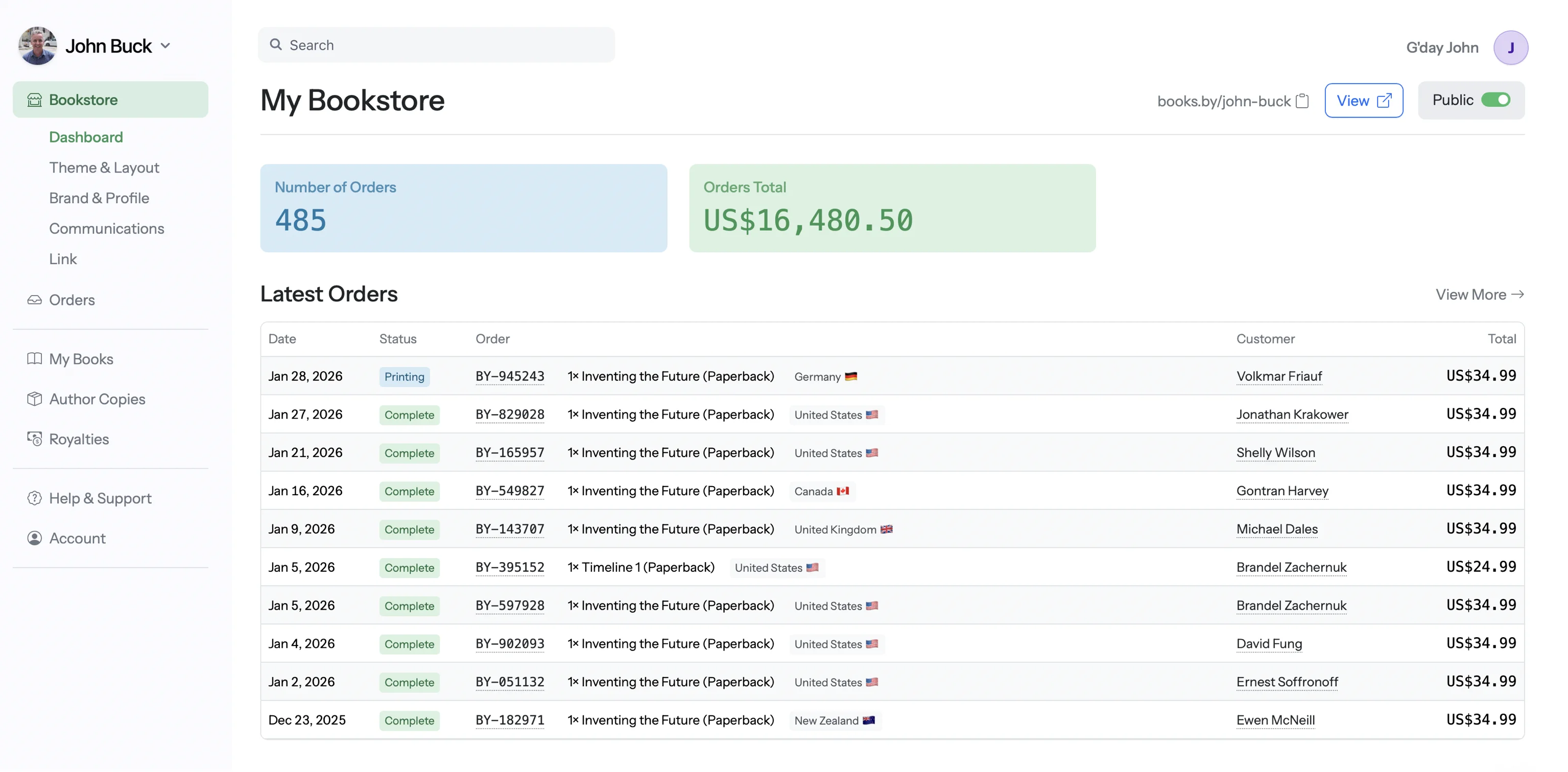
Your Book. Your Brand. Your Store.
Sell directly to corporate clients, order bulk copies at production cost, and capture every lead. Built for business authors who understand ROI.
Pricing Strategy for Business Books
Business readers are less price-sensitive than any other audience. A $25 book that helps an executive make a $500,000 decision is trivially priced. Don't race to the bottom.
| Format | Price Range | Notes |
|---|---|---|
| Ebook | $9.99 – $14.99 | Higher than fiction; business readers expect to pay for value |
| Paperback | $18.99 – $24.99 | Standard for professional publishing |
| Hardcover | $29.99 – $39.99 | Premium positioning; ideal for client gifts |
| Bulk (50+ copies) | 30-50% discount | Volume pricing for corporate orders |
A common mistake: pricing too low and signaling that your ideas aren't valuable. If your consulting day rate is $5,000, a $9.99 paperback undercuts your positioning. Price proportionally to your professional brand.
Calculate Your Royalties
See how much more you could earn selling business books directly through Books.by compared to Amazon KDP.
Marketing a Business Book
Business book marketing differs fundamentally from consumer book marketing. You're not trying to reach millions — you're trying to reach the specific decision-makers who can hire you, book you, or champion you internally.
Strategies That Work
Podcast guesting: Business and industry podcasts are hungry for guests with structured expertise. Your book gives you a hook and credibility. Prepare a few core talking points that tie back to your framework.
LinkedIn: This is where your audience lives. Share excerpts, frameworks, and behind-the-scenes publishing content. Your book legitimizes your voice on the platform.
Speaking engagements: Books get you on stages; stages sell books; books get you on more stages. It's a flywheel. Negotiate book sales or giveaways into speaking contracts.
Strategic gifting: Send books to the specific executives and decision-makers you want relationships with. Not randomly — with personal notes explaining why chapter X is relevant to their situation.
Association partnerships: Industry associations often promote books to their members. Approach them about bulk discounts, newsletter features, or conference partnerships.
What Typically Fails
Amazon advertising: Business books rarely perform well with Amazon ads. The CPCs are high, and business readers don't typically impulse-buy nonfiction the way fiction readers do.
BookBub: Works brilliantly for fiction; rarely effective for business nonfiction. The audience doesn't overlap much.
Chasing bestseller lists: Buying your way onto bestseller lists is expensive and often meaningless for your actual business goals. A book that reaches 1,000 of the right people beats one that briefly appears on the Wall Street Journal list.
Calculating the ROI of Self-Publishing a Business Book
Let's make this concrete. Assume you're a consultant with a $20,000 average engagement. You invest $10,000 in producing a high-quality book (editing, design, initial inventory). You then spend $5,000 on strategic marketing over a year.
If that book generates just one additional consulting engagement, you've made 33% return. Two engagements, 167% return. Most business authors find that a good book generates multiple engagements, speaking invitations worth thousands each, and ongoing passive lead generation.
This is why the "should I self-publish or traditionally publish?" question is different for business books. Traditional publishing might offer a $10,000 advance — but you lose control of pricing, timing, bulk ordering, and direct sales. The $10,000 is rarely worth the constraints.
Frequently Asked Questions
Absolutely. Many respected business thought leaders self-publish. What matters is quality of content and production, not the publishing route. A well-designed self-published book with valuable insights carries more weight than a mediocre traditionally published one.
35,000-50,000 words is ideal. Some of the most influential business books are even shorter. Executives are busy — they want actionable insights, not padding. Density of value beats page count.
Critical — more so than any other genre. Your book is a proxy for your professional quality. A cheap-looking cover suggests cheap thinking. Invest in professional design for both cover and interior.
Yes — this is one of the most powerful uses of a business book. With Books.by, order bulk copies at production cost with no retail markup. The ROI on strategic book distribution often exceeds 1000%.
Paperback: $18.99-$24.99. Hardcover: $29.99-$39.99. Ebook: $9.99-$14.99. Business readers are less price-sensitive — price for value and positioning, not volume.
Yes — often the primary purpose. Include calls to action for consulting. Offer bonus materials for email signup. Sell directly to capture leads. The book opens doors to much larger engagements.
Create a branded storefront for B2B sales with volume discounts and invoice capability. Many authors sell hundreds of copies to single corporate clients for training programs. You keep control and 100% of margin.