Every therapist has explained the same concepts hundreds of times. The cognitive triangle. Thought records. Grounding techniques. Grief stages. Sleep hygiene. You've drawn the diagrams on whiteboards, printed handouts, and watched clients lose them between sessions.
A workbook changes that dynamic. It puts your therapeutic tools into clients' hands — something they can reference at 2am when anxiety spikes, not just during your scheduled hour. It extends your impact beyond the session and beyond your caseload.
But therapist publishing comes with considerations that don't apply to other authors: dual relationship concerns, evidence-based accuracy requirements, and the responsibility of creating content that could influence vulnerable populations.
This guide addresses both — the practical how-to and the ethical how-to-do-it-right.
What Therapists Publish (And Why)
Client Workbooks
The most common and most useful format. Workbooks for specific issues — anxiety management, depression recovery, anger regulation, grief processing, relationship skills. These contain psychoeducation, exercises, worksheets, and prompts that clients work through alongside therapy.
A workbook serves multiple purposes:
- Provides structure for client homework
- Ensures consistent delivery of evidence-based techniques
- Gives clients something tangible to reference between sessions
- Reduces repetitive explanation time in sessions
- Can be used with groups as well as individuals
CBT/DBT Skills Journals
Guided journals with specific therapeutic prompts. Thought record templates. Emotion logs. Distress tolerance tracking. These become daily practice tools for skills learned in session.
The key differentiator from generic journals: yours include the psychoeducational context. Not just "write about your feelings" but "identify the thought → examine evidence → reframe" with scaffolded prompts.
Psychoeducation Guides
Informational books that explain mental health concepts to clients and their families. "Understanding Your Teenager's Anxiety." "What to Expect in Couples Therapy." "A Parent's Guide to Child Grief."
These work well as pre-therapy resources (clients arrive more informed) or as recommendations for family members who aren't in treatment but need context.
Self-Help for General Audiences
Books for people who may never see a therapist. These require different positioning — you're not writing for clients, you're writing for readers encountering these concepts cold. More background, more context, more careful caveating.
Professional Resources
Materials for other therapists. Training guides, treatment manuals, supervision frameworks. A smaller market but potentially lucrative — therapists pay for continuing education and quality resources are valued.
Ethical Considerations for Therapist Authors
This is the section other publishing guides skip. But for mental health professionals, ethics aren't optional.
Dual Relationships and Selling to Clients
The core tension: if you profit from selling books to your clients, you've created a financial relationship alongside the therapeutic one. Most ethics codes address this.
Best practices for direct client sales:
- Offer at cost. Books.by lets you order author copies at printing cost (~$4-5). Sell to your own clients at this price — you don't profit from the therapeutic relationship.
- Make it optional. Never require the workbook. Always offer alternatives (photocopied worksheets, verbal instruction).
- Disclose clearly. "I wrote this workbook and offer it at my cost. Using it is optional, and I don't profit from your purchase."
- Consider free for clients. Build the workbook cost into your session fees. Every client gets one. No purchase dynamic at all.
Sales to general public: Selling your book on Amazon, through Books.by, or at conferences to people who aren't your clients raises no dual relationship issues. This is simply authorship.
⚠️ Check Your Licensing Board
Ethics guidelines vary by license (LCSW, LPC, psychologist, MFT) and by state. Review your specific board's guidance on business relationships with clients before establishing any sales model.
Evidence-Based Accuracy
If your workbook claims to teach CBT techniques, it needs to accurately represent CBT. Misrepresenting evidence-based treatments — whether through oversimplification, distortion, or mixing in non-evidence-based elements — is ethically problematic and potentially harmful.
What this means in practice:
- Cite sources for therapeutic techniques
- Don't claim "cures" or guaranteed outcomes
- Distinguish between established evidence and your clinical intuitions
- Have colleagues with relevant expertise review your content
- Update when research evolves (print-on-demand makes this easy)
Scope and Disclaimers
Your book isn't therapy. Make that explicit.
Required disclaimer elements:
- Reading this book doesn't establish a therapeutic relationship
- The content isn't a substitute for professional treatment
- Readers experiencing mental health crises should seek immediate professional help
- Outcomes vary; exercises may not work for everyone
Put this prominently — copyright page at minimum, ideally also in the introduction.
Workbook Design: Practical Considerations
Leave Space to Write
The number one formatting mistake in therapy workbooks: not enough writing space. Clients need room. A thought record should have a full page. Journal prompts need 10+ lines minimum.
Size recommendations:
- 8.5" × 11": Best for worksheet-heavy workbooks. Familiar, comfortable, plenty of room.
- 7" × 10": Good balance of portability and writing space.
- 6" × 9": Works for journals with shorter prompts. Gets cramped for complex worksheets.
Consider Your Printing
With Books.by, you choose between black-and-white and color printing:
- B&W ($1.26 + $0.016/page): Works for text-heavy workbooks, thought records, journals
- Color ($1.379 + $0.036/page): Better for diagrams, emotion wheels, visual exercises
For a 150-page workbook, that's ~$3.66 B&W or ~$6.78 color per copy at author pricing.
Test With Real Clients
Before finalizing:
- Give draft copies to 3-5 clients willing to provide feedback
- Watch where they struggle or get confused
- Notice if writing spaces are adequate
- Ask what's missing or unclear
- Revise based on actual use
Print-on-demand means you can update anytime. Your first version doesn't have to be perfect — but testing improves it significantly.
Distribution for Therapists
Direct to Your Clients
Order author copies at cost from Books.by. Keep stock in your office. Provide at cost to clients who want them.
Your Own Storefront
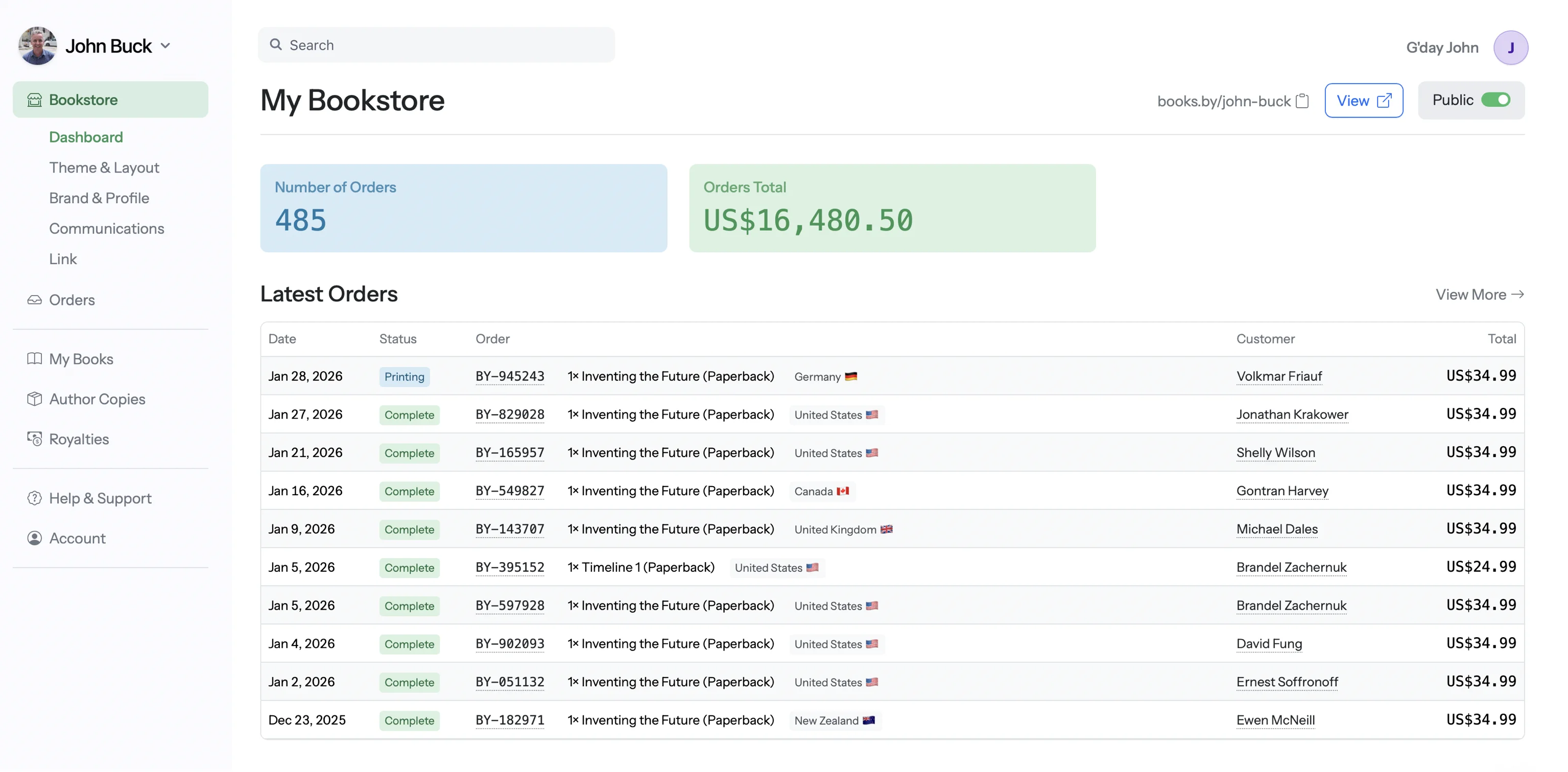
Books.by gives you a branded store at books.by/yourname. Sell to the general public, past clients, or people who find you online. You keep 100% royalties and get buyer email addresses.
Referral Network
Send copies to colleagues who might recommend your workbook to their clients. Psychiatrists, primary care physicians, school counselors, other therapists. "I wrote this anxiety workbook — feel free to recommend it to patients who might benefit."
Amazon (For Visibility)
List on Amazon for discoverability. When people search "CBT workbook" or "anxiety journal," you want to appear. Royalties are lower (~40% after printing), but the exposure can drive traffic to your practice.
Calculate Your Royalties
See how much more you could earn selling therapy & counseling books directly through Books.by compared to Amazon KDP.
Group Therapy Resources
If you run groups — DBT skills groups, anger management groups, support groups — workbooks become especially valuable.
Benefits for group settings:
- Every participant works from the same material
- Structured homework between sessions
- Participants can review missed content
- Professional materials elevate the group experience
Order bulk author copies for each cohort. A 12-week DBT skills group with 8 participants needs 8 workbooks at ~$5 each — $40 total. Build into your group fee.
Building a Referral Engine
A published book establishes you as an authority in your specialty. This drives referrals in ways that advertising can't match.
How it works:
- Psychiatrist reads your anxiety workbook, starts recommending you for therapy
- School counselor uses your workbook with students, refers families to you
- Other therapists discover your book, refer clients outside their specialty
- Media requests your expertise based on published work
- Speaking invitations follow from established thought leadership
The book keeps working for years. One workbook can generate referrals for a decade.
Content That Helps vs. Content That Sells
A therapist's book should prioritize therapeutic value. But there's a tension — you're also building a practice, generating income, establishing expertise.
The solution: make it genuinely helpful first. If your workbook actually helps people manage anxiety, if your journal actually supports recovery work, if your guide actually educates families — the business outcomes follow.
Clients and colleagues recommend helpful resources. They don't recommend self-promotional content dressed up as clinical material.
Frequently Asked Questions
Therapists commonly publish: client workbooks for specific issues (anxiety, depression, grief), CBT/DBT skills journals, psychoeducation guides for clients and families, self-help books for general audiences, professional resources for other clinicians, and guided journals with therapeutic prompts.
Yes, dual relationships require careful navigation. Best practices include: offering the workbook at cost (no profit from your own clients), making purchase optional, providing alternatives (photocopied worksheets), and disclosing that you benefit from sales. Consult your licensing board's ethics guidelines.
Ideally, yes. Workbooks representing CBT, DBT, ACT, or other therapeutic modalities should accurately reflect those evidence-based approaches. Misrepresenting techniques or making unsupported claims can harm clients and damage your professional reputation. Include citations where appropriate.
More than you think. Journal prompts need 8-10 lines minimum. Thought records need full pages. Leave generous margins. Consider larger trim sizes (8.5"×11" or 7"×10") for workbooks where writing is central. Test with actual clients before finalizing layout.
Yes. With Books.by, you can order author copies at cost (around $4-5 for a 150-page workbook) and sell or give to clients. Many therapists sell at cost to their own clients and at retail price online to avoid dual relationship concerns.
Absolutely. Include a clear disclaimer stating that the book doesn't constitute therapy, doesn't establish a therapeutic relationship, and that readers should seek professional help for mental health concerns. This protects both you and your readers.
A published book establishes expertise and generates referrals. Psychiatrists recommend your anxiety workbook to patients. Other therapists use your materials with their clients. Speaking invitations and media requests follow. The book becomes a credibility asset that drives practice growth.